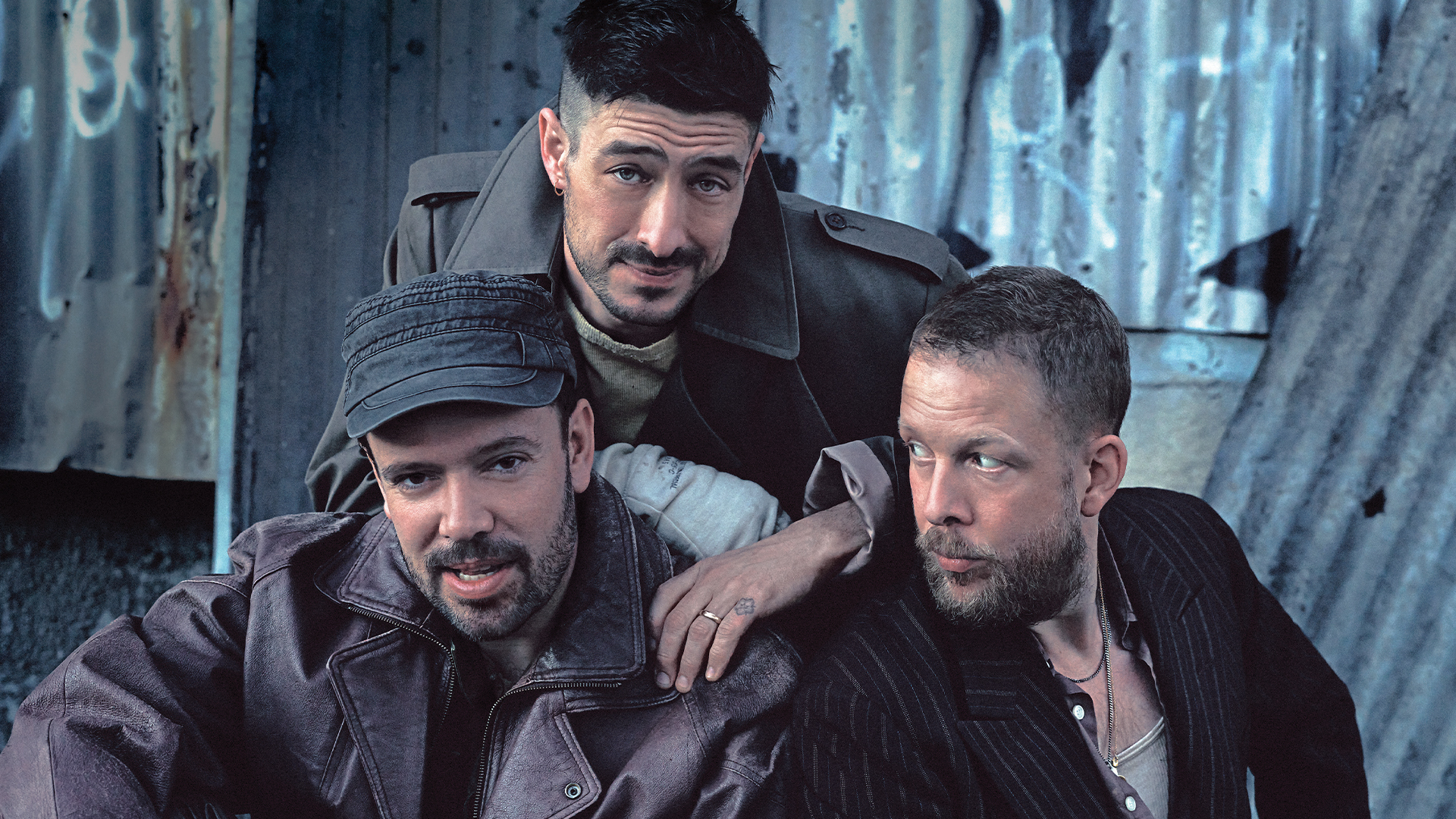
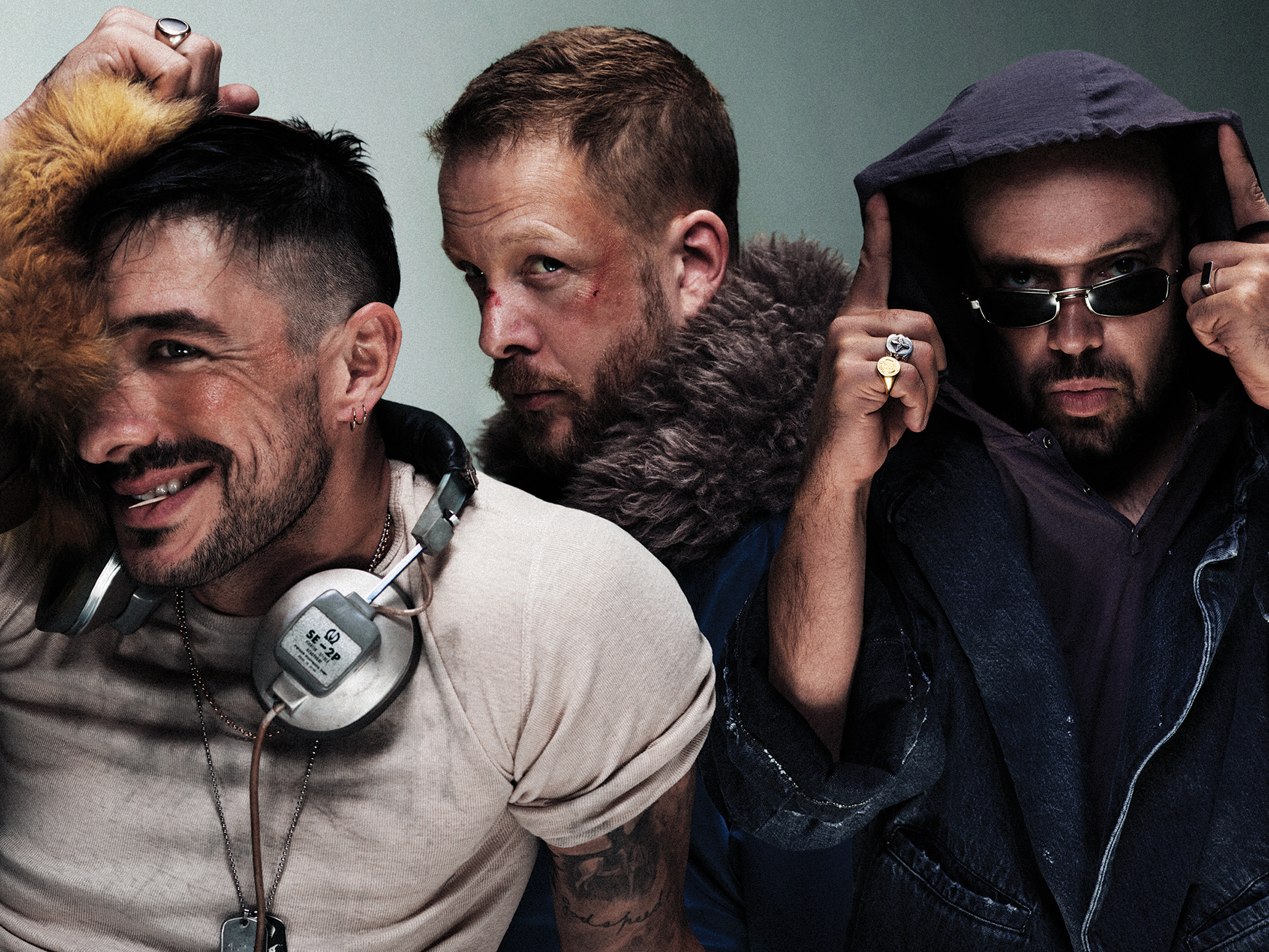
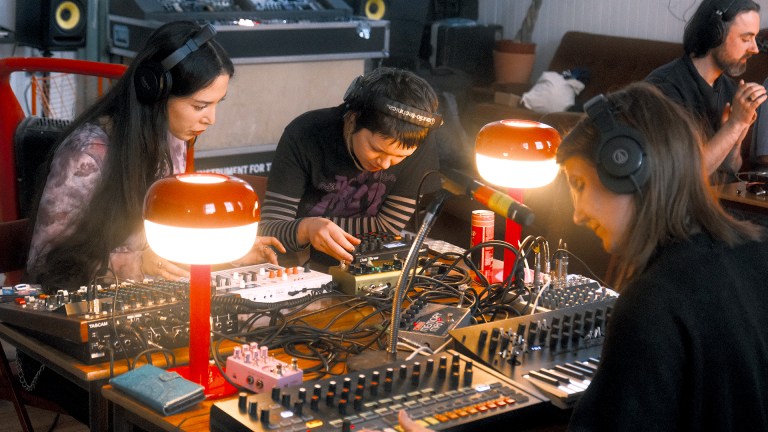
Pianist Ben Lovett, frontman Marcus Mumford, bassist Ted Dwane
Share
Marcus Mumford hasn’t had running water at his West Country home for a couple of days when we meet. He’s considering checking into a budget hotel just to get a proper wash. “We’ve had storms. There’s another one coming through today,” he says.
Instead of a budget hotel, however, we’re in an upstairs space at Electric House, the Notting Hill outpost of the Soho House chain.
It’s chilly in the wood-panelled room, so much so that when Mumford and guitarist bandmate Ted Dwane sit down to talk with Big Issue, we all agree to keep our coats on.
For great interviews like this one and much more, get your copy of this week’s Big Issue magazine. Find your nearest vendor here
“I fucking love Big Issue,” says Dwane. Mumford agrees: “It feels like a conversation starter of a magazine, doesn’t it? I always have great conversations with the people that sell it. I really enjoy that tactile, human, relational thing you get from – at least my experience of – picking up Big Issue. In a world that also has lots of media that is more disconnected from human relationships, having that more tactile one is nice.”
It is a theme of their music – and something they return to during our conversation: community and human connection.
In 2012, Mumford & Sons were described in the press as the “biggest band in the world”, an accolade previously reserved for the likes of The Beatles, U2 and Led Zeppelin. The two men sitting in comfortable coats and jeans, vaguely resembling 30-something southerners who wisely cashed out their equity in a fintech startup, have headlined Glastonbury and played with Bob Dylan.
Advertising helps fund Big Issue’s mission to end poverty
Advertising helps fund Big Issue’s mission to end poverty
The White House’s archives contain a picture of Barack Obama, George Clooney and David Cameron looking on rapt as the band perform at a state dinner.
When they broke through in 2009 with debut album Sigh No More, their folk-pop was the stomp-clapping, waistcoat-wearing embodiment of that era. Liam Gallagher said they looked like “fucking Amish people”. And, I tell them, it was songs like The Cave which I remember trying and failing to learn on the guitar in year nine.
“The good thing about that song is you only need one finger and you can do the whole thing,” Mumford says. Which makes me feel bad. “If I had known that…” I say. “In an open tuning,” he clarifies, absolving me. I feel better.
They are here ahead of the release of Prizefighter, their second album in the space of two years.
“I think that we’ve made the best record we’ve ever made,” Mumford says. “I feel as evangelistic about our band as I did right at the beginning.”
Advertising helps fund Big Issue’s mission to end poverty
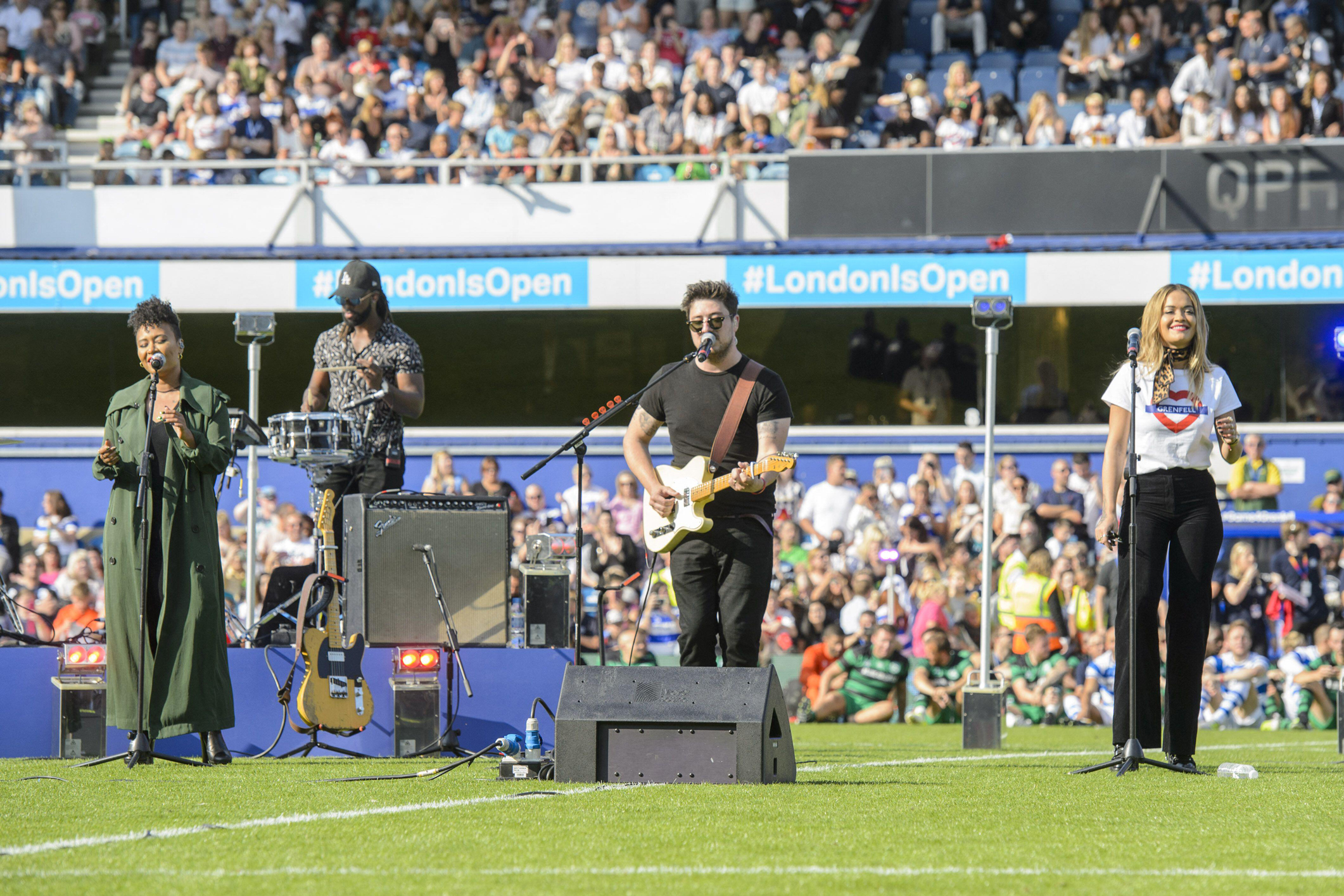
Emeli Sande, Marcus Mumford and Rita Ora performing at half time during Game4Grenfell, 2 September, 2017. Image: Matt Crossick / Alamy
Alongside Marcus Mumford the singer, friend of celebrities, husband of Carey Mulligan, is Marcus Mumford the activist. In the aftermath of the Grenfell fire, he set up the Grenfell Foundation charity.
“I’ve always been really hesitant to speak on anyone’s behalf, because I think that’s been part of the problem historically with Grenfell. We basically went around saying ‘how can we be helpful’, not inserting yourself into it, which can be the temptation with this,” he says.
“I think that community was failed by both the market and the state. On a seismic level. And I also got to witness the power of community when it was organised, and I’ve never experienced such resilience and courage to speak truth to power than among those guys. What we got to see up close was a total privilege. And they’re still doing it. And they’re just amazing people.”
Demolition work has begun on the tower, but almost a decade on from the disaster, there have been no prosecutions. “I think it’s a shame on our system. I think it’s all taking too long,” Mumford says. “Of course, you look at other examples like Hillsborough. Justice for Hillsborough is ongoing, it’s really scary. The Grenfell community have always seen this as a very long game, and they’ve been incredibly patient, but they are continually let down.”
One track on the new record had an unusual genesis. “Alley Cat, I wrote in a prison actually. I go into prison and do poetry workshops and that came out of one of those sessions with the lads. Which I felt slightly conflicted about to start with,” Mumford says.
Advertising helps fund Big Issue’s mission to end poverty
Protests in Minneapolis
So… is it his San Quentin? He laughs. “No, Alley Cat is just fucking around.” The singer seems shy when talking about prison volunteering, which he got into after Covid, motivated by “my love of local communities. I like being present in the place where you live.”
He adds: “If all of us were defined by the worst thing we ever did, we’d all be fucked. I believe in grace, I believe in mercy, I believe in responsibility, choices, consequences, of course. I’m not a libertarian of that kind. But at the same time I just don’t think we have enough grace for each other.”
Two days before I meet Mumford and Dwane, a man named Alex Pretti is shot dead in Minneapolis by US immigration agents.
Video footage of the killing has been everywhere, coming weeks after an Immigration and Customs Enforcement (ICE) officer killed Renée Good – also in Minneapolis, also on camera.
These events have been dominating Mumford’s head for a mix of reasons.
“One of our songs, White Blank Page, has been used a bit by some anti-ICE protest videos, which I’m thrilled about,” he says. “I cried watching the news yesterday after what looked like the execution of Alex Pretti. As a band that’s spent a lot of time in America, we’re really concerned about what we see.”
Advertising helps fund Big Issue’s mission to end poverty
He adds: “I think it’s an absolute disgrace what ICE is doing in the States and not reflective of what we know to be the values of most Americans we’ve ever come across. And we’ve travelled America more than most of my American friends ever have. We just see the value of the humans that we meet there, across the board.”
If you want to gauge where the country’s culture has shifted in the past 15 years, consider two adaptations of Wuthering Heights. Back then, it was Kaya Scodelario (Effy from Skins to you and me) as Cathy and, as the end credits rolled, a track by Mumford & Sons played. The band had come up in a folky explosion alongside acts like Laura Marling and Noah and the Whale. It was Holly, a song by Jay Jay Pistolet (Justin Young, later lead singer of the Vaccines), which led Dwane to the big city.
“That’s what made me want to move to London,” says Dwane. “I remember sitting in a little parish church in my parents’ village trying to learn that. Just thinking, I’ve got to get to London. I’ve got to try and hang out with these dudes,” he says. Mumford chips in: “I wrote him fan mail because of that song.”
Dwane says: “It’s been nice to have been born of something that’s so of a place and a time. Having a community around your music is a really helpful thing, especially in the days before algorithmic music discovery. People would find us because of the people around us”.
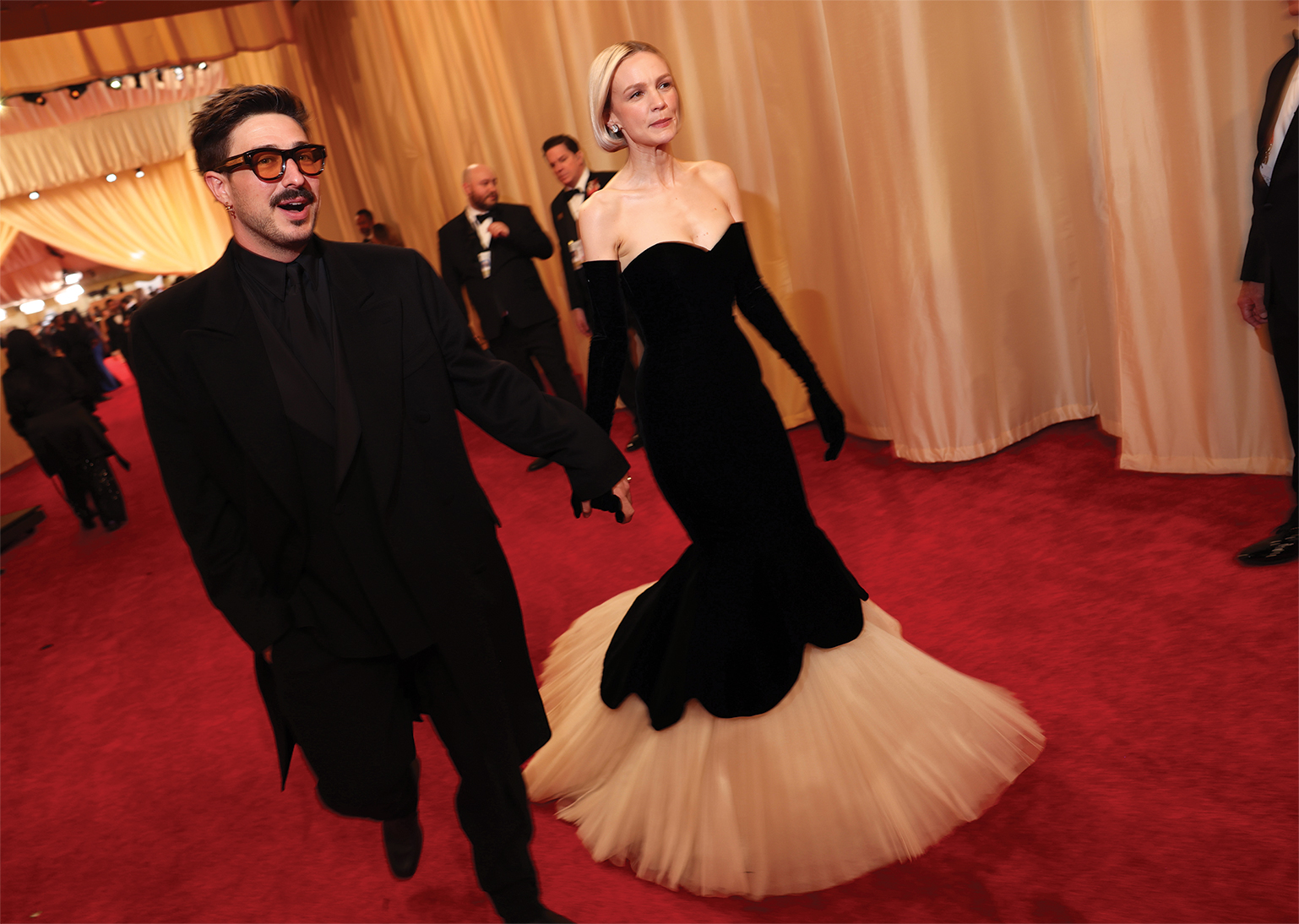
Mumford with wife Carey Mulligan at the Oscars, 2024. Image: Jay L. Clendenin / Shutterstock
Fast forward to 2026, and Wuthering Heights is back in cinemas. The landscape has moved. Margot Robbie is Cathy and Charli XCX is doing the entire soundtrack. Mumford & Sons are no longer the upstarts — instead, they’re in with director Emerald Fennell.
“Creatively, she’s one of my heroes, she’s a genius,” Mumford says of Fennell, whose collaboration with his wife Mulligan for 2020’s Promising Young Woman bagged them both Oscar nominations. “She’s become one of my wife’s best friends. She’s absolutely hilarious and has this incredible attitude towards making things that I really admire.
Advertising helps fund Big Issue’s mission to end poverty
“You gravitate towards other creative people, especially in this new era of not being in denial about being an artist. You hang out with people who might be in different jobs, but artistically I’m now fascinated by all sorts of creative people, and she’s one of the ones that I’m fascinated to see what she puts out into the world. She’s a visionary.”
Aged 38 and 41 when we speak, Mumford and Dwane are whippersnappers in a landscape where acts still play arena shows into their 80s. When I call them young, though, Mumford comes back to a point: “You were in year nine when The Cave came out?”
Part of any longevity as a band is learning to treat it more like a job. Mumford has been sober for almost seven years. “It’s been great. I love it. But I was a fucking legend, sometimes,” he says. Dwane adds that live shows have calmed down: “We used to get through an astonishing amount of booze before, during, and after a gig.
“Now, there’s a renewed sense of gratitude and professionalism… when that many people have paid to come and see you, they just want you to sing in tune and try and get the notes right.”
Almost five years after banjo player Winston Marshall left the band amid controversy over tweets, reviewers still say they’re missing his energy. “I think it’s better that people are where they want to be, right. There’s no way that Win could still be here. It wouldn’t have been right for him or for us,” says Dwane.
“Creatively it’s impossible to know if it would have been easier or harder with Win in the room. Because, essentially, we’re just on our path trying to do everything right, and this has been a really great record-making experience.”
Advertising helps fund Big Issue’s mission to end poverty
The band will play Hyde Park on 4 July – a live experience in which the area closest to the stage is reserved for punters willing to pay ‘golden circle’ prices. Mumford says Hyde Park is making “a good swing” for the top tier of British venues. Dwane chips in: “We do have a slight aversion to golden circle, because we feel it on stage. It’s never quite right. I’m sure management are trying to massage that into… a bronze circle, maybe.”
Now they’re in that mid-career maturity, there are many reasons to go to a Mumfords gig. “Some people come to a Mumford & Sons gig and think it’s going to be tops off, pints thrown, like some sort of Pogues gig from the late ’80s, says Dwane. “And some people come and their favourite songs are the more quiet, intimate moments. And they come for almost a meditative, acoustic experience.”
Then I ask what the drug of choice for their fans is. Dwane says: “A nice warm ale, isn’t it?”
“No, because that’s very laddish,” Mumford says.
“That’s true, actually. It’s a white wine spritzer,” Dwane says, to a cackle from Mumford. “I think it’s like warm Sauvignon… no I’m joking… on a train with a screw top. No I don’t know what it is,” Mumford says.
Fuelled by sparkling water, the booze conversation turns to snakebite. “A couple of those and you can automatically play The Cave,” Dwane says.
Advertising helps fund Big Issue’s mission to end poverty
Mumford adds: “Yes, that’s it, that’s what you were missing. Drink two of those.”
Prizefighter is out now on Island Records. Mumford & Sons play British Summer Time at London’s Hyde Park on 4 July.