Advertising helps fund Big Issue’s mission to end poverty
Opinion

For people in Gaza, ceasefire has changed little. 2026 must see a real end to the violence

Riham Jafari, advocacy and communications coordinator at ActionAid Palestine, writes about the changes she hopes to see in Gaza and for Palestinian people in 2026

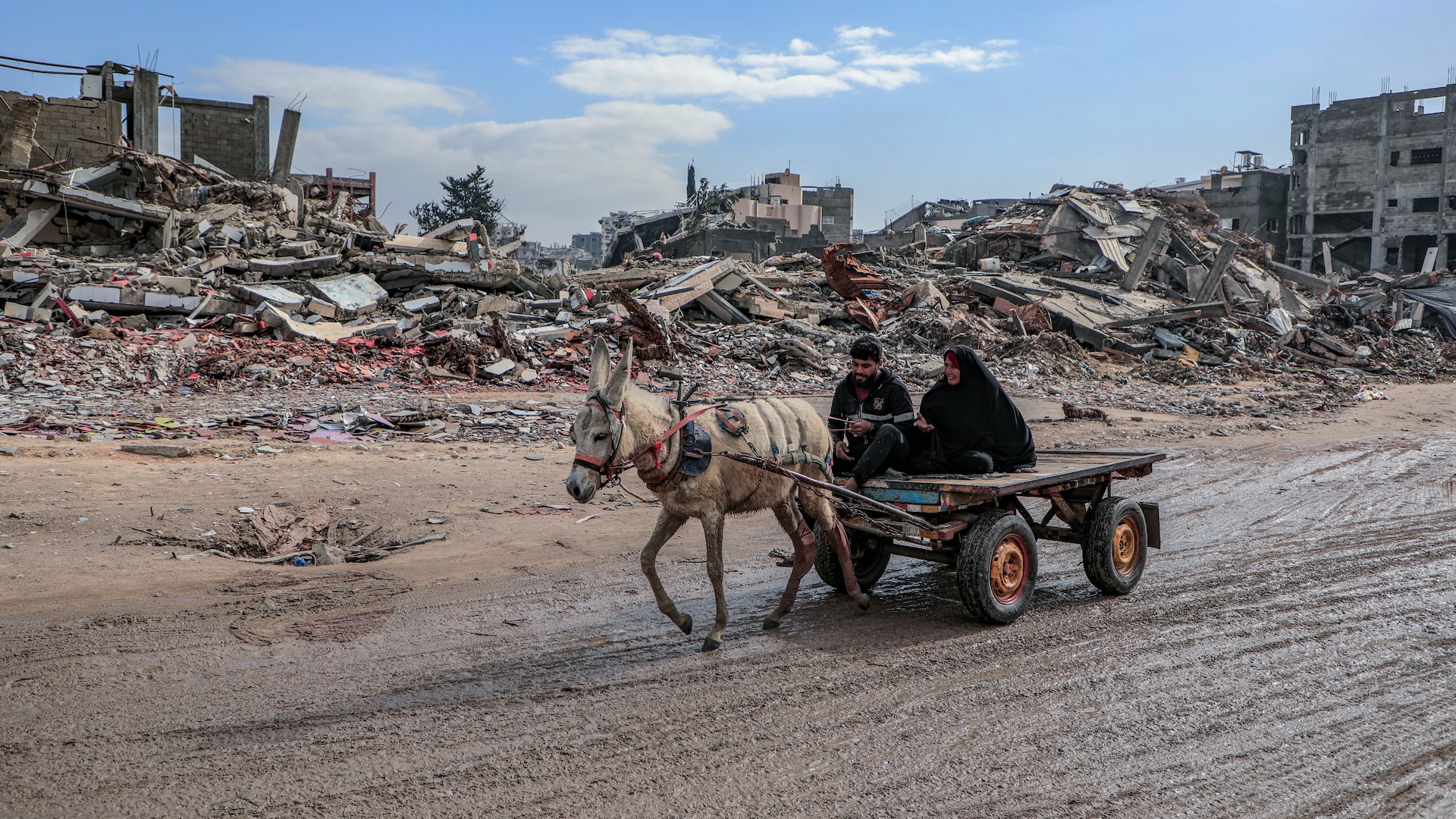
Destruction in Gaza. Donkey pulling cart with people on it.

Inside a Jabalia Camp, a Palestinian refugee camp in the North Gaza. Image: Mohammed Ibrahim/ Unsplash

As 2025 draws to a close, life in Gaza remains dangerous, miserable and uncertain, despite the ceasefire, while in the West Bank, the situation is deteriorating by the day. Riham Jafari, advocacy and communications coordinator at ActionAid Palestine argues that if 2026 is to mark a turning point, governments and world leaders must stop their inaction and break the silence to dismantle the underlying power structure that oppresses Palestinian.

After two years of being relentlessly bombed, starved and displaced by the Israeli army, the ceasefire deal that came into effect on October 10 should have brought respite for the exhausted and traumatised people of Gaza. But, more than two months on, little has actually changed and Gaza’s 2.2 million residents remain trapped in a painful limbo – not quite in war, but not in peace and safety either. Instead of the full ceasefire that was hoped for, Israeli military attacks continue, and humanitarian supplies continue to be used as a bargaining chip.  

This grim reality exposes the stark truth: that while the system of control imposed on Palestinians by the Israeli authorities remains in place, a ceasefire will only ever manage the violence, not truly end it. Until that system is dismantled, a ceasefire alone cannot bring safety, dignity or recovery.

Read more:

The killing in Gaza may have slowed but it has not stopped. At least 360 people have been killed by the Israeli military since the beginning of the ceasefire, including children. These deaths are not simply in flagrant breach of the agreement: they reveal the limit of a ceasefire that leaves the underlying power structure intact and Palestinian lives expendable. 

Hundreds of thousands of people are still displaced, and those whose homes are in the 58% of Gaza which is under Israeli military control and off-limits to Palestinians, have no idea when they will be able to return. With around eight out of ten buildings in Gaza destroyed, people remain living in tents and makeshift shelters, exposed to the bitter winter cold and rain. At least 16 people died during Storm Byron in mid-December, including three children. Entire families are housed in tents pitched precariously among piles of rubble, at high risk from unexploded bombs. 

Advertising helps fund Big Issue’s mission to end poverty

While some humanitarian supplies are entering Gaza, it is nowhere near the amount needed, and the Israeli authorities continue to prevent crucial items from getting in. Nearly three quarters (73%) of NGOs recently surveyed said they had vital cargo unable to enter Gaza due to Israeli government restrictions, and several key border crossings remain closed. It means Gaza is currently experiencing major shortages in even the most basic of supplies, from tents to medicines. While there is more food available in the markets now, prices remain beyond what most people can afford, and hunger is still widespread: one in four households still report eating just one meal per day. 

Children in Gaza are still not in formal education. Not a single hospital is being back to being fully operational. Life is difficult for everyone in Gaza but women and girls are particularly impacted. With the health system still on its knees, at least 15 women a week are giving birth outside medical facilities – often without even basic medical supplies – while access to essential services, such as those that offer support for survivors of gender-based violence, remains severely reduced.  

Gaza’s people continue to show extraordinary determination to survive. But survival should not depend on ingenuity under siege. Without essential supplies and equipment – including the heavy machinery needed to start shifting the rubble and construction materials to start rebuilding – recovery is simply impossible.  

Meanwhile in the West Bank, where I live, the same system of oppression is advancing through different means. Violence from both Israeli soldiers and settlers has soared, with this October recording the highest number of settler attacks in a single month since records began in 2006. Illegal land grabs and settlement expansion have ramped up – enabled by the Israeli state – while tens of thousands of people displaced by major army raids on refugee camps and cities in the north still have no idea of when they will be able to return. Our freedom to move around or even leave our own neighbourhoods remains severely curtailed, as increasing numbers of checkpoints, roadblocks and gates stop people from going to school, work, hospitals, or visiting their families and friends. 

As 2025 ends, Palestinians are once again forced to watch as decisions about our future are made in distant conference rooms. While several countries, including the UK, have announced recognition of a Palestinian state, recognition without dismantling occupation risks entrenching the very conditions that deny Palestinians meaningful sovereignty. 

In a time of ever multiplying conflicts and crises, the world must not let Gaza and the West Bank fade from attention in 2026: the new year must bring meaningful change on the ground. In the short term, that means an end to all restrictions and a massive scale up of humanitarian supplies entering Gaza, so that basic needs for food, shelter and medical care can be adequately met, and rebuilding and reconstruction work can begin.

But it means more than just a return to life as it was before the war began: a ‘normal’ marked by an illegal occupation and 18-year blockade by the Israeli authorities. Palestinians have the right to live in freedom and to determine their own future, just like all other people, and countries like the UK have a duty to help make this a reality. 

That means dismantling the system of oppression and control over Palestinian life by ending the illegal occupation, as the International Court of Justice has called for. It means ensuring full justice and accountability for war crimes, crimes against humanity and genocide perpetrated against Palestinians—without which there can be no real healing.  

It means using all political, diplomatic and commercial means to ensure international humanitarian law is implemented and to hold perpetrators to account, including by applying travel bans and asset freezes against Israeli officials where there is evidence of responsibility for atrocities. And it means ensuring that Palestinians, and particularly women, are at the heart of all efforts to recover and rebuild for the future.

Riham Jafari is advocacy and communications coordinator at ActionAid Palestine.

Do you have a story to tell or opinions to share about this? Get in touch and tell us more

Change a vendor’s life this Christmas.

Buy from your local Big Issue vendor every week – or support online with a vendor support kit or a subscription – and help people work their way out of poverty with dignity.

Advertising helps fund Big Issue’s mission to end poverty

GIVE A GIFT THAT CHANGES A VENDOR'S LIFE THIS CHRISTMAS 🎁

For £36.99, help a vendor stay warm, earn an extra £520, and build a better future.
Grant, vendor

Recommended for you

View all
From bubbles to 'SlopTok': Why 2026 could see both the highs and lows of artificial intelligence
Jeni Tennison

From bubbles to 'SlopTok': Why 2026 could see both the highs and lows of artificial intelligence

It's fine to be confused by Labour's economic plans – here's the thread that connects it all
Chancellor Rachel Reeves
Pranesh Narayanan

It's fine to be confused by Labour's economic plans – here's the thread that connects it all

The housing crisis is going nowhere. 2026 must offer a better vision for the future
a construction worker measuring a wall
Mark Washer

The housing crisis is going nowhere. 2026 must offer a better vision for the future

The dehumanising narratives around benefits need to stop in 2026 – for all our sakes
keir starmer at a changing realities meeting
Ruth Patrick

The dehumanising narratives around benefits need to stop in 2026 – for all our sakes