The world may be giving up on solving conflicts, warns Doctors Without Borders boss
Cuts in aid funding and restricted access have put pressure on already stretched aid organisations. But there is hope in humanity, says Christopher Lockyear
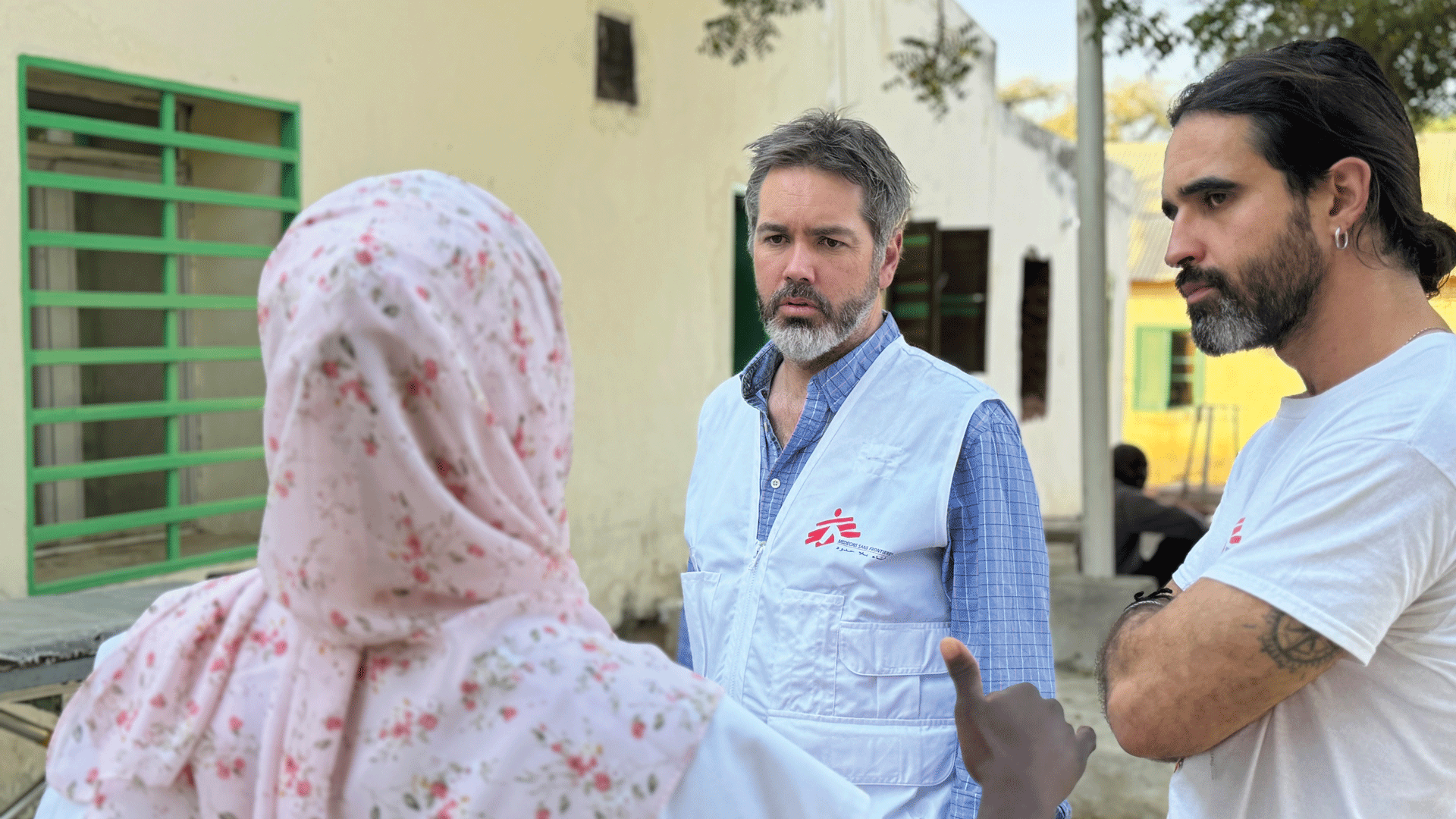
Christopher Lockyear (centre) in Sudan in 2024. Image: Thibault Fendler / MSF
Share
Every time Christopher Lockyear visits a warzone, he is nervous about what he will find.
The secretary general of Médecins Sans Frontières (MSF), or Doctors Without Borders, directs teams of medical staff around the world as they carry out lifesaving interventions in horrific circumstances.
Humanitarian workers have faced increasing challenges this year, blocked from accessing people who need help and risking their lives with hospitals targeted by aid strikes.
Aid funding has been slashed, the most significant of cuts made by the United States government. MSF is mostly privately-funded but saw a surge in demand as other health services were shut.
Lockyear speaks to the Big Issue about the challenges of carrying out aid in this context and his fears moving into 2026 – but he reminds us that there is hope to be found in humanity too.
Big Issue: What are the biggest challenges MSF has faced in 2025?
Advertising helps fund Big Issue’s mission to end poverty
Advertising helps fund Big Issue’s mission to end poverty
Christopher Lockyear: There are complex humanitarian access issues. That’s been key in Gaza. Supply is needed, but it’s also a question of having staff who have slept, eaten and are not desperately worried for their families.
One of our physiotherapists was killed in an airstrike in Gaza back in October. That has an impact in terms of being able to provide humanitarian assistance, as well as it being an unacceptable tragedy.
We’re over 98% privately-funded. We don’t rely on government funding. However, there’s been massive aid cuts across the world – US aid being the most significant – but the UK, Germany and the Netherlands have also reduced funding. We see the consequences of that directly.
In Baidoa, Somalia, 37 health sites closed. We saw a surge in patients. In Ethiopia, we’ve seen nutrition services in refugee camps closed in Gambella, and that’s put 80,000 children at risk of life-threatening malnutrition. We’re getting more patients and it costs more to treat those patients. We’re stretched.
Have funding and donations helped you keep up with demand?
Advertising helps fund Big Issue’s mission to end poverty
We can only treat as many patients as funding allows. We could always do more, but we have roughly 67,000 people working for us. Last year, we did 16 million outpatient consultations, admitted half a million malnourished children into outpatient feeding centers and treated nearly 100,000 people for sexual violence. That’s a consequence of 7.1 million private donors. Solidarity is there. People care.
How do you decide how resources are allocated?
There’s no algorithm. There’s no formula. Sometimes the limitation is financial. Sometimes it’s security. It’s always a challenge to make sure we can get our teams in the right places, to keep them as safe as possible and get supplies in.
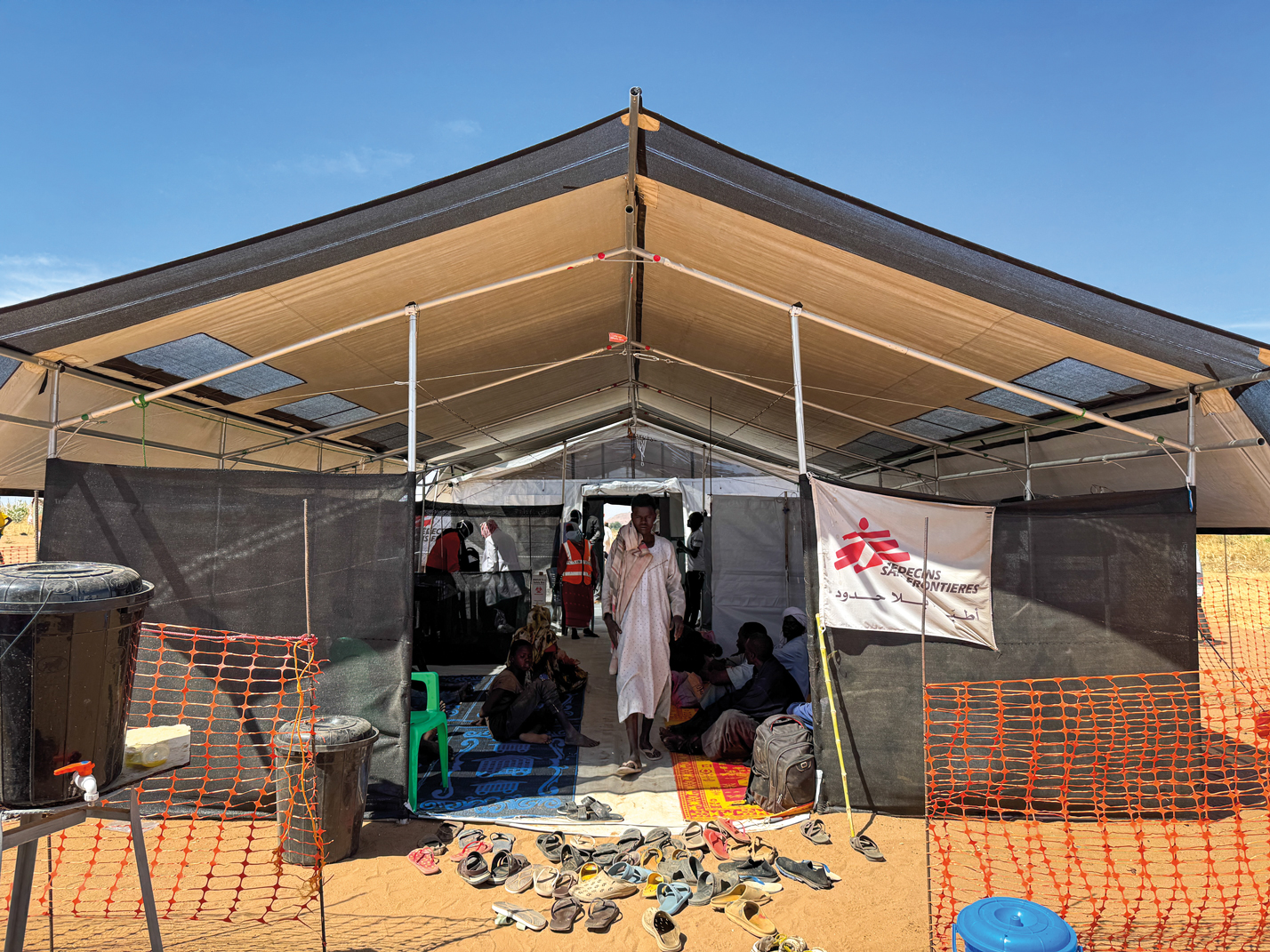
A Médecins Sans Frontières treatment centre for displaced people from El Fasher, Darfur. Image: Natalia Romero Peñuela / MSF
You recently visited Ukraine. What did you see there?
I was struck by the regularity of air raid alerts and the intensity of what it is to be living with those daily. Even if there’s not a strike, the alert itself in the middle of the night means there’s a lot of tired and sleepless people. There were regular attacks on the electrical infrastructure and that’s having an impact on the humanitarian response.
One day, I visited two hospitals and an ambulance dispatch site and all of them were having electricity supply issues. The ambulance dispatch was in the dark. The teams were constantly concerned about being able to sustain the equipment.
Advertising helps fund Big Issue’s mission to end poverty
In Gaza, hospitals have been targeted. How has that changed the way you work?
I was in Gaza just before the Rafa invasion, and at that time, we were living in fear of an invasion in Rafa but thought that there’s no way that it could possibly happen. Everybody was packed into the south of Gaza. The thought was unfathomable.
People, including our staff, had been displaced multiple times. We’ve had 15 staff members killed. Nowhere in Gaza has been safe. Even with the ceasefire, there’s violence continuing, and it’s still incredibly difficult to get supplies in.
It’s a continual exercise in questioning our presence there from a staff security point of view. We’ve insisted that we continue to speak about what we’re seeing and the horrors of that war, to ensure that we’re not becoming complicit in what is happening.
Borders and divisions have become big issues in parts of the world. Has that made your work more challenging?
Advertising helps fund Big Issue’s mission to end poverty
We’re seeing a change in how borders are used. There are borders within borders. We must look within countries, as well as between countries and between different areas of control. Sudan is a classic example. Gaza another, where there is ongoing occupation and siege. In many cases, it’s increasingly difficult to get permission to provide humanitarian assistance by a sovereign or quasi-sovereign entity in an area where they’re not necessarily in day-to-day control.
That’s pretty fundamental in terms of humanitarian response. We’re not here to contradict the laws of a nation. We adhere to them. However, we will challenge those if it impacts people’s suffering, particularly from a medical perspective.
Are some crises, like Sudan, being overlooked?
Sudan is a horrendous war on people. It’s been over two and a half years now. It’s been systematic and deliberate, and in many cases, with the intention to destroy entire communities. On 26 October, there was an attack on El Fasher by the RSF [Rapid Support Forces]. We have been anticipating the horrors of that moment for many months.
Before that happened, in North Darfur, our teams were treating women who had told us they were taking post-exposure prophylaxis [a treatment to stop HIV infection], in the anticipation of being raped. It’s just one indicator of how systemic sexual violence has become in that conflict.
But since, and this is emblematic of the seriousness of the situation, we haven’t been able to get into El Fasher. We’re still waiting for permission. From what we have seen, from the testimonies survivors have given us, it looks catastrophic.
Advertising helps fund Big Issue’s mission to end poverty
It appears that a large part of civilians who were still alive before October 26 were killed or died or have been detained or trapped. It’s horrific. We haven’t been able to go and respond yet but we have really strong fears about what’s happened there.
With so many horrors happening in the world, how can people make themselves aware without feeling overwhelmed?
Every time I visit somewhere, I’m still nervous about what I’m going to find, especially if it’s somewhere I’ve never been to before. There’s something quite intimidating about names on a map and statistics. But then everywhere I go, and this might sound slightly weird and counterintuitive, not only is it fulfilling and inspiring, but I enjoy myself. I have fun.
There are horrors happening. But I’m meeting friends. I’m having dinner by the roadside. I’m chatting with team members about their families, how the situation used to be before the war started. There’s an amazing resilience and life goes on.
It’s natural to feel uncertain and helpless. But it’s important to remind ourselves that just because of what is going on in the world, it doesn’t mean that solidarity and compassion and care have diminished. To keep faith in people is key.
Médecins Sans Frontières have resumed their activities in Gaza. Image: MSF
Who has had an impact on you?
Advertising helps fund Big Issue’s mission to end poverty
When I was in Gaza, there was a burns hospital. Everybody had horrific burn injuries. There were two girls, around four or five years old, who had serious burns. They were like the centre of the hospital. I don’t want to say court jesters, but they were adopted by everybody and gave everyone energy.
There was also an outpatient, a young boy, maybe around seven or eight, who’d also had a burn injury and was coming to our clinic every day for dressing. His uncle had been killed in the bombing in which he was burned. They’ve been through such unbelievable events. But his dad was so patient and tender and caring through his painful redressings. Seeing that depth of love was incredible.
What do you see being the biggest issues of 2026?
I’m worried that as a world we’re giving up on solving conflicts. Resolving conflict has never been easy or straightforward. The peace and security agenda needs a new seriousness and energy and depth to it. Without states being able to call each other out when crimes are committed and when they don’t allow access into populations in need, unless we collectively tackle the accountability deficit, then we’re just going to be spinning our wheels – whether it’s peace and security or law and justice.
Humanitarian workers can never solve those conflicts. I’m worried that humanitarian work becomes the ‘get out of jail’ card for states.
Without states being able to call each other out when crimes are committed and when they don’t allow access into populations in need, unless we collectively tackle the accountability deficit, then we’re just going to be spinning our wheels – whether it’s peace and security or law and justice. And as a consequence, people will look at humanitarian workers as a subsidiarity for solving conflict.
Advertising helps fund Big Issue’s mission to end poverty
Buy from your local Big Issue vendor every week – and always take the magazine. It’s how vendors earn with dignity and how we fund our work to end poverty.