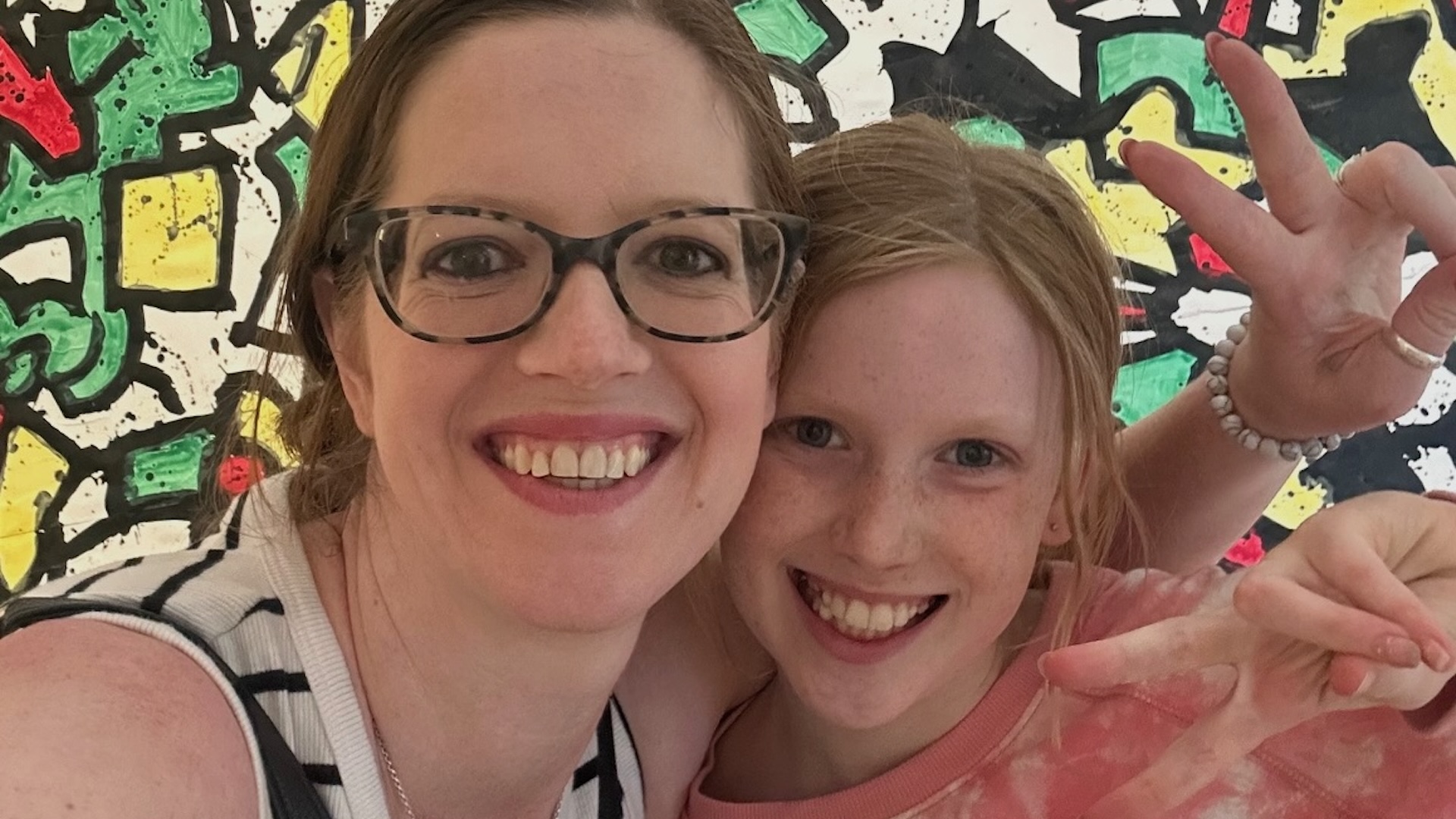
She hated school – absolutely hated it. She had emotionally-based school avoidance from a very young age. A friend of mine who was the SENCo [special educational needs coordinator] in the school took me aside and said: ‘Have you considered Ava might be autistic?’ It blew my mind a bit. I looked into it and was like: ‘Oh my gosh, absolutely.’ I tried to get her a diagnosis but kept coming up against it. A SENCo in another school said she can’t be autistic because she makes eye contact, which is obviously not true.
We got her diagnosed but had to go down the private route. It was a tough journey and she absolutely detested school. I felt quite diminished sometimes. I think there was a lack of knowledge. We got an EHCP [Educational, Health and Care Plan] and we moved her into a different school, because we had moved house anyway and she was really unhappy and we wanted to see if a change of scene would help her. We had a bit of a honeymoon period, and the school tried really hard. They worked closely with her and she was quite happy.
But around Christmas 2024, everything started to rapidly unravel and go downhill. Her emotionally-based school avoidance was significant. She felt misunderstood. They couldn’t provide the support that she needed in a mainstream setting. A lot of her difficulties are sensory, so she’s very sensitive to noise, people’s tone of voice, smells, and you just can’t control that in a mainstream school. We reached the point where she was experiencing significant emotional distress. It was terrifying, considering she was just nine.
The school and I were in agreement that she needed a specialist provision that she couldn’t carry on doing this. We found one, but the local authority didn’t want to name it. Last April, she stopped going to school entirely. She just could not cope with it whatsoever. We have spent the last nine months fighting the local authority, trying to get the provision that she needs. It’s been an incredibly challenging nine months.
Alongside that, I was a headteacher, so I was dealing with all of this and then at the same time becoming more and more frustrated with coming up against red tape in my own school. I wanted to help children. And it was like hitting your head off a brick wall. It was just so exhausting and I felt eaten up with guilt really that I felt like I’m not meeting anyone’s needs. My staff were miserable half the time because they were all exhausted. There’s red tape and there’s not enough money.
I’ve got my husband. I had family support, but there was no external support. So I quit because I felt really strongly that I couldn’t continue to be silent about how broken everything was. I wanted to shout from the rooftops and you can’t do that when you are a headteacher. I wouldn’t criticise my school at all. I was really lucky. But at the end of the day, I still had a local authority to answer to and government policies I didn’t agree with.
Advertising helps fund Big Issue’s mission to end poverty
We found out in January that the local authority are naming a specialist school for Ava. So we won. She’s so happy. She’s so ready to go back to school. But it’s taken a long time to get there and a lot of money to get there. I’ve had to pay for all her home education myself. There’s been little support despite her having an EHCP.
Ava is now in a good place. She’s ready to return to school. She’s articulate and she always says she knows that she can’t go back into a mainstream. She can’t cope with it. She said to me once that it’s because she has to hide and she has to mask everything about her. She can’t be her real self. She’s a very high masking autistic female. So know it wasn’t healthy for her. Actually, she’s been able to unmask now. She’s been able to be herself and find her feet and she’s so ready to learn and she’s so excited to start.
But the mainstream environment was significantly traumatic for her and has had a lasting impact. As a mum, you feel guilty. There’s been days where she has had to sit on the TV all day and I’ve had to work. You feel guilty that she’s not getting the education and guilty about the money you’re spending on legal fees that could be spent on something else. Should we have forced her to go to school? I know the answer to that is no, but you are constantly questioning yourself and that creates a spiral for you as a family.
It infuriates me that parents are having to become such experts and advocates for their children. We’re lucky that we could afford legal aid. And when I say we could afford it, we’ve had to make sacrifices in other areas. Many parents are not able to get legal aid to enforce the law.
I do advocacy for other parents and the delays, the bureaucracy, the complete infringement of the SEND code of conduct and basic equality acts is unbelievable. Often parents don’t even realise their rights, which I think is what authorities are banking on. There are a few free services out there, but there are so many parents in the same scenario that if you do seek help, you’re going to be waiting weeks and weeks to get an appointment.
If you look at rates of emotionally-based school avoidance, 92% of cases are neurodivergent [according to a widely-cited study published in 2023]. Classrooms now are packed to the brim. They are often overwhelming on a sensory level. Policies are rigid with regards to uniform and even behaviour. A lot of children can’t cope. As a headteacher, you’re expected to promote these policies and publish attendance figures. It made me feel quite ill when I couldn’t even get my own child to go to school. There’s a huge lack of funding.
Advertising helps fund Big Issue’s mission to end poverty
The SEND white paper is coming out and there is a huge concern in the community around them potentially scrapping EHCPs – but EHCPs themselves aren’t the problem. The problem is bureaucracy and lack of funding. EHCPs are an essential route to ensure that children have got their legal rights in black and white. Ultimately, they are a legal document that protect your child. It’s a very slow process and local authorities are struggling to fund them. But if they remove them, I think that would be really quite devastating for families.
My concern with suggested proposals is that they’re being driven by financial pressure and not actually driven by children’s needs. The fact of the matter is local authorities are crippled in debt and we can’t move away from that but I am worried that the reforms are a bit of a wolf in sheep’s clothing. I’m worried that they will make it harder for disabled children to access education or have their legal rights enforced. SENCos are overwhelmed.
Teachers are overwhelmed. They’re walking out in their droves. There’s a lot of talk about SEND hubs within mainstream, and I actually think it would be great if all mainstreams had them, but that is not going to provide a lot of children with the provision they need. My daughter would never have gone to one of those because she would have looked different. She wants to be with her own, specialist community. It worries me that there is talk about moving away from specialist provision. I think that could be dangerous.
I just want my children to access an education that allows them to do something that they want to do when they are older. If my daughter wants to do an art GCSE, I want her to have access to that. I want my children to have friends who love them for who they are, and I want them to feel included in a community that they feel safe in. For a lot of children, school doesn’t feel safe. When Ava came back from the trial day of her new school, she said: ‘I didn’t know school could feel like that I actually felt safe. I think I found the one. I think I found the school for me.’
Response from the Department for Education
Responding to the Big Issue’s series around the SEND system, a Department for Education spokesperson said: ”These heartbreaking cases show why it’s so crucial we strengthen support for children with SEND and ensure families get help earlier and closer to home.
”We know too many parents are forced to fight for support, with rising demand meaning children’s needs can escalate to crisis point before help arrives. That is not good enough – and our reforms will mean more support for children, not less.
Advertising helps fund Big Issue’s mission to end poverty
“Our reforms are designed to strengthen support for children and ensure help is delivered earlier and more consistently. We have already committed to unprecedented long-term investment, including £200 million to train teachers in SEND and at least £3 billion to create 50,000 new specialist places, and there will always be a legal right to additional support for children with SEND.”
Despite these reassurances, there remain fears that SEND support will be reduced rather than enhanced.
Do you have a story to tell or opinions to share about this? Get in touch and tell us more.
Change a vendor’s life this winter.
Buy from your local Big Issue vendor every week – and always take the magazine. It’s how vendors earn with dignity and how we fund our work to end poverty.
You can also support online with a vendor support kit or a magazine subscription. Thank you for standing with Big Issue vendors.
Advertising helps fund Big Issue’s mission to end poverty