One, Turner, born in Covent Garden where his father was a barber, the other a country boy from deeply rural Suffolk whose father was a wealthy corn merchant and miller. One working class and one decidedly middle class. And the working-class boy makes it to the top of the Royal Academy and accompanying prestige in his mid 20s; the other middle-class boy is in his 30s before he is made an associate of the Academy. Turner became very wealthy through his art and presents a picture of England that seems by its subject matter to be about capitalist accumulation. Turner is the more progressive and Constable the true country reactionary.
Read more:
I didn’t look at one Turner painting in the whole exhibition, although I was glad they were there for people to make the comparison. It’s a great idea to celebrate the 250 years of Turner’s birth, and at the same time Constable’s who was born a year later. Turner the blasé, with superabundance of red and yellow, and Constable with deep variations of greens and browns. Turner great at painting seas that look like sea, and Constable painting skies as if they are full of true clouds.
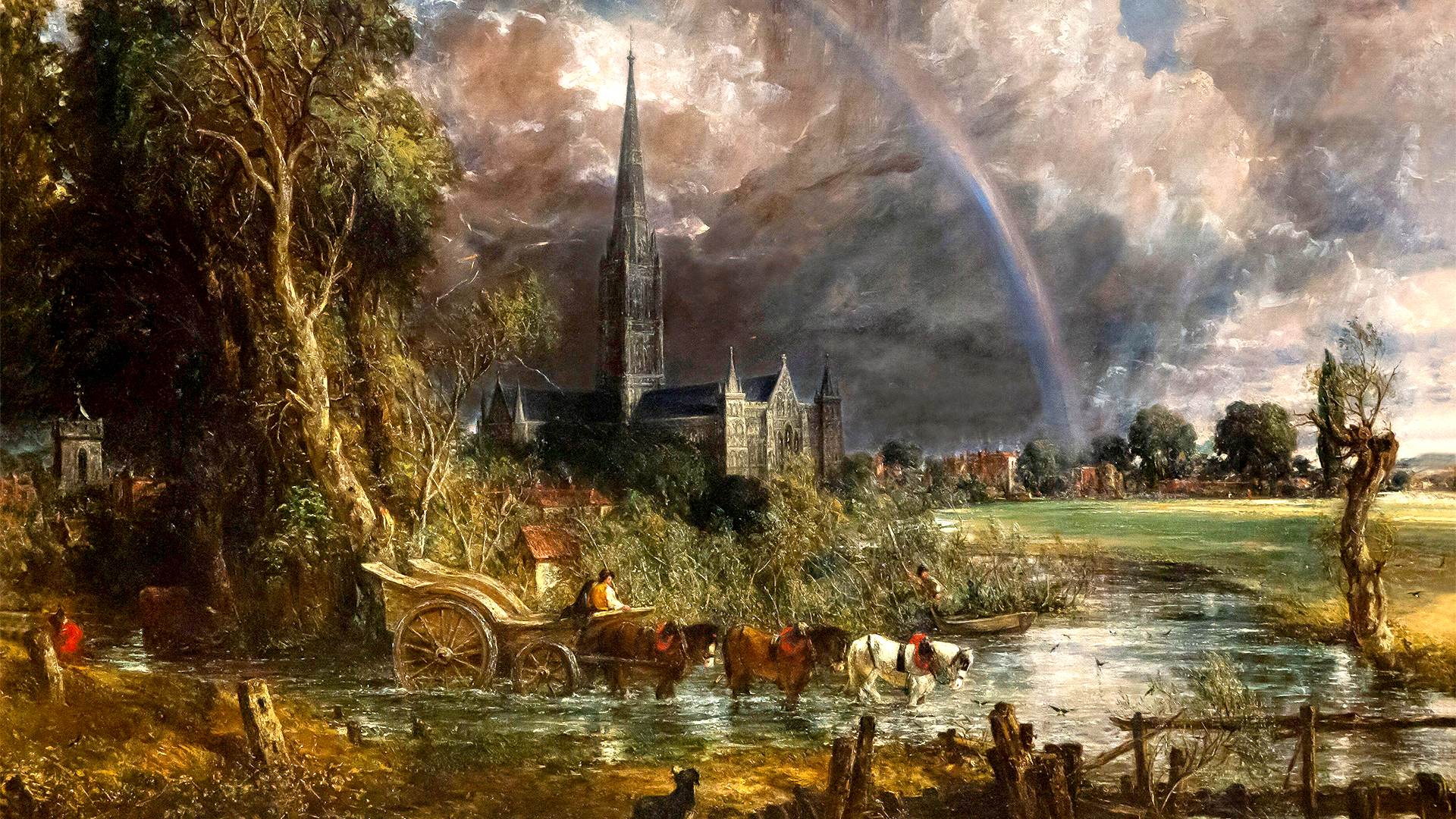
Overwhelming Turner, showing off Turner; Turner proving that aside from his inability to paint people he can do history, industry, imitate the great of the European tradition. A splendid showman – a bit like Great Britain in the 19th century. Constable meanwhile seems to paint only a corner of England, never travelling very far from his precious East Anglia. For me, his finest work is Salisbury Cathedral from the Meadows; the greatest English painting of the whole of the 19th century.
Yet 50 years ago I launched an art magazine called Art Perspectives at the vast Turner exhibition at the Royal Academy. There was no question then of combining Constable’s work as has been done at Tate Britain’s current exhibition. The first issue of Art Perspectives was exclusively about Turner. A year or two later I helped found the Tate Gallery’s magazine Turner Studies. I wanted to call it ‘Turners Epoch’, which would have covered 50 years before his birth and 50 years after; thus covering everything from the early 18th century to the beginning of the 20th.
The Tate Gallery was desperate to get its hands on the vast Turner bequest which contained hundreds of works left by Turner to the nation. I was told that therefore the Trustees of the Tate had to look as if they were doing a lot for Turner’s legacy, hence Turner Studies that ran for a number of years.
Turner insisted that his work has to be shown in a state-sponsored museum, which was provided by the Clore Foundation. Since those times Constable has grown again in stature. But if you want to see the large Constable collection I grew up on at the V&A Museum you will have to settle for a handful; they have too many other things acquired since Constable’s daughter left hundreds of works to the nation, so Constable is in storage. Perhaps, after all this time, we need a Constable museum.
In some ways I was worn out by all the Turner 50 or so years ago. I am still worn out by him, and refreshed by Constable. It’s a bit like Andy Warhol, who 60 years ago I thought was the bee’s knees. But he has not lasted in my affection.
Forgive me if you’re a Turner lover. Once he floated my boat, but now it’s all Constable. Look at Hadleigh Castle by Constable in the Tate’s permanent collection. A finished painting and a vast oil sketch. It’s all about the wonderful use of paint. Look at them close up.
I hope you have had a great Christmas. But go and see the T&C show and see if you can see what I see, or not.
John Bird is the founder and editor-in-chief of the Big Issue. Read more of his words from our archive.
Do you have a story to tell or opinions to share about this? Get in touch and tell us more.
Change a vendor’s life this Christmas.
Buy from your local Big Issue vendor every week – or support online with a vendor support kit or a subscription – and help people work their way out of poverty with dignity.