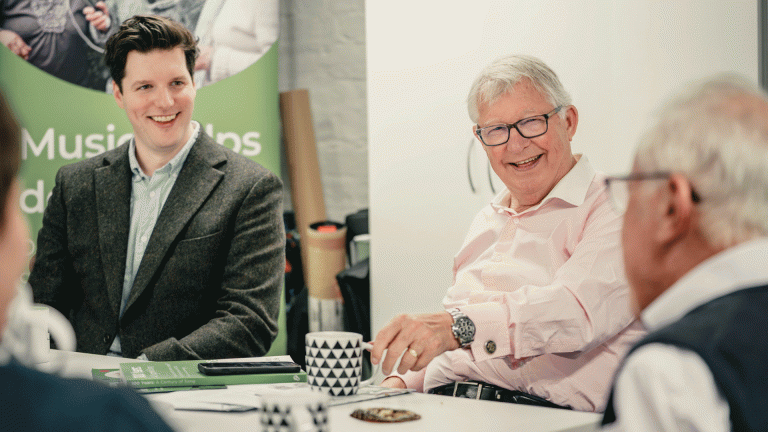
“We said, so first, do you do any of these activities? And then we said, if you do the activities, how often do you do them, and how much joy do you get?”
Listening to music for pleasure topped the joy index, receiving an average joy score of 6.16 out of 7, followed by playing a musical instrument (6.04), reading books (6.00), crafting (5.92) and volunteering (5.84).
Sport, theatre, painting, and writing all ranked above 5.7 in the study, commissioned by publishing company Immediate.
Keep reading the journalism that powers our mission
Register free to continue and learn more about the stories, campaigns and the support we provide, helping people facing poverty across the UK.
Scrolling social media ranked “rock bottom” for joy achieved (5.19) – and top for time spent. This is hardly surprising, said Banerjee. It’s what the “technology is built to do”.
“It’s designed to keep our eyes on it – in order to make us look at advertisements,” he told Big Issue. “We’ve got this very, very clear pattern, that is we’re spending a lot of time doing stuff that doesn’t particularly bring us joy.”
Scrolling taps into the same psychological reward systems that drive many behavioural addictions, separate research has found. “Addiction is the most significant negative impact of using social media,” a 2023 study from the US’s National Institute of Health declared.
The scale of it is hard to ignore. The average time spent per day online on personal (i.e. not work) smartphones, tablets and computers in May 2025 was 4 hours and 30 minutes, according to Ofcom, with the figure increasing to 6 hours and 20 minutes for people aged 18-24. A 2022 survey found that more than half (52%) of UK people describe themselves as addicted to scrolling, with 86% of millennials and 82% of Gen Z reporting “scrolling addiction”. Globally, about “210 million people exhibit patterns similar to addiction,” according to the same study.
Infinite scroll, autoplay and hyper-personalised feeds remove natural stopping points, hijacking dopamine feedback loops in much the same way slot machines do.
“It’s actually very impressive that they [big tech companies] found such an effective way of capturing people’s attention,” said Dr Banerjee. “It’s key to the business model.”
The problem, he argues, isn’t just that scrolling feels bad, but that it replaces other activities.
“What this study shows it is it is taking up all the time that we could be doing other stuff that’s really, really healthy for us. Stuff that helps us to relax and helps us to get into the zone in a really positive way.”
This fear has fuelled mounting political pressure, particularly when it comes to children. Australia has already moved to ban social media for under-16s, while in late January prime minister Keir Starmer pledged to take “robust action” to tighten children’s use of social media. Young people are being “pulled into a world of endless scrolling, anxiety and comparison”, he warned.
This is true, said Banerjee – but the negative impact doesn’t tail off at 16.
“I’m actually a child psychologist by training, so I’m very much with that in terms of the particular vulnerabilities and concerns around children being exposed to things on social media – all of those things are absolutely true,” said Banerjee.
“But the reality is that there are many, many unhealthy and damaging aspects of our habits with social media, for adults as well.”
Scrolling actively crowds out activities that offer “immersion and connection”, he continued.
“We’re so disconnected from the sensory experiences of what’s around us. You can see, very often, people walking past absolutely awe-inspiring, beautiful natural scenes, and yet they’re stuck with their head in a phone.”
So how to fight back? Carving out time for the activities that ranked highest for joy – reading, crafting, playing instruments – is a good start, the study suggests.
“We need to be very purposeful and proactive in saying… making that specific commitment to allocate time, headspace really, to these different types of activities,” Banerjee said.
Easier said than done, of course; who amongst us hasn’t made a resolution to go on our phones less?
But in the very least, this research adds to a growing body that proves the disconnect between what we put into social media and what we get out of it.
“They are hijacking our attention for profit,” Banerjee said. “That is bad for us.”
Do you have a story to tell or opinions to share about this? Get in touch and tell us more.
Change a vendor’s life this winter.
Buy from your local Big Issue vendor every week – and always take the magazine. It’s how vendors earn with dignity and how we fund our work to end poverty.
You can also support online with a vendor support kit or a magazine subscription. Thank you for standing with Big Issue vendors.