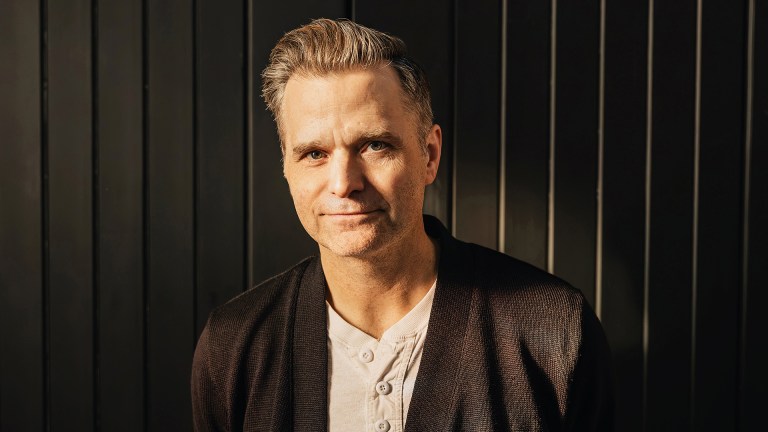
“The melodic material is simple,” he says, smiling. “The piano part is really just a chain of suspensions.”
It was pleasingly disarming. Here was Richter, essentially boiling down his secret ingredient to an uncomplicated chord sequence. Of course, Sleep – like the scores to Hamnet, and the three-part ballet Woolf Works, just revived at Covent Garden – is far more than the sum of its parts. The crunchy harmonies – comfortingly melancholic – build to a slow reveal, wriggling in that wormy peristaltic locomotion until the very last moment.
Read more:
Keep reading the journalism that powers our mission
Register free to continue and learn more about the stories, campaigns and the support we provide, helping people facing poverty across the UK.
In his latest piece for The Guardian, Radio 3 presenter Tom Service describes “Why Max Richter’s Hamnet needle-drop left me cold”, declaring that “the stunning thing about Richter’s music is how empty it is”. While recognising that populism is rarely a good defence, it’s worth pointing out that On the Nature of Daylight, a piece that appeared in 2004’s anti-Iraq war album The Blue Notebooks, is deemed so filmic that it has been used in everything from The Handmaid’s Tale to Hamnet. But one person’s goosebumps is another’s chills.
A strong case was made for the return to the era of individual songs within a soundtrack with Southbank Centre’s recent premiere performance of Sleepless in Seattle in Concert. The quirky 1993 rom-com – in which Meg Ryan as Baltimore journalist Annie is mesmerised by widower Sam (Tom Hanks) after his son calls a radio talk show – was brought alive by musicians nestled under the big screen. Composer Marc Shaiman created bespoke linking music to segue between known hits including Louis Armstrong’s A Kiss to Build a Dream On and Jimmy Durante’s As Time Goes By, which were charming in this special Valentine’s Day version for wind, piano and percussion – the memories will last far longer than a bunch of flowers.
Such film concerts are increasingly popular – next up is the Royal Scottish National Orchestra and Chorus with Hans Zimmer’s score to sword-and-sandals epic Gladiator (Usher Hall, Edinburgh, 13 March and Glasgow Royal Concert Hall, Glasgow, 14 March) and the Royal Northern Sinfonia for John Williams’s music to Harry Potter and the Philosopher’s Stone (The Glasshouse International Centre for Music, Gateshead, 18-19 April).
Recording of the month
Loved as a folk favourite, in recent years the accordion has been consolidating its reputation as a classical instrument. Latvian accordion player Ksenija Sidorova shows its complex capabilities in Prophecy, a new album recorded with the Estonian Festival Orchestra and Paavo Järvi. Prophecy (2007), the title work, is an eerie, atmospheric concerto by Erkki-Sven Tüür, with strange, haunted fairground-type effects, while Tõnu Kõrvits’s four-movement Dancesfurther experiments with the extremities of the squeeze box.
Prophecy by Ksenija Sidorova is out now on Alpha Classics
Claire Jackson is a writer and editor
Do you have a story to tell or opinions to share about this? Get in touch and tell us more.
Change a vendor’s life this winter.
Buy from your local Big Issue vendor every week – and always take the magazine. It’s how vendors earn with dignity and how we fund our work to end poverty.
You can also support online with a vendor support kit or a magazine subscription. Thank you for standing with Big Issue vendors.