Advertising helps fund Big Issue’s mission to end poverty
Opinion

I took a walk where I grew up in London. I saw how gentrification has damaged the community

We need a bigger and better form of social thinking than we have ever had before, writes John BIrd

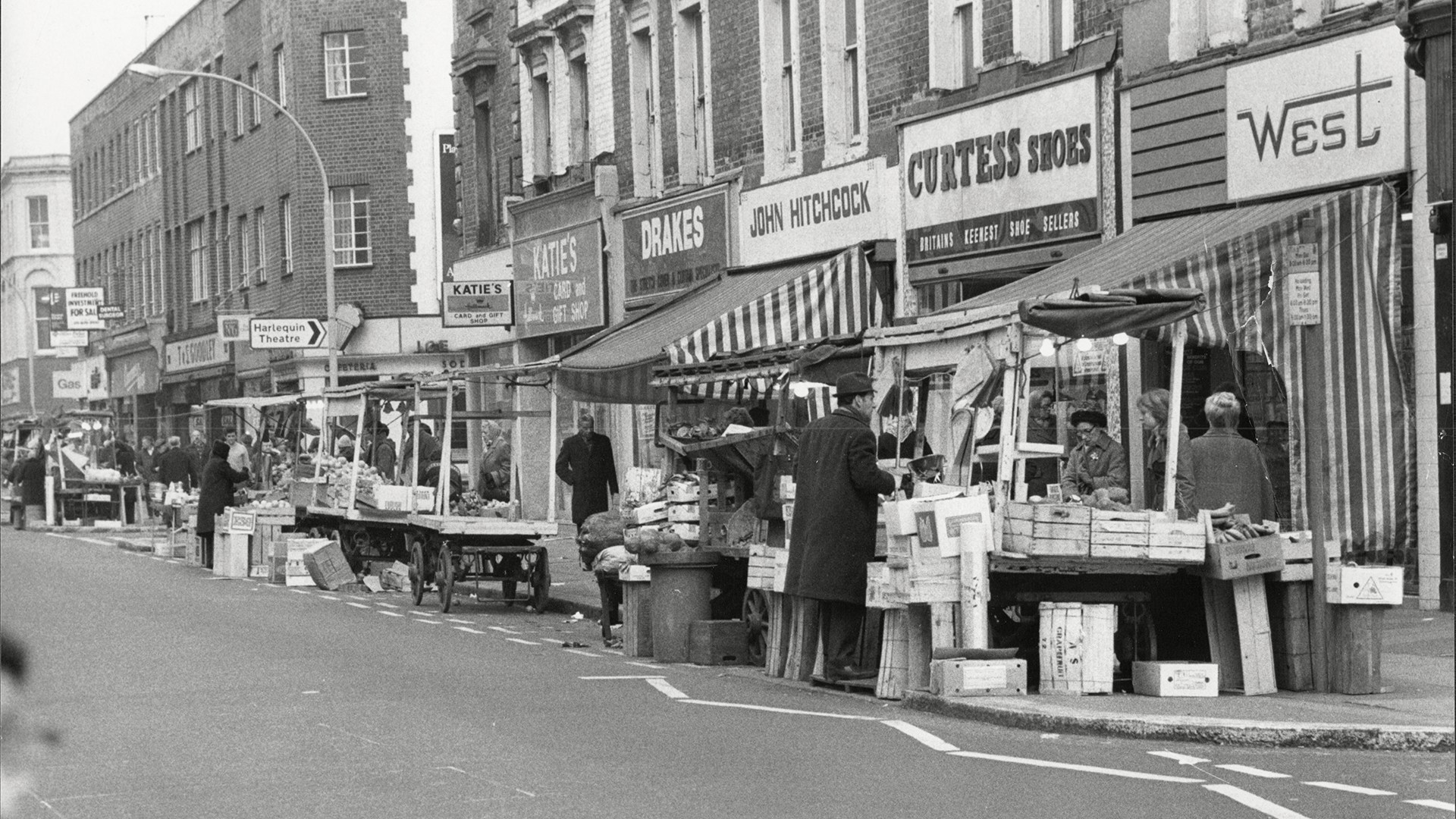
The shops in Fulham in the 1970s have been replaced by a plethora of estate agents

The shops in Fulham in the 1970s have been replaced by a plethora of estate agents. Image: George Harris / ANL / Shutterstock

It was probably in the early 1970s that pictures first appeared in newspapers showing an iced-up world. These are the first imagined images I remember of a change to our environment caused by the expansion of industry. It was the result of our dependence on industrialisation, which was creating an enormous hit to the natural world due to carbon emissions.

It seemed we were heading back to a time of permanent ice age, minus the woolly mammoths. I, in my early 20s, was rather glad that if the environment was going to be screwed by a petroleum-led industrial world then a cold realm would be the result. Having been born into a largely cold slum world, to me cold was preferable to hot.

But now it would seem the opposite is the case, though occasionally one hears that hot and cold may well combine in a future environmental Armageddon, the result of our climate tampering through thoughtless industrial expansion.

I do meet people who still claim there is nothing to worry about. That it’s the natural world that cyclically throws up heat, that any link with industrial change is unproven. Admittedly most of these opinions are held alongside other opinions of a very right-wing nature. So you can, if you are of a liberal progressive or left-wing mind, write these people off as delusional.

But it did get me thinking about what you might call ‘social environmentalism’. If the supposed crackpots deny the causes of our fiery summers, can they equally deny the damage done to our social world? The despoliation of our high streets? The grubby dirtiness often to be found in our parks and open spaces, and the littered verges of our highways.

Last week I undertook a sentimental journey back to Fulham, Chelsea and Kensington, where I had spent not only my youth but also part of my late-50s. Where I remarried and started a new family among the memories of a struggling early life of poverty and wrongdoing. What a damaged F,C& K I witnessed! And have increasingly witnessed throughout the years.

Advertising helps fund Big Issue’s mission to end poverty

The plethora of estate agents replacing hardware stores and newsagents, cobblers and greengrocers is social environmentalism gone decidedly wrong. Stationers disappeared and turned into shops selling houses to buy or rent at exorbitant cost. Florists and grocers once abundant are now wellness hubs where your inability to cope with life is turned into an industry.

Read more:

Thousand-pound houses have morphed into two-million-pound-houses among streets that once had a social mix but are now anaesthetised into mock-bourgeois redoubts. Cleaner and better painted, yes, but showing where wealth has been concentrated into bricks and mortar that harm the social environment as significantly as our boiling summers.

Main roads that formerly did not host a person sitting down to beg show further the onslaught of this attack upon our social environment. Poverty mixed with plenty. All this achieved against a post-war backdrop of increasing wealth for some and a largely state-funded wretchedness for others. 

That’s not to say that need was not on display in the misnamed ‘good old days’. But gentrification has not resulted in a better functioning society. The baby definitely got thrown out with the bath water as councils and national governments mistook the increased value of bricks and mortar for a better-functioning society and democracy. A social illness, the collapse of community, was passed off as progress.

But financially – and this confounds my miserable observations of the transformed streets of my youth – it all added up. Bigger incomes could be garnered from rates and taxes derived from wealthier households and posher shops. A greengrocer versus a swanky estate agent in terms of council income is a no-brainer: go for the swank, and bollocks to the cabbage, was the municipal mindset.

Advertising helps fund Big Issue’s mission to end poverty

Why? Because of the piling of costly social responsibilities onto the shoulders of local government. If you are going to help your borough’s needy – and ever-increasing budget – you will need the swank. No swank, then you have to beg more from the national government.

Our contemporary climate deniers will probably also claim that market forces should rule the roost. If a high street becomes peppered with wellness hubs and estate agents then that’s a natural law manifesting itself. But a kind of devalued anarchy is the result. 

Pockets of poor people are these days often, especially in F,C&K, surrounded by plenty. My own place of birth, Notting Hill, is a case in point. Need stalks the expensive streets where plenty also strolls. 

A decayed social environmentalism is undeniable, though it is often dressed as social improvement. ‘Thank god’ must be the cry of many councillors when they have more dosh to spend on the borough’s socially challenged. But a healthier community is not the result.

I make these observations because I believe we need a bigger and better form of social thinking than we have ever had before. An eternal optimist, I believe we can strive for better for us all. 

Thirty-five years ago I think we set out on such a path. Happy Birthday, Big Issue. But there is more to be done.

Advertising helps fund Big Issue’s mission to end poverty

John Bird is the founder and editor-in-chief of the Big Issue. Read more of his words from our archive.

Do you have a story to tell or opinions to share about this? Get in touch and tell us more

Change a vendor’s life.

Buy from your local Big Issue vendor every week – and always take the magazine. It’s how vendors earn with dignity and move forward.

You can also support online:
Subscribe to the magazine or support our work with a monthly gift. Your support helps vendors earn, learn and thrive while strengthening our frontline services.

Thank you for standing with Big Issue vendors.

Advertising helps fund Big Issue’s mission to end poverty

Do you know how Big Issue 'really' works?

Watch this simple explanation.

Recommended for you

View all
It’s time we stopped having to face up to a SLAPP
Nik Williams on SLAPP
Nik Williams

It’s time we stopped having to face up to a SLAPP

I was homeless as a child. I know what Andy Burnham needs to do to end rough sleeping for good
Danny Beales walks down a street in Ruislip Manor with a blue bridge in the background spelling the name of the area
Danny Beales

I was homeless as a child. I know what Andy Burnham needs to do to end rough sleeping for good

Why building homes around railway stations is ‘far from an assault on the countryside’
a train at a station in the UK
Russell Curtis

Why building homes around railway stations is ‘far from an assault on the countryside’

Ending rough sleeping is the goal, but taking bars off benches is a good start
This anti-homeless bench in Bournemouth will hopefully soon be a thing of the past
John Bird

Ending rough sleeping is the goal, but taking bars off benches is a good start