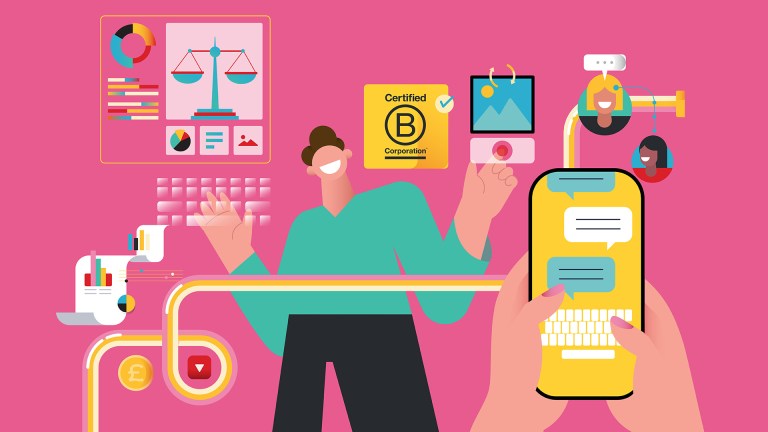
There is a difference, most would argue, between organisations where social purpose is the entire point and those where it’s a footnote to a profit motive. Big Issue Invest (BII), Big Issue Group’s social investment arm, sits firmly at the higher-impact end today: lending capital to charities and social enterprises at affordable rates, in places and to organisations that mainstream finance won’t touch. We asked BII’s managing director, Holger Westphely, what the true potential of the impact economy is.
Get the latest news and insight into how the Big Issue magazine is made by signing up for the Inside Big Issue newsletter
What is the impact economy?
HW: A great part of it is the organisations, the initiatives, even clubs and trusts, that are trying to address societal problems through their activity. Their activity might be direct interventions to address a problem – a typical charity model is ‘give me some money and I will do stuff that directly helps’ – or it might be an incidental impact, like training young people to become baristas and running a coffee shop.
The main business is running a good coffee shop, but there is a clear intention to give opportunities to young people who might struggle in the job market. That’s not the same as Costa happening to employ young people. Social impact has to be a goal.
How does Big Issue Invest fit in the impact economy? What work do you do?
Advertising helps fund Big Issue’s mission to end poverty
We raise capital from government bodies, philanthropists, corporates, foundations and banks, and lend it to charities and social enterprises at affordable rates with flexible repayment terms. We’ve supported alcohol addiction and recovery services in the North East, community hubs in areas that aren’t hives of activity, and we work with combined authorities in regions like the West Midlands to bring more capital to the area.
Read more:
The impact economy has had its critics. Some say the definition outlined in the NPC report includes companies with questionable records. Is that a fair criticism?
We haven’t got clear rules as to what organisations in the impact economy are allowed to invest in and what they’re not, and of course you’re going to have a massive variation – from the really high-impact social enterprise to something that’s maybe not that different from a mainstream corporation.
To expect the entire impact economy to be hyper-focused on every issue just isn’t realistic, and it isn’t impact-maximising. Those criticisms will come from individuals focused on those specific topics, and it’s probably a good thing. Many organisations will go, ‘well actually, that’s true, maybe I haven’t paid enough attention to this’. I’d almost call it part of a well-functioning impact economy.
The impact economy’s value in the UK is huge – £428 billion. Is it booming right now?
Advertising helps fund Big Issue’s mission to end poverty
The sector is quite resilient, because it doesn’t have the profit motive. It can find resources that purely commercial companies might not have access to or bother looking for. But is it booming right now? I would be hesitant to say yes. Everyone is struggling at the moment. Has it been booming over the last
decade? Yes, absolutely, for a lot of reasons. People have paid more attention to it. It’s developed. The millennial generation is seeking impact as part of their employment. There are new sources of capital. There’s been a lot of creativity. But this year specifically, things are tough.
How significant is the government’s new Office for the Impact Economy?
You always have to be sceptical about whether something will be a turning point. But there’s hope. We’ve had a few governments now that haven’t really pushed it. There was the Big Society agenda under David Cameron – although that came with a lot of funding cuts, so it was more of a gesture than a commitment. What’s smart about the current initiative is saying: we don’t have any money, but we could at least join the dots, be smarter within government and understand how to engage with the impact economy more effectively to facilitate its continued growth. I think that’s a positive trend.
Whose responsibility is it to solve social problems: government or the market?
The beauty of a free economy is you can set up an organisation to solve almost any problem you come across. That’s not something government is particularly good at. Government’s job is large-scale planning and coordinating, but you could argue it’s trying to solve too many problems through legislation and funding. I think they have to work together. The idea of government being more of a cheerleader for the social economy, providing support infrastructure rather than delivering directly, is a positive direction.
If you could ask for one thing from government to support the impact economy, what would it be?
Advertising helps fund Big Issue’s mission to end poverty
Finding a way to blur the lines a little – some form of light-touch regulation that makes the impact economy more inclusive, while still addressing greenwashing and the problems that come with that. The NPC report was maybe criticised for widening the definition too far, but I’m very much of the opinion that you should widen it. You should find a way of recognising purpose-driven businesses alongside the more traditional regulated sector. Done carefully, that’s how you grow something.
Do you have a story to tell or opinions to share about this? Get in touch and tell us more.
Change a vendor’s life.
Buy from your local Big Issue vendor every week – and always take the magazine. It’s how vendors earn with dignity and move forward.
You can also support online:
Subscribe to the magazine or support our work with a monthly gift. Your support helps vendors earn, learn and thrive while strengthening our frontline services.
Thank you for standing with Big Issue vendors.
Advertising helps fund Big Issue’s mission to end poverty