Inside the government-backed community hub teaching people digital skills: 'It is for my future'
Big Issue was invited to the Bromley by Bow Centre as the government unveiled plans for community hubs like these to get funding to teach people digital skills. The centre is carrying out vital work, but is the funding enough to keep people digitally literate at a time when technology is changing so rapidly? We asked the minister for digital inclusion, Liz Lloyd
Minister Liz Lloyd in a workshop at the Bromley by Bow Centre. Image: Alecsandra Dragoi / DSIT
Share
Mahbubur dreams of working as a teacher again. He was a teacher in Bangladesh before he moved to the UK a few years ago, and he has been working hard to perfect his English, but he also needs to build his computer skills before he can secure a job as a teacher here.
Here in the Bromley by Bow Centre, a community hub in East London, the 27-year-old is learning both. Centres like these are the quiet heart of communities across the country, providing a wide range of services to people from all walks of life to help them thrive.
“Before, I didn’t know how to talk with my colleagues and my friends and family here in the UK, so this class has been very helpful,” says Mahbubur.
We are speaking on the day his class has received a visit from the government. Liz Lloyd, the minister for digital inclusion, was a special guest in the workshop – popping in for a brief chat with the participants as her department prepared to announce that 80 local schemes like this one will receive financial support.
The government’s £11.7 million Digital Inclusion Innovation Fund will support projects in communities across the UK, helping people at risk of being left behind access skills and confidence online.
Advertising helps fund Big Issue’s mission to end poverty
Advertising helps fund Big Issue’s mission to end poverty
There are around eight million adults in the UK who lack digital skills and 1.6 million who live offline altogether, according to research cited by the government.
The Bromley by Bow Centre’s Connected Lives project is one of the initiatives set to receive funding which will total £105,100.
It will support residents who attend the centre’s welcome hub programmes, including its community food pantry, by providing digital skills, training and devices to use for practical life tasks like managing benefits and paying bills online.
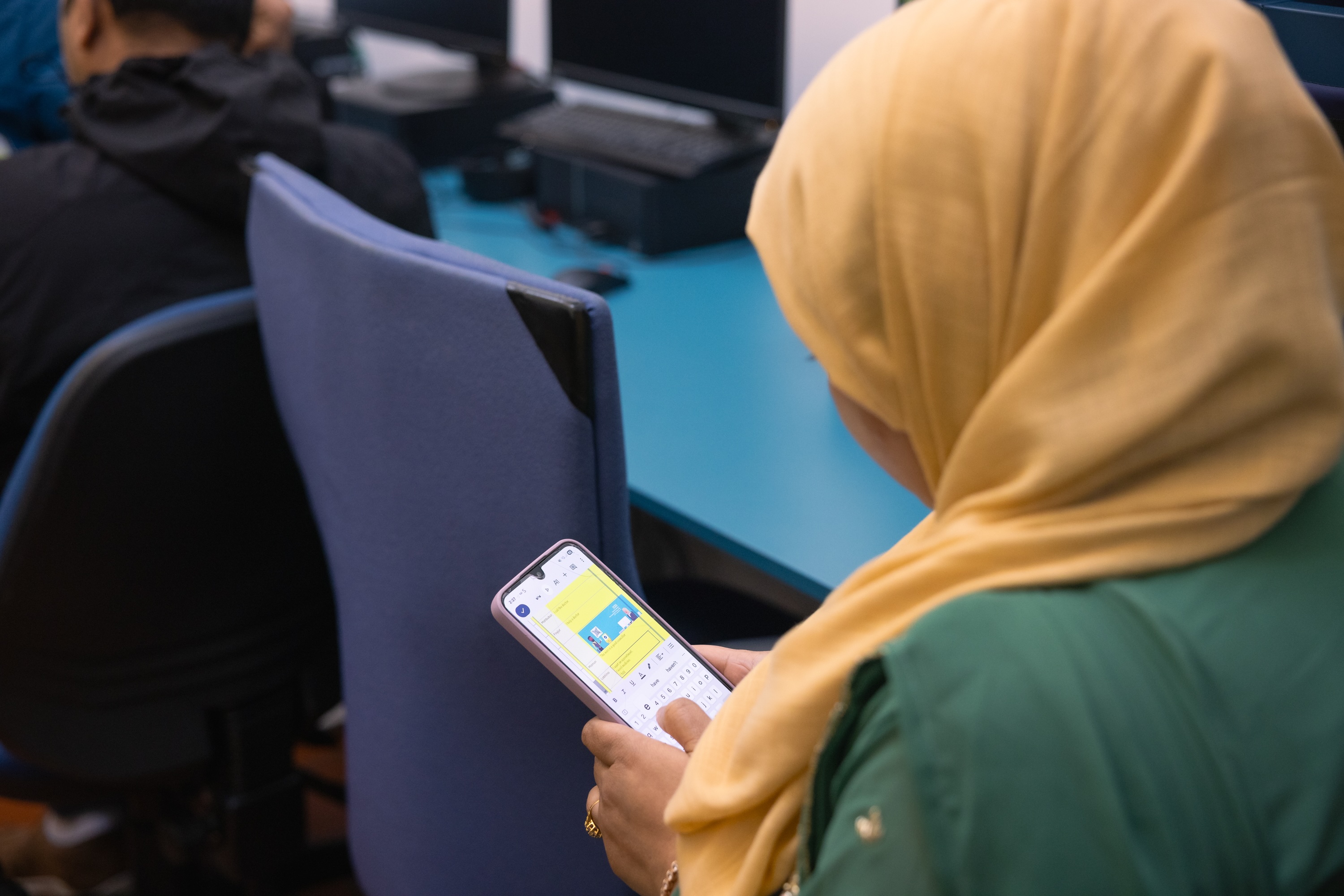
In Mahbubur’s English class, the minister watches as the group use a QR code to practise their language skills.
His classmate Nicoleta, who is from Romania but has lived in England for more than a decade, says she hopes to work in computers one day. “I want to do something for my life and my future,” she says.
This should also boost the economy, by giving people the skills to secure good jobs and become more valuable contributors to the country.
Advertising helps fund Big Issue’s mission to end poverty
In Mahbubur and Nicoleta’s class, they learn digital skills as well as language skills. Image: Alecsandra Dragoi/ DSIT
The skills Nicoleta has learnt in the class will help her on the way, as well as supporting her with the digital skills she needs in everyday life. “I can apply for jobs online, or book an appointment at the GP, for example, because I understand,” Nicoleta says.
The Bromley by Bow Centre has directly supported more than 5,000 people in the past year, with an estimated 16,900 people across East London indirectly benefiting from the centre’s support, such as families and households.
“Maybe in the future, I’ll work here,” Nicoleta says, gesturing to the Bromley by Bow Centre. “I’m sociable. I have passion. Maybe in the future, but I need to learn.”
A fellow guest at the community centre, Golam, explains how he benefits from a project which helps him cope with the high cost of living while improving his digital skills at the same time.
“I find it really comfortable to come to this hub so I can learn how I can reduce my high gas and electric bills. I have learnt ways to keep my bills cheaper. We’re learning from our own community ways to get help and what help is available,” Golam says.
Other projects which will benefit from the government’s funding include a project run by Age UK which will help thousands of older people to learn how to use the NHS app. Sheffield United’s Community Foundation will trial using e-sports video gaming to help 400 young people build digital skills.
Advertising helps fund Big Issue’s mission to end poverty
There is also funding for two projects which will support people facing homelessness, including Homelessness Action Resource Project (HARP) and the University of Sussex’s EmpowerNet project, which will support at least 200 adults experiencing homelessness and housing insecurity in West Sussex.
Portions of the fund have also been allocated to the devolved governments in Scotland (£764,020), Wales (£400,368) and Northern Ireland (£267,249).
What the minister for digital inclusion had to say about the government’s plans
After visiting the Bromley by Bow Centre’s workshops, Liz Lloyd spoke to the Big Issue about the next steps to expand digital inclusion.
Why are community spaces like this important for the government’s plans for digital inclusion?
I think what I’ve seen today is that digital teaching or learning digital skills isn’t just a technical thing. It’s also about confidence. It’s about trust. And in community spaces like this, you can interact with teachers or mentors or community prescribers, or a vast range of people here who are trusted to convey accurate information. And the second thing is, you can combine it with the actual life skills that you need.
At a time when the government plans to roll out digital IDs, there have been fears that people who don’t have a smartphone will be left behind, including people facing homelessness. What plans are in place to support people facing homelessness to access digital skills?
Advertising helps fund Big Issue’s mission to end poverty
All across the government, we’re thinking about what particular barriers people will face. So if they’re older, if they have other accessibility needs, or if they’re homeless, there are different reasons why getting online might be hard. It could be around access to devices, and there are both community and other schemes they can get devices out. It could be access to data. There are data banks available, and there were pledges made as part of the digital inclusion action plan to provide data to those. Or it could just be about confidence.
Liz Lloyd in a workshop helping people cover their energy bills and other cost of living issues. Image: Alecsandra Dragoi/ DSIT
How will the government navigate digital inclusion at a time when it is changing so rapidly amid the rise in AI? How can people hope to be digitally literate when it is changing so quickly?
It’s about building blocks. This digital inclusion fund will meet people where they are. It may be about the very first steps. On the AI side, we’re doing various things. We’ve got a huge programme with businesses to upskill 7.5 million people who are in the workforce to enable them to take advantage of AI, and transform their skills so they can be more productive for themselves and the businesses they work in.
Online scammers are becoming increasingly intelligent. Some people are understandably concerned about the threat of the online world, particularly if they’re not digitally literate. Are there plans to address this?
It’s sensible to be thoughtful about your online safety from a scam and fraud perspective and a disinformation perspective. We’re bringing in the cyber security and resilience bill. We’ve also written to the FTSE 350 – the biggest firms – setting out things that their management should be doing to keep their businesses safe. And we’ve got a package that small businesses can access with what they need to do.
A pensioner struggling to afford heating bills, or a single mum struggling to put food on the table might ask why they should care about digital inclusion. What would you say to them?
Advertising helps fund Big Issue’s mission to end poverty
Well, I mean, there is some research that you can get some deals if you access online offers. That’s one reason why it’s a good idea. Second, if you access your account and information and know more about it, you can reduce your energy consumption, your water consumption, and you can become more in control of your spending and reduce your bills.
How do you plan to address the fact that people might just not want to go into the digital world?
There is lots of opportunity out there. It’s taking it step by step. We see here in the centre, you have trusted people who can help dispel some of the fears and help people stay safe online. And people learn from each other. It’s word of mouth. You build that trust.
There are certain groups of people who face significant barriers to navigating the digital world – one of those groups is asylum seekers. Another is prison leavers. What is the government doing for these groups of people who have traditionally faced barriers to the digital world?
They’re perhaps slightly different sort of groups. I mean for prison leavers, there are many areas of support, but I think just going back to the start, you have to take each group where they are and have a look at what the barriers are and what can be done to support them.
Advertising helps fund Big Issue’s mission to end poverty
Change a vendor’s life this Christmas.
Buy from your local Big Issue vendor every week – or support online with a vendor support kit or a subscription – and help people work their way out of poverty with dignity.
Advertising helps fund Big Issue’s mission to end poverty