Advertising helps fund Big Issue’s mission to end poverty
Opinion

What next for Palestine Action? High Court judgment is important victory for the right to protest

At Liberty, we believe the proscription of Palestine Action was an overreach by the government. The High Court agrees

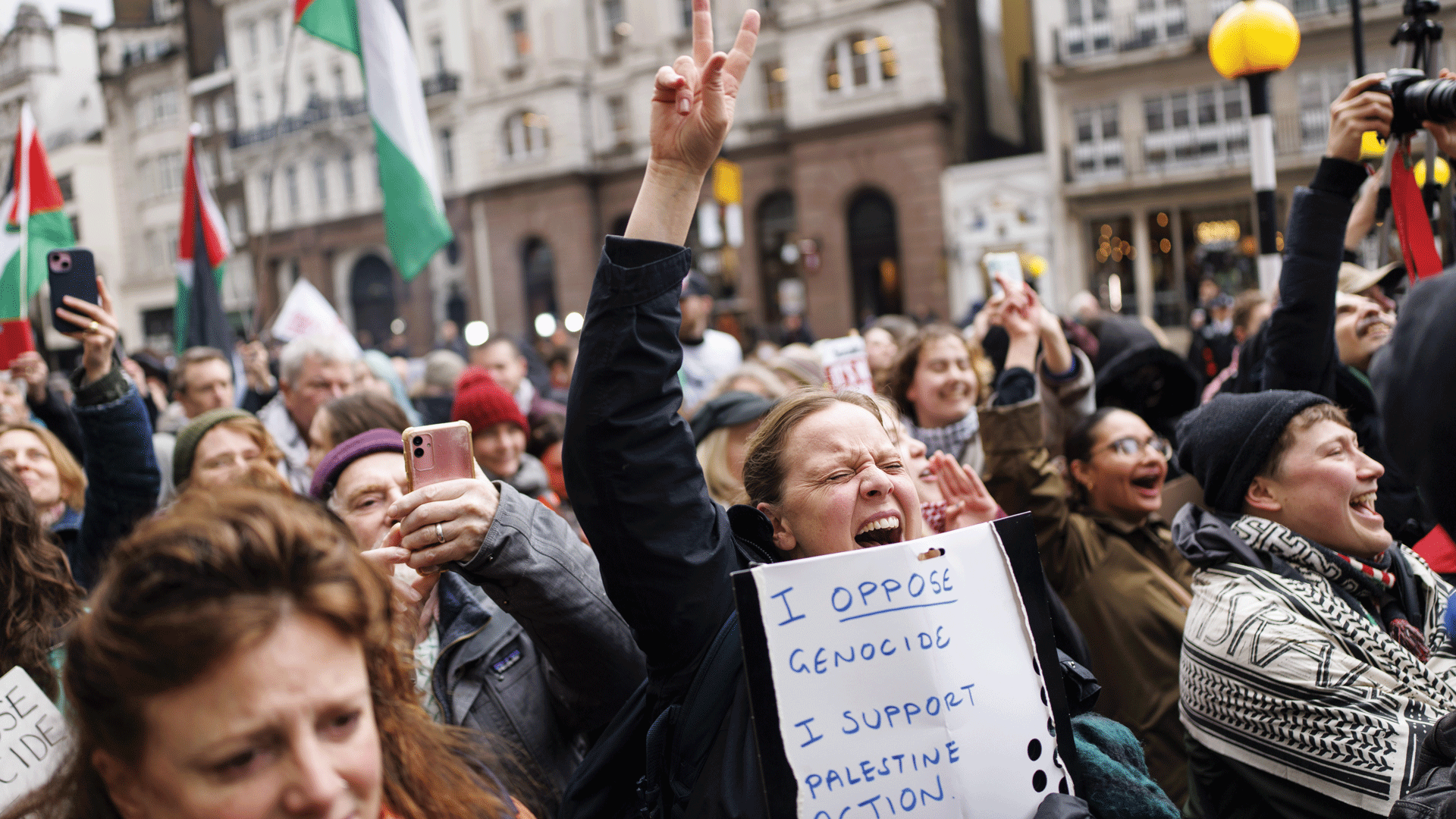
Palestine Action supports at the Royal Courts of Justice

Supporters of Palestine Action at the Royal Courts of Justice in February. Image: Shutterstock

Three weeks ago, the High Court ruled that the proscription of Palestine Action was unlawful. The judgment provides helpful insight into some of the thornier issues posed by how proscription – and the counter-terror regime more widely – currently operates.

What the judgment didn’t say is also revealing: it was accepted that three of Palestine Action’s activities met the statutory threshold for terrorism (a low bar) but that this was not enough to warrant the rights-restrictive power of proscription, given 99% of their actions did not meet the definition of terrorism.

While the judgment is an important victory (for now, government intends to appeal), the court did not specify what proportion of technically terrorist actions would justify the use of counter-terror powers.

The relevant part of the definition in the Terrorism Act 2000 covers an act (or threat of an act) involving serious damage to property, designed to influence a government to advance a political, religious, racial or ideological cause.

This potentially captures a huge range of activities, from toppling the Colston statue at a Black Lives Matter protest to filling US bomber engines with nuts and bolts at RAF Fairford to protest the Iraq War. Crucially, these types of protest or direct action have (rightly) never been treated as terrorism in the UK, despite potentially being technically terrorist under the statutory definition.

The definition of terrorism is intentionally broad. It was designed to capture more behaviour than terrorism alone. That overbreadth was presented to parliamentarians as acceptable because ministers, police and prosecutors had exercised their discretion well in the past.

Advertising helps fund Big Issue’s mission to end poverty

If they did not in future, the new Human Rights Act 1998 would provide a safeguard. During the Terrorism Bill’s second reading in 1999, then-home secretary Jack Straw assured parliament that the Human Rights Act would offer “powerful control” over the use of these powers. The High Court has now done exactly what he promised it would.

The court made three key findings. First, the home secretary did not follow her own policy, the purpose of which is that “not all organisations that meet the concerned in terrorism requirement should be proscribed”. This is critical in the context of the definition’s being too broad; considering a vast amount of activity potentially falls under the definition, the home secretary needs to choose when to target something as terrorism.

Second, proscription significantly interfered with rights to freedom of expression and association by restricting peaceful protest carried out under the Palestine Action banner. Third, of hundreds of activities, only three met the terrorism definition and had “not yet reached the level, scale and persistence” required to justify proscription and its “very significant interference” with Convention rights, particularly when ordinary criminal law was available.

The court therefore found the decision disproportionate and unlawful, breaching Articles 10 and 11. Importantly, it held that the home secretary had not articulated any need to proscribe beyond asserting that the group was concerned in terrorism.

The judgment is a vital check on government overreach. It remains unclear when property-focused direct-action falls outside the terrorism definition, and at what point counter-terror powers become proportionate.

Read more:

We want to see these lines clarified by amending the definition of terrorism, so it only catches the kinds of actions and behaviour it actually seeks to target by specifying what kind of property damage amounts to terrorism: when it creates a serious risk to life, national security, or the health and safety of the public or a section of the public, or when it uses arson, explosives, or firearms.

This would enable current and future governments to uphold their duty to safeguard the public and national security; while protecting peoples’ rights and preventing the kind of overreach we saw with Palestine Action.

Victoria Tecca is policy and campaigns officer at Liberty

Do you have a story to tell or opinions to share about this? Get in touch and tell us more

Change a vendor’s life this winter.

Buy from your local Big Issue vendor every week – and always take the magazine. It’s how vendors earn with dignity and how we fund our work to end poverty.

You can also support online with a vendor support kit or a magazine subscription. Thank you for standing with Big Issue vendors.

Advertising helps fund Big Issue’s mission to end poverty

HELP VENDORS KEEP WORKING THROUGH THE COLD

For £36.99, help a vendor stay warm, earn an extra £520, and build a better future.
Grant, vendor

Recommended for you

View all
Council tax hikes won't improve services or pay workers better. But I have an idea
Paul McNamee

Council tax hikes won't improve services or pay workers better. But I have an idea

What Spain's migration decision means for the UK
A Spanish flag flying in the street.
Dr Allan Njanji

What Spain's migration decision means for the UK

Mike Soutar: Employers are sitting on their hands when it comes to hiring. How can we change that?
Big Issue ambassador Mike Soutar.
Mike Soutar

Mike Soutar: Employers are sitting on their hands when it comes to hiring. How can we change that?

A new kind of politics is coming our way
John Bird

A new kind of politics is coming our way