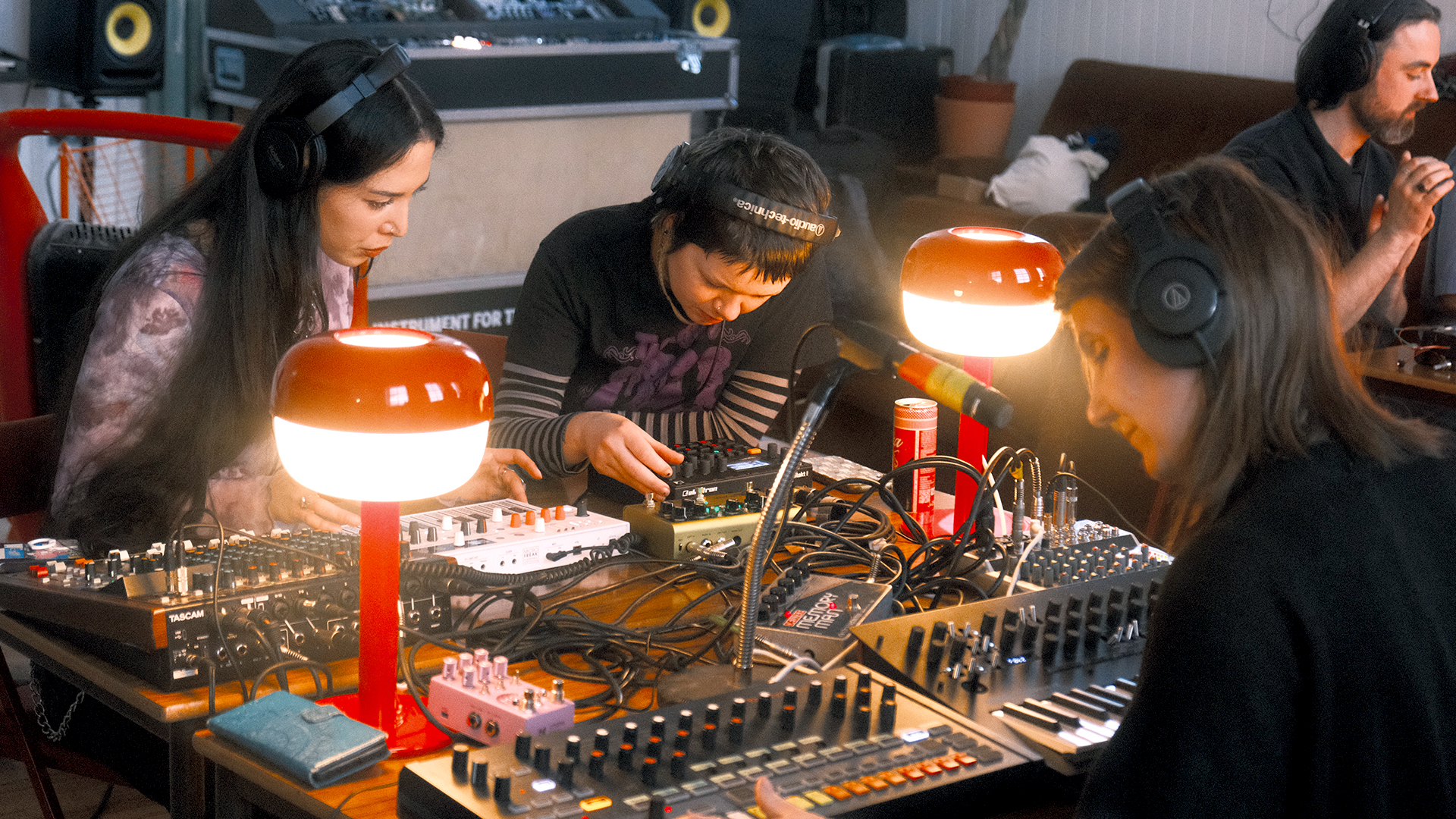
“It’s always a complete cacophony at first,” Cook says, grinning. “Everyone’s out of tune and the volume is jumping all over the place.” But gradually participants discover how intuitive these blipping, burbling machines can be, with a bit of trial-and-error knob twiddling. “Suddenly you have this group of people all listening to each other and collaborating,” says Cook. “It’s honestly magical.”
Read more:
Situated in a former Victorian primary school in Glasgow’s Gorbals, GLOSS on the face of it shares little in common with a library. Instead of shelves of books, the room is lined with strange and wonderful electronic instruments: Moog Grandmothers, Korg MS‑20s, an Elektron Digitakt II sampler and a Roland TR‑808 drum machine (the rhythm box synonymous with early hip‑hop and acid house).
Keep reading the journalism that powers our mission
Register free to continue and learn more about the stories, campaigns and the support we provide, helping people facing poverty across the UK.
For now, visitors can’t take equipment home, though GLOSS hopes to introduce lending. You’re unlikely to be shushed for making too much noise. Yet as Cook explains, the philosophy at GLOSS – a non‑profit supported by arts funding grants and subscriptions – is deeply rooted in the ethos of traditional book-lending repositories.
“We consciously picked that name,” he says. “There’s something utopian about a library. It’s a public good that offers people things on a very equal footing.”
Lewis and Suzi are best known as the cosmic electronic pop duo Free Love (formerly Happy Meals).
During the Covid‑19 pandemic, the pair began searching for new ways to stay creative and collaborative.
Advertising helps fund Big Issue’s mission to end poverty
“It originally started during lockdown as an online series of workshops called ITEM – Introduction to Electronic Music,” Cook explains.
Participants joined remotely from around the world for weekly sessions covering different aspects of electronic music‑making. As restrictions eased, the project moved offline with its first in‑person workshop at La Chunky Studio in Finnieston, supported by Creative Scotland and music tech company Ableton. The Cooks began developing the idea into a permanent facility.
In the early stages, the collection was modest. Then a serendipitous opportunity arose through Glasgow artist Scott Myles, who was building Instrument for the People of Glasgow – an installation composed of massed synthesiser modules donated by international organisations. After showing at GoMA, the completed machine was eventually given to GLOSS and now forms the centrepiece of the collection.
They moved into their bricks-and-mortar premises in January 2025. To date they have delivered more than 100 editions of their free ITEM workshops. Users of the library come from across the musical spectrum. Some are experienced, practising musicians; many are simply synth-curious absolute beginners.
In an era increasingly shaped by AI, Cook believes spaces like GLOSS can be an antidote and “the future of music”. The founders hope their community will continue to grow – alongside the library’s collection. Because when it comes to synthesisers, to borrow from synth‑pop giants Depeche Mode, they just can’t get enough. “If any readers are prepared to donate anything interesting,” Cook says, “we’re listening.”
Do you have a story to tell or opinions to share about this? Get in touch and tell us more.
Advertising helps fund Big Issue’s mission to end poverty
Change a vendor’s life.
Buy from your local Big Issue vendor every week – and always take the magazine. It’s how vendors earn with dignity and move forward.
You can also support online:
Subscribe to the magazine or support our work with a monthly gift. Your support helps vendors earn, learn and thrive while strengthening our frontline services.
Thank you for standing with Big Issue vendors.