Advertising helps fund Big Issue’s mission to end poverty
Opinion

Thousands of people face modern slavery in the UK. Why do we hear so few of their stories?

There is a crisis of exploitation unfolding in homes, on the streets, in local businesses, and across the care sector, writes Dr Lewis Njabulo Sibanda, a lecturer in law at The Open University

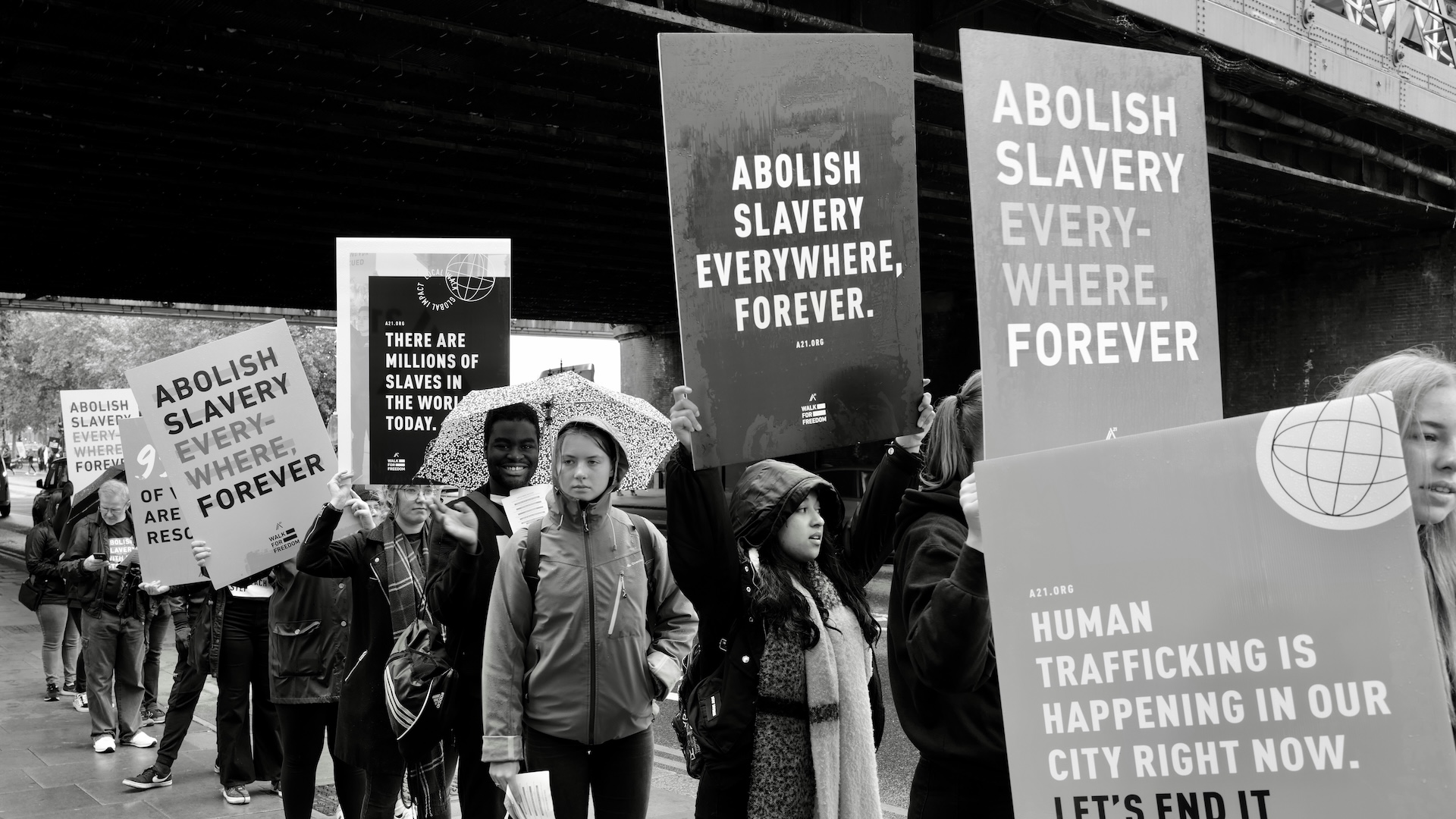
People protesting against modern slavery.

People protesting against modern slavery. Image: Unsplash

Every so often the media spotlights high-profile cases of modern slavery that briefly shock the public conscience before unfortunately fading from view. There was recently the sentencing of a UN judge to six years and four months for forcing a young woman to perform domestic labour, as well as the recognition of a woman abused by Mohammed Al Fayed as a victim of modern slavery.

These cases appear as random instances of extreme abuse by individual bad apples, and they can be addressed through tougher policing and criminal prosecution. However, this obscures a much wider crisis of exploitation unfolding in homes, on the streets, in local businesses, and across the care sector. While policing plays an important role in treating harm that has already occurred, it does little to address the conditions that make people vulnerable to exploitation in the first place. This results in treating the symptoms of the problem, while allowing the underlying causes to persist.

This can potentially explain why modern slavery cases continue to rise in the UK, despite the adoption of the Modern Slavery Act more than a decade ago. The act consolidated various offences relating to exploitation such as slavery, forced labour, servitude and human trafficking. This was widely praised as sending a clear message to traffickers that the UK was not the place to trade in human lives. Rather than deterring exploitation, the legislation has operated within a social and economic environment that continues to produce vulnerability.

Read more:

Evidence of this can be seen in the increasing number of identified cases. The National Referral Mechanism (NRM), which is the UK’s framework for identifying potential victims of modern slavery, reported a 22% increase of referrals in 2025. The number rose to 23,411 cases compared 19,117 the previous year. While the Home Office attributes this rise partly to increased awareness and a possible growth in exploitation, it admits that the main driver remains unclear.

A more persuasive explanation is offered by the Independent Anti-Slavery Commissioner, who warns of a growing pipeline of vulnerability that traffickers are able to exploit. Vulnerability in the context of modern slavery refers to the personal, situational and contextual characteristics that make individuals more susceptible to exploitation. Some common factors known to drive vulnerability to modern slavery include poverty, unemployment, homelessness, insecure immigration status, and disability. By limiting people’s options and reducing their ability to resist coercion, these conditions can leave individuals increasingly exposed to abuse and exploitation.

Advertising helps fund Big Issue’s mission to end poverty

The 2026 report by the Group of Experts on Action against Trafficking in Human Beings (GRETA) highlights a disconnect between the international legal framework and the approach adopted by the MSA 2015 in relation to vulnerability. The idea of an ‘abuse of a position of vulnerability’ is central to how trafficking is understood under international law, as it is one of the means by which trafficking acts are committed. More importantly, the international legal framework adopts a broad understanding of abuse of vulnerability including any situation in which a person has no real and acceptable alternative but to submit to the abuse involved.

Similarly, decisions of the European Court of Human Rights have recognised the occurrence of human trafficking through subtle forms of coercion such as the abuse of economic and social vulnerability. By contrast, the MSA 2015 adopts a narrower approach, limiting the relevant ‘means’ to situations involving force, threats, or deception, or where the victim is a child, mentally or physically impaired, or connected to the perpetrator through a familial relationship. In practice, courts often consider the abuse of vulnerability as an aggravating factor as opposed to a defining feature of modern slavery.

This approach fails to reflect the lived realities of modern slavery in the UK, where multiple forms of vulnerabilities intersect to heighten exploitation. Economic pressures linked to the rising cost of living, high youth unemployment, and a hostile immigration environment intersect to push those with limited choices into insecure and exploitative work. There is an urgent need to align the UK’s legal definition of human trafficking with international standards, particularly by recognising the central role that vulnerability plays in enabling exploitation. This might go some way to cutting off the pipeline that is currently able to source situations of modern slavery in the UK.

Dr Lewis Njabulo Sibanda is a lecturer in law at The Open University.

Do you have a story to tell or opinions to share about this? Get in touch and tell us more

Change a vendor’s life.

Buy from your local Big Issue vendor every week – and always take the magazine. It’s how vendors earn with dignity and move forward.

You can also support online:
Subscribe to the magazine or support our work with a monthly gift. Your support helps vendors earn, learn and thrive while strengthening our frontline services.

Thank you for standing with Big Issue vendors.

Advertising helps fund Big Issue’s mission to end poverty

Do you know how Big Issue 'really' works?

Watch this simple explanation.

Recommended for you

View all
My son lost his life doing the right thing. Now I'm fighting for a better future for young people
Dr Mark Prince
Mark Prince

My son lost his life doing the right thing. Now I'm fighting for a better future for young people

Poverty is a growth industry. Starmer has not seemed to grasp this nettle
Prime minister Keir Starmer
John Bird

Poverty is a growth industry. Starmer has not seemed to grasp this nettle

Who can afford to work in television?
The cast of This Is England 90
Professor Beth Johnson

Who can afford to work in television?

Tackling violence against women and girls means dismantling the systems that enable it
A women's rights protest sign
Hannah Bond and Taahra Ghazi

Tackling violence against women and girls means dismantling the systems that enable it