Inside the lab where new homes are tested to see if they can stand the heat
The University of Salford’s Energy House 2.0 is the place where new homes are blasted with extreme heat and cold to see how they can deal with the changing climate. Big Issue went for a look around
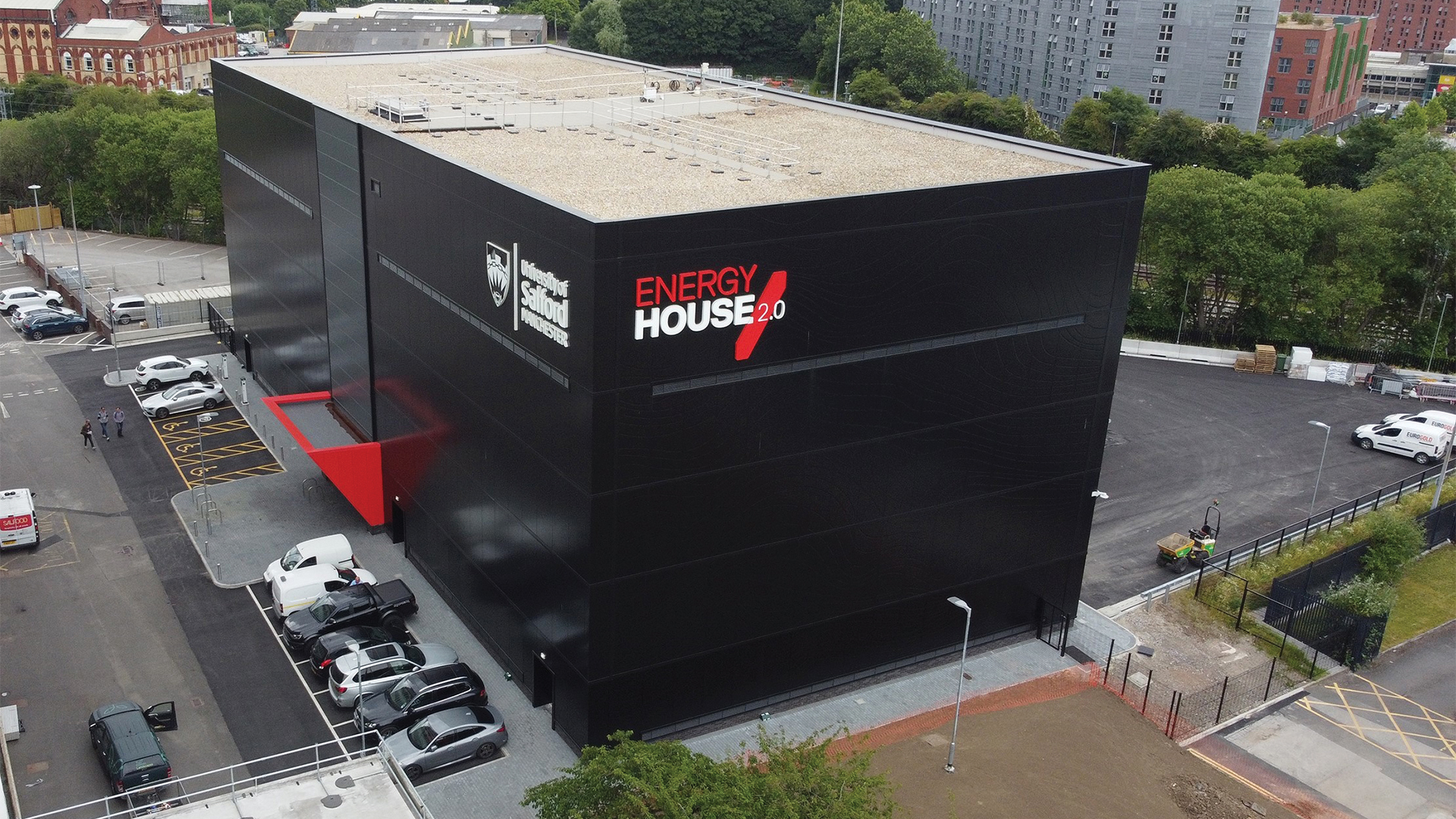
Energy House 2.0 in Salford. Image: Unversity of Salford
Share
It’s 33°C in sweaty Salford at the peak of June’s heatwave when Big Issue arrives at Energy House 2.0. The towering black structure sticks out among the University of Salford’s more traditional buildings. If you pass by on a Bee Network bus, you’d probably have no idea that the lab is playing a crucial role in future-proofing Britain’s homes.
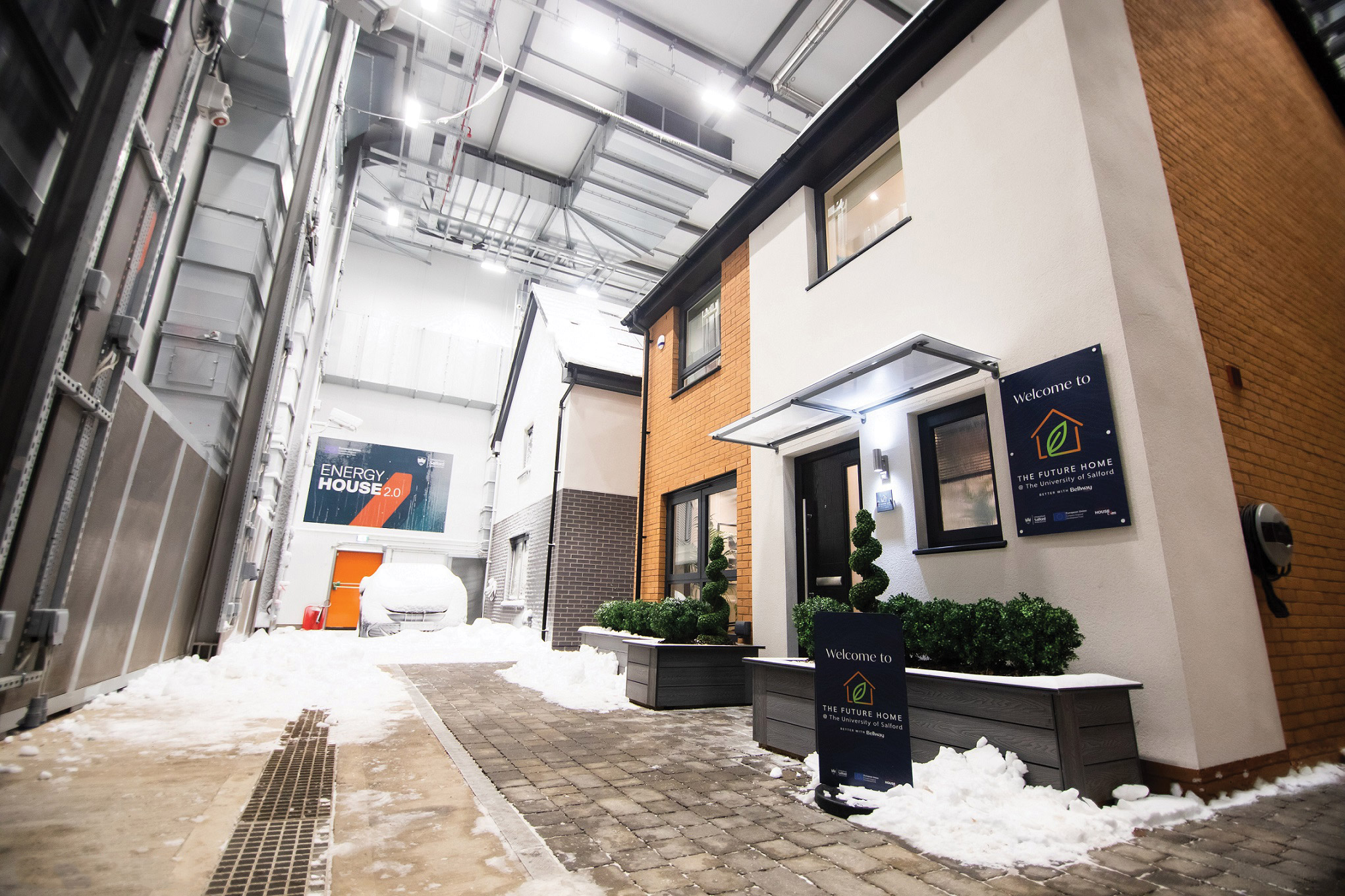
Energy House 2.0 consists of two giant environmental chambers. In one of them sits two three-bedroom, detached homes, built by Bellway, Barratt Redrow and Saint-Gobain, much like you’d see on newbuild housing estates around the country.
The difference is these homes are a testbed for technology to improve energy efficiency in new homes and make them more liveable in a changing climate. That means blasting them with wind, rain, snow and solar radiation with temperatures in the environmental chambers able to go as low as -23.5°C or as high as 51°C. Big Issue is told the chambers can simulate most habitable places on earth and work is under way to emulate some of the hotter parts of the Middle East.
But, as temperatures soar outside, we’ll take something a tad cooler for our tour. Unfortunately for us, the current tests at Energy House 2.0 are focused on hot weather so when we step into the chamber it’s 33°C, just like outside. Going inside the houses is a different story. Walk through the door and you’re met with an instant cool sensation. It’s pleasant.
The houses are decorated and fully furnished. But they are packed with testing equipment – foil covered globe sensors and air sensors – and technological innovations. Reverse heat pumps are mostly responsible for the cooler temperatures. The experts at Energy House 2.0 are currently working out what to do about condensation on the pipes feeding cold water around the building – for now, small Tupperware containers are catching the dripping water.
There are infrared radiators in the property, even on the ceiling. The fan-coil units are bigger than in the average home to incorporate the heat pump’s cooling properties.
Advertising helps fund Big Issue’s mission to end poverty
Advertising helps fund Big Issue’s mission to end poverty
Ljubomir Jankovic, professor of energy and buildings at Energy House 2.0, is our tour guide. He demonstrates how Energy House 2.0 has turbocharged the housebuilding sector’s ability to prepare for extreme weather. Lessons on how to ventilate homes, address heat absorption and incorporate clean energy all come from these chambers.
“This is all very useful learning because we now know that when temperatures outside become really very high, we can have homes that have heat pumps and we can reverse these heat pumps,” Professor Jankovic says.
“We will need some additional work invested into the heating system to make it suitable for cooling. But the underlying function is there and we can use that in the future to help the nation deal with these kinds of temperatures.”
Continue reading for free
Registration is free and takes less than 30 seconds.
Our supporters make Big Issue’s work possible. Join us to see the impact we’re having together and discover more ways to help people facing poverty access income, opportunity and support.
Energy House 2.0 opened its doors in January 2023. The £16 million development was funded by a European Regional Development Fund grant and saw 150 small and medium-sized enterprises (SMEs) from across Greater Manchester contribute. Since then, refugee tents, homeless shelters, a house partly built out of graphene and a modular home are among the other dwellings tested at the site. People have even spent the night in the homes to test them out.
The work has been vital to inform the government’s Future Homes Standard, unveiled in March and coming into force next year. The new building regulations aim to slash the carbon output of new homes by up to 80%, making solar panels a mandatory fixture and introducing cleaner heating in the race to net zero.
Advertising helps fund Big Issue’s mission to end poverty
“We sit on the Future Homes Standard group and we also collaborate with industry,” says Professor Jankovic. “For example, our research builds straight into both Bellway and Barratt Redrow’s construction processes. So when they construct new houses, learning from here is taken straight into there. As climate change evolves, building regulations need to evolve as well, and we are providing evidence to help with that process.”
Jamie Bursnell, head of technical and innovation for Bellway, added: “The Future Homes Standard building regulations are the most significant change for the industry, and we have led the way through this research to understand how our homes perform with low-carbon technology.
“The research shows that new build homes can provide low-carbon, low-running-cost heating without the need to pay for expensive retrofitting of secondhand homes, which can run into tens of thousands of pounds. This means new homes built to Future Home Standards will have a vital role to play in reducing the UK’s carbon footprint as the grid moves to net zero.
“Thanks to our partnership with The University of Salford, Bellway has already begun installing air source heat pumps to this optimum specification, meaning people living in our homes can reduce their carbon footprint while saving money.”
Energy House 2.0 can test extreme heat and cold, including simulating how new homes will fare in the snow. Image: University of Salford
Two more homes are set to be built in the other environmental chamber later this year, once an experiment to test the merits of hempcrete – a carbon-negative bio-composite mix between hemp and lime – has ended. The two ‘new’ homes will be recreations of properties built in the 1930s and 1980s in recognition that retrofit will be the reality for most people not living in a newbuild.
According to the UK Green Building Council, 80% of the homes that will exist in 2050 are already built, meaning that 29 million homes will need to be retrofitted in the next quarter of a century.
Advertising helps fund Big Issue’s mission to end poverty
Many of the innovations tested in Energy House 2.0 will be filtering out into homes around the country. For Professor Jankovic, it is a source of pride.
“It’s impressive. It’s a pinch-yourself moment every day you come to work,” he tells Big Issue. “It is an amazing facility. We had -20°C temperatures here not long time ago – everything was frozen, you couldn’t see through the windows.
“We have a very nice team. There’s about 24 of us, and we are all friends. We pull in the same direction. We love what we are doing, so it’s great to work here.”
As he talks about the size-able task of retrofitting existing homes, there is clearly a feeling of duty in the work that goes on in Salford. Professor Jankovic adds: “I think we have a unique position now to be able to contribute to the learning and wellbeing of the nation.”
As Big Issue steps out of Energy House 2.0 and back into Salford’s sweltering sun, there’s plenty to sweat about: whether it be the current temperature or whether homes can stand the heat. But it’s the sweat and toil at Energy House 2.0 that will be key to making future heatwaves that bit more bearable, slashing energy bills and giving us a shot at saving the planet.