What the eviction of 87-year-old Maricarmen in Spain teaches us about the meaning of home in 2026
There has been outrage and protests in Spain following the eviction of Maricarmen. If financial capital can cross borders to buy our homes, tenants can cross borders to defend them, writes Sindicato de Inquilinas e Inquilinos de Madrid's Pablo Pérez
by: Pablo Pérez
27 Sep 2026
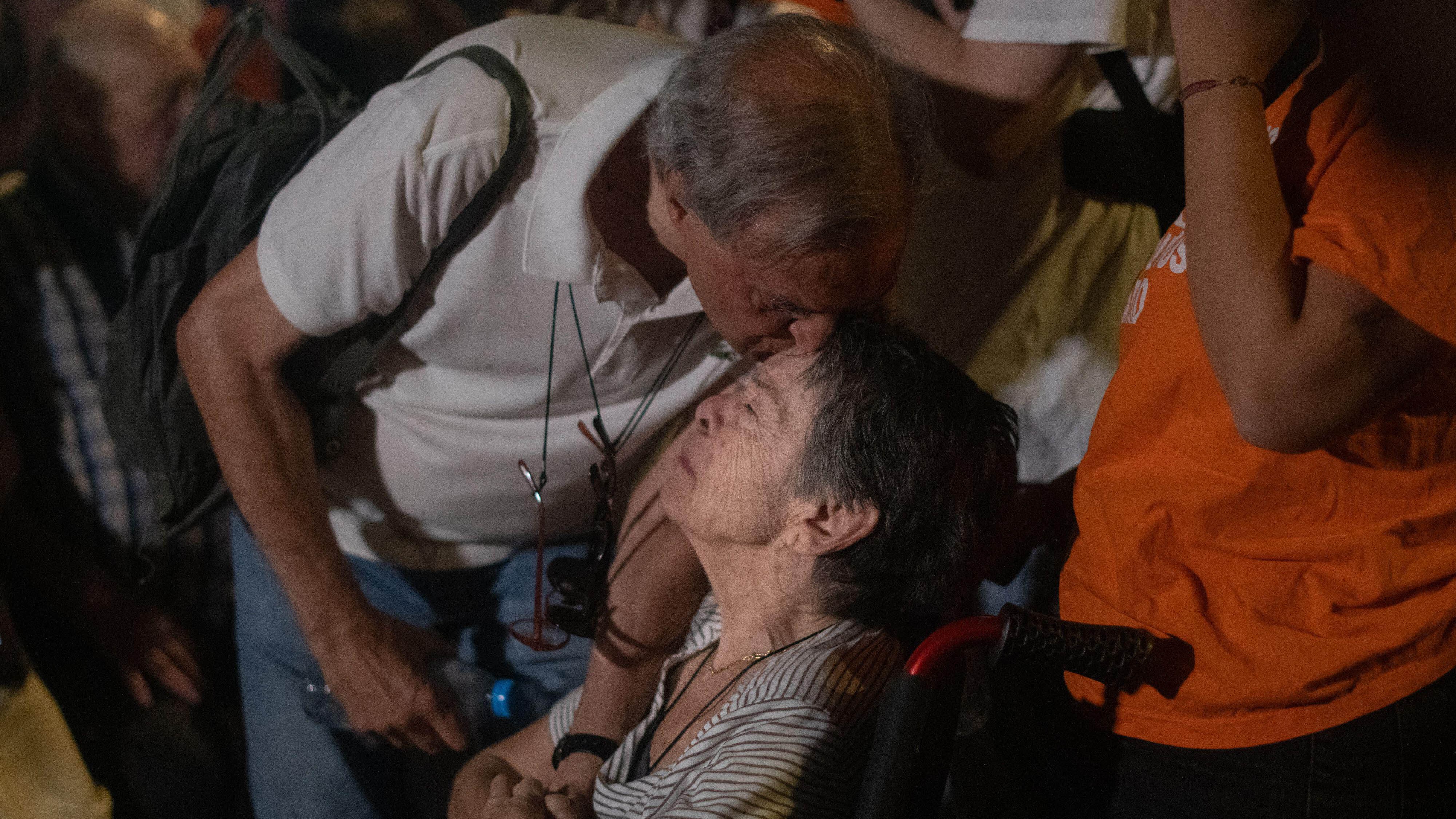
Maricarmen is supported by dozens of people during a rally under the slogan 'Maricarmen is staying', on 22 September in Madrid. Image: Associated Press / Alamy Stock Photo
Share
This week, two very different gatherings have taken place in Madrid.
At the IFEMA convention centre, The District brought together thousands of executives, investors and real-estate companies to discuss what its own organisers describe as “deal-making and investment opportunities”. Blackstone, Brookfield and other major international investors were among the firms represented at an event built around the premise that cities, buildings and homes are assets through which capital can generate returns.
Across the city, another gathering is beginning. From 24 to 27 September, around 70 tenants’ unions, housing organisations and social movements from 24 countries are meeting for El Barrio (The Neighbourhood), a summit of housing movements organised in opposition to that logic.
The contrast could hardly be clearer. They meet to discuss how to invest in our cities. We meet to discuss how to live in them.
And between these two visions of Madrid lies the story of Maricarmen.
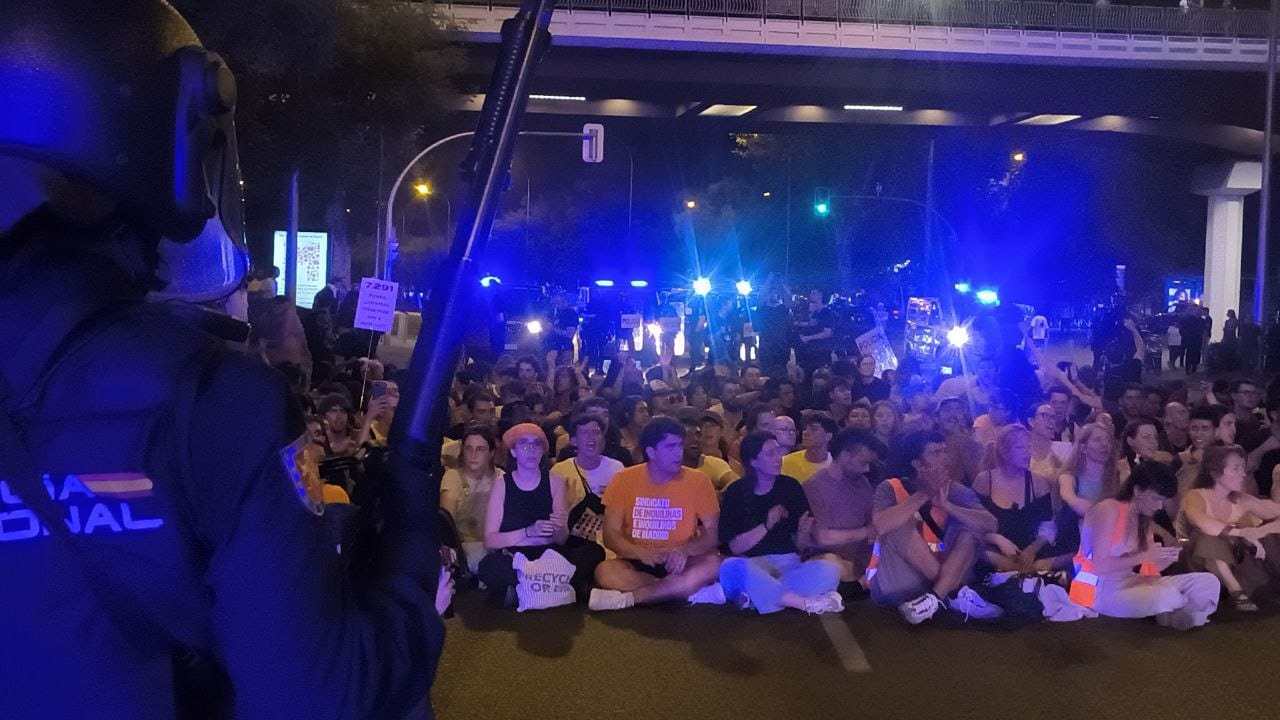
On 23 September, Maricarmen Abascal, an 87-year-old woman, was evicted from her home in Madrid’s Retiro district where she had lived for around 70 years. It was the fourth attempt to evict her, and hundreds of people gathered outside her building to try to stop it. She was eventually evicted by the police on a stretcher.
Advertising helps fund Big Issue’s mission to end poverty
Advertising helps fund Big Issue’s mission to end poverty
This was not the inevitable consequence of some natural shortage of housing. It was the result of political choices, property relations and a housing system in which the right of an investor to obtain a greater return can prevail over a person’s ability to remain in the home where she has spent her entire adult life.
Maricarmen’s eviction has sparked protests in Madrid. Image: Sindicato de Inquilinas e Inquilinos de Madrid
Maricarmen had been paying around €500 (£430) a month. After investment fund Urbagestion purchased the property, they offered her a new rent of roughly €2,000 (£1,720) a month — way over her monthly pension of €1,300 (£1,118). This is because Spanish tenant law allows landlords to raise the rent or evict tenants for no fault after their lease expires (which is usually after five to seven years, depending on the lease).
Even the UN Committee on Economic, Social and Cultural Rights had requested interim measures calling on Spain to suspend the eviction or ensure an adequate housing alternative while it examined her case. After the eviction took place, the UN Special Rapporteur on the right to adequate housing argued that it should have been suspended to prevent irreparable harm.
Keep reading the journalism that powers our mission
Register free to continue and learn more about the stories, campaigns and the support we provide, helping people facing poverty across the UK.
Maricarmen’s case is extreme. But the forces behind it are not exceptional. Across Madrid, tenants encounter those same forces in different forms: rent increases that push households out of their neighbourhoods; temporary contracts that turn permanent insecurity into a business model; tourist apartments, coliving and flex-living developments that extract ever more value from residential space; buildings bought with tenants still living inside them; and homes treated primarily according according to the returns they can produce.
This is precisely why The District matters. The housing crisis is often described as though it were a technical malfunction: not enough supply, too much demand, insufficient construction. But for much of the real-estate industry, soaring land values, rising rents and the expansion of new housing “asset classes” are not signs that the system is malfunctioning. They are investment opportunities.
The same housing market can therefore produce two completely different experiences. For an investment fund, a neighbourhood experiencing rapidly increasing rents may represent an attractive market. For a tenant, it may mean having to leave the street where her children grew up. For investors, housing can be an asset class. For us, it is home.
Advertising helps fund Big Issue’s mission to end poverty
This is also why the failure in Maricarmen’s case cannot simply be attributed to one landlord. Public institutions failed her too. The Madrid regional government and Madrid City Council failed to secure an adequate solution that allowed an 87-year-old woman to remain rooted in her community. The contrast is particularly difficult to ignore when the president of the Madrid regional government recently spent €6.3 million (£5.4 million) in public money purchasing a luxury penthouse — an acquisition that has itself become the subject of intense political controversy.
But responsibility does not stop at Madrid’s regional government. Spain’s central government has repeatedly promised that this would be the legislature in which the housing crisis would finally be confronted, yet measures capable of providing greater protection to vulnerable tenants have become trapped in parliamentary negotiations. Ministers themselves acknowledged after Maricarmen’s eviction that provisions contained in a stalled housing decree could have allowed her eviction to be suspended.
For a tenant facing eviction, institutional explanations about jurisdiction, parliamentary arithmetic or administrative competences offer very little comfort. A housing system should ultimately be judged by what happens when somebody is about to lose their home. Maricarmen tells us that the current one has failed that test. And that is why El Barrio is not simply a protest against The District. We want to build the organisation capable of confronting the power represented inside it all year round.
Capital already operates internationally. The same investors buy housing in Madrid, Berlin, London, Dublin, Los Angeles and Barcelona. Investment strategies cross borders effortlessly. So must tenant and housing organising. El Barrio brings together organisations from Europe, the United States, Latin America and elsewhere to exchange organising strategies, strengthen tenants’ unions and develop forms of coordinated action. Our objective is not simply to describe the housing crisis together. It is to build the collective power necessary to change it.
And our demands are concrete.
Rents must come down. Effective rent regulation must prevent landlords from extracting an ever-growing share of household incomes.
Advertising helps fund Big Issue’s mission to end poverty
Tenants need permanent contracts and residential stability. A home cannot provide security when remaining in it depends upon repeatedly surviving new contracts, price increases and renewal negotiations.
Tenants must have the right and organisational capacity to take collective action, including rent strikes. When thousands of people confront the same landlord practices individually, landlords hold the power. When tenants organise collectively, that balance begins to change.
And housing policy must move beyond the assumption that simply building more market housing will solve the crisis. Construction alone does not guarantee affordability when new housing is incorporated into the same system of speculation and extraction. The deeper task is to expand housing outside speculative markets and progressively treat housing as a social good rather than primarily as a financial asset.
These demands are not an abstract programme. Maricarmen shows why they matter. We do not want another campaign after another 87-year-old woman is threatened with eviction. We do not want another last-minute negotiation after somebody has spent decades building a life in a neighbourhood. We do not want solidarity to arrive only when the police are already standing outside someone’s door.
We do not want one more Maricarmen.
The extraordinary response to her eviction — neighbours filling the street, people offering rooms and homes, and solidarity demonstrations spreading to other cities — also reveals something else. The housing crisis creates enormous suffering, but it is creating enormous collective anger too. That anger can become resignation. It can be redirected against migrants or against other people struggling to find a home. Or it can become organisation.
Advertising helps fund Big Issue’s mission to end poverty
We choose organisation. That is the message we are bringing to El Barrio. If financial capital can cross borders to buy our homes, tenants can cross borders to defend them. If investors can coordinate internationally, so can we. If they have funds, portfolios and financial vehicles, we have something they ultimately depend upon: millions of people who live in, maintain and pay for the homes from which their returns are extracted.
The District presents one possible future for Madrid: a city increasingly organised around the profitability of real estate. We are fighting for another: a city where people can stay; where growing old does not mean being expelled from the neighbourhood in which you have spent your life; where having less money does not mean having fewer rights; and where homes exist first and foremost for those who inhabit them.
Because a district can be bought and sold. A barrio is lived in. And Madrid’s barrios are not for sale.