A throng of people run towards food trucks because they are starving. Security guards try to keep people from trampling each other. Distribution workers can only supply food for a set number of families. It may only last them days.
This is the reality for food aid organisations responding to disasters across the world. They are on the front lines of emergencies which often feel distant to life in the UK, but as threats from the climate crisis and global conflicts grow, British people are being warned to prepare for emergencies too.
The UK government is launching a campaign urging people to stock up on supplies including non-perishable food and bottled water, warm clothes and blankets, and battery-powered torches. The intention was not to scaremonger, or suggest threats are imminent, but to encourage people to start preparing in case of an emergency.
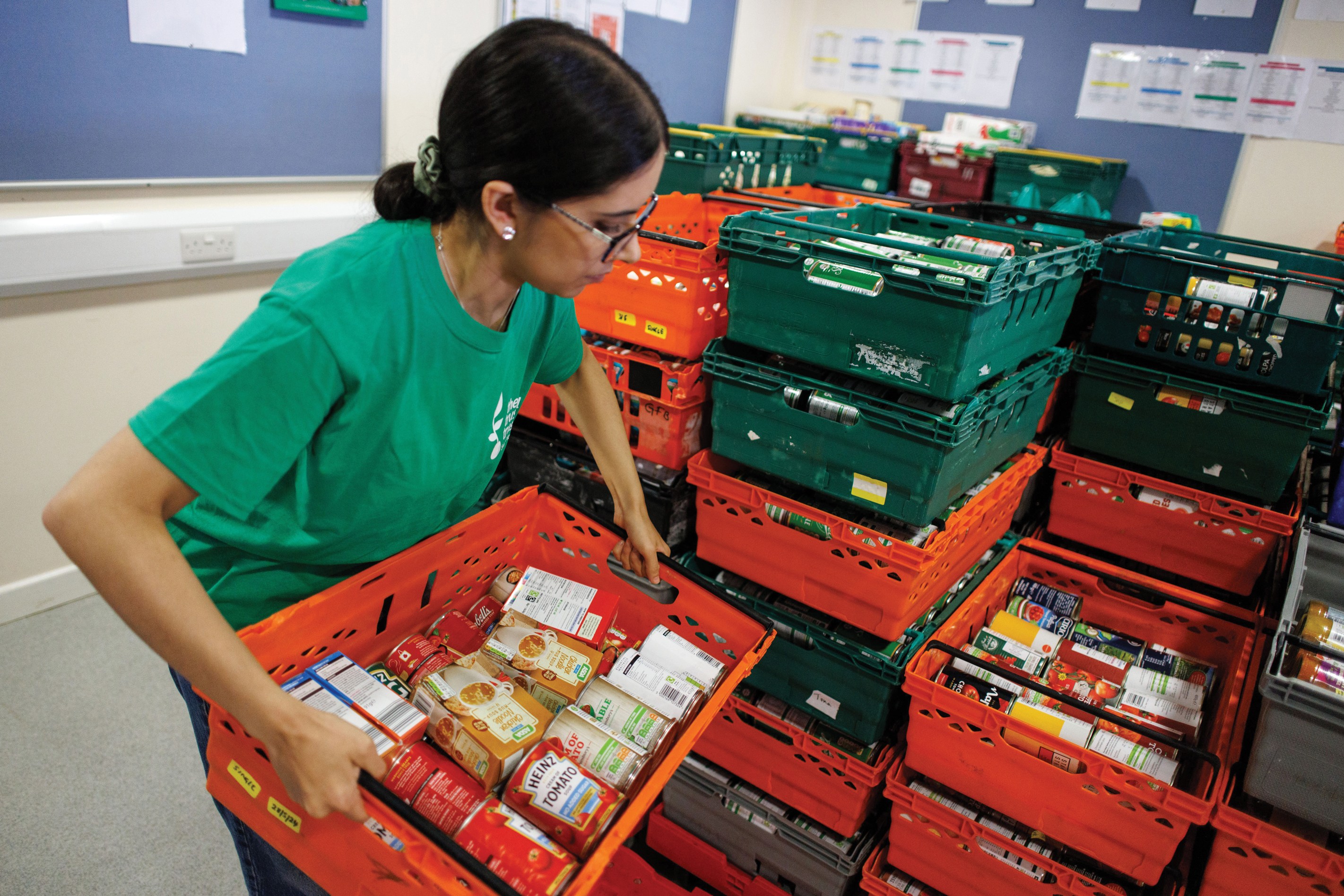
But the people most at risk in a crisis are also those who are least able to prepare – those living in poverty and barely able to afford to survive each day as it is. Food banks have a history of stepping in to support their communities in emergencies, but many tell Big Issue they are at breaking point and struggling to provide food week-to-week.
“People on the poverty line are again going to feel the brunt of something that has been beyond their control,” says Annie McCormack, chair of Broke not Broken, which runs a food bank in Kinross-shire in Scotland. “They contribute least to the climate crisis, but they feel the impact first and probably worse than anybody else.” McCormack is reminded of the pandemic, during which the number of referrals went “completely berserk” and the food bank was forced to change the way it worked.
“We took on a lot of stress and pressure, and we were able to deliver on that, but that wasn’t without cost – financial and human cost. And we felt like we could maintain this high turnover and energy because we could see light at the end of the tunnel.”
Advertising helps fund Big Issue’s mission to end poverty
Advertising helps fund Big Issue’s mission to end poverty
But after the pandemic came the cost of living crisis and there has been no relief. It is a perpetual state of emergency. For McCormack, it is difficult to imagine surviving another crisis.
“The thought that there would be another layer of crisis on top of that perma-crisis is a worry because for us, that would mean we’d have to start saying no. And we’re the last resort. It’s a real concern.”
At Portsmouth Foodbank, Jimmy MacPherson adds that “any disruption to food supplies would significantly affect our ability to support people in crisis, increasing the risk of hunger, destitution and social isolation”.
Keep reading the journalism that powers our mission
Register free to continue and learn more about the stories, campaigns and the support we provide, helping people facing poverty across the UK.
Even the UK has seen the impact of extreme weather through flooding and wildfires, while conflict overseas affects food supplies and sends oil and gas prices soaring. In volatile times, food aid organisations are often the first resort.
“Food banks are here in communities already,” says Lynda Battarbee, director of operations at Trussell. “They’re trusted. Lots are in church buildings or known spaces. If a problem happens in a low-income community or people facing hunger and hardship are struggling, food banks will absolutely be present as much as they can be.”
This plays out on a global scale. Giselle Aris, vice president of programmes at the Global Food Banking Network, explains that food banks are “so attuned to the needs of their communities” and “when it comes to shocks, they leverage those relationships to identify where food is abundant and redistribute it to places where it’s scarce”.
Advertising helps fund Big Issue’s mission to end poverty
But with crises intensifying, some food banks face the risk that “there could be an increase of thousands more people in the area they serve who need food assistance”.
In the Philippines, which has faced typhoons, flooding, landslides, fires and volcanic eruptions in recent years, Rise Against Hunger works to get food to local people. Jomar Fleras, its executive director, says he feels “overwhelmed” by the extent of the crises which have followed one after another. People are desperate and starving.
“People try to get into our trucks to get the food,” Fleras says. “We have security because when we go into a community, there’s going to be a mob, and we don’t want people to get trampled.
“We have to make sure we know exactly how many people we are going to serve, so we can serve everybody. The most you could really do is a week of food for a family.”
Countries are increasingly competing for aid, and there is donor fatigue: the more crises happen, the less people are willing to donate. Fleras and his team are already preparing for the next emergency. An earthquake is expected in Manila with experts predicting tens of thousands of casualties.
“We’ve started stocking food,” he says. “When there’s a disaster, you don’t know when it’s going to hit. We’ve started prepositioning our rice meals, because if we do this post-disaster, it will be more expensive. Right now, the roads are passable, so we can put food there ready for distribution.”
Advertising helps fund Big Issue’s mission to end poverty
The UK isn’t facing such severe threats – but it is significant that the government is suggesting we prepare.
Action plans are being worked up behind the scenes to build the country’s resilience. A government spokesperson said: “As announced in July, we’re launching a campaign later this year, to raise awareness of simple steps people can take to be ready for everyday emergencies, like extreme storms.
“We’re building it alongside more than 5,000 members of the public and 400 partner organisations, drawing on their expertise and insights. There’ll be a number of free steps people can take, such as signing up to the Priority Services Register or checking in with community members, which can make a big difference in an emergency.”
A spokesperson for the National Preparedness Commission added: “The advice that government is providing for households now brings the UK in line with other countries – notably in Scandinavia and the Baltics – who have been preparing their populations for widespread disruption for many years.
“The idea is that, as a nation and as communities, we work together to increase our resilience.”
Advertising helps fund Big Issue’s mission to end poverty
But it’s important that the government and local authorities get communications right. Trussell’s Battarbee explains: “We don’t want anyone in poverty to be scared by any of the messaging. We’re trying to give information to food banks. Information is power. They can do the thinking so that if something happens, they feel more prepared.
“But we don’t want people to be worrying the food bank isn’t going to be there for them when they need it. If people are not able to follow government guidelines and stockpile a few days’ worth of food, we want to reassure them that food banks will continue to do all they can to be available to people who can’t afford the essentials.
“We are supportive of the government’s messaging to help people be prepared, but we want to make sure the nuance is understood as well – that while we are preparing for what may be around the corner, we have people facing their own emergencies today.”
Trussell has worked with the National Emergencies Trust “to think through how to support people who are not in a position to make their own preparedness plans”.
The charity recently added power cuts to its list of possible emergencies and provided food banks with resources to prepare, given recent changes which will make it easier for the National Energy System Operator to call for rotating blackouts at short notice.
“We expect that if these happen, they will be for just a few hours at a time rather than for many days,” Battarbee says. “Like many other charities, food banks are in lots of different types of community buildings, not all of which have generators, and so we want [them] to be as prepared as possible.”
Advertising helps fund Big Issue’s mission to end poverty
Meanwhile in the capital, London Resilience has commissioned Sustain to map food infrastructure like food banks, community kitchens and food hubs.
“This was to try and get a better idea of what exists to support communities in the face of potential disruption,” says Kristen Guida, head of strategy, prevention and community resilience at London Resilience. “We’re now looking to set up a food resilience partnership that can make connections with the formal resilience structures in London to build trust, encourage resource sharing, and ensure better coordinated response.”
Government warnings may sound unnerving, but it’s important it doesn’t drive a mad dash to the supermarket for supplies. This could drive up inflation and put people in a worse situation, particularly those on the lowest incomes.
“I worry that by telling people to stockpile it could actually drive the price of food up even more,” says Sam O’Keefe, manager at St Matthew’s Centre Pantry in Merseyside.
“This then creates more anxiety in those who already can’t afford to buy enough for their families this week, let alone gather extra for the future.”
Remember the empty shelves and battle for toilet paper in the pandemic? It made it more difficult for food banks to feed people in need. Sabine Goodwin, director of the Independent Food Aid Network, says that finding ways to reduce the amount of support people need is key – that means increasing people’s financial resilience. Goodwin has long called for a cash-first approach so that people are not reliant on emergency food parcels.
Advertising helps fund Big Issue’s mission to end poverty
In England, the Crisis and Resilience Fund is a start, giving councils funding to provide cash before referring people to food banks. But the level of support depends on where you live.
Portsmouth Foodbank’s MacPherson says: “Charitable and community organisations cannot be expected to shoulder this burden alone. There is a vital role for government at national and local level to implement policies that reduce exposure to food and fuel insecurity, strengthen social safety nets and improve household resilience. Without action to address the structural causes of poverty and inequality, vulnerable individuals and families will continue to bear the greatest consequences.”
Yet Kris Gibbon-Walsh, deputy chief executive of Felix, adds that the resilience of food aid organisations remains vital. He says this means businesses making their surplus food available to charities for redistribution. It also means ensuring food aid organisations can “pivot quickly when a crisis happens, working with the food industry, government and civil society to coordinate a response and get food to where it is needed most”.
How to help your community prepare
People can prepare for emergencies by simply engaging with their local community.
Anna McConnell, head of operations at the National Emergencies Trust, points out that people may already be part of a local running club, student union, local housing association or other group. How can you help the people you meet through those? It might be thinking about what you can do to support your community if there is a gas leak, flood or fire. Which of your neighbours might need extra help?
“We don’t know when that next terrible thing’s going to happen, but we know that people who are better connected have better outcomes after emergencies,” McConnell says.
Advertising helps fund Big Issue’s mission to end poverty
There are incredible community initiatives in Britain, such as spaces like pubs and libraries offering warmth in cold weather or icy drinks in a heatwave.
Francesca Lamarque, community resilience manager at the National Emergencies Trust, adds: “It’s going to be a lot more difficult for some households to prepare than others. The more we can prepare as communities, the more we can support each other when the worst happens. Knowing your neighbours can make the biggest difference in an emergency.”
So, what do you do now? If you can afford to prepare a little bit, with non-perishable food items to last you a few days in case of an emergency, it will mean organisations will be more able to help people most in need. But if you cannot afford to do this, there will be people who can help you – and community might just be your lifeline.
How to prepare
The National Preparedness Commission advises households to store enough food and water to be self-sufficient for three days, so that local support groups, councils and emergency services have more capacity to help vulnerable people.
Families may want to agree a place to meet in case of emergencies, or write down important phone numbers, details of insurance policies, bank accounts, copies of prescriptions, and keep them handy in case they need to leave home in a hurry. Every adult is advised to learn how to turn off the water, gas and electricity in their home.
You can find out if you are eligible for the Priority Services Register, which ensures utility companies know about vulnerable people and can get them priority help if the water goes off or lights go out.
Advertising helps fund Big Issue’s mission to end poverty
Local Resilience Forums across the UK work to understand local risks and those most vulnerable to them.
Scott Norman, chair of the Norfolk Resilience Forum, and deputy chief fire officer at Norfolk Fire and Rescue Service, suggests that “buying one extra thing occasionally to build up supplies is a better approach than having one big expense at once”.
“If you can, build up what you already have gradually and take simple steps to prepare for things like a power cut, water outage or severe weather – including a plan for keeping in touch with family and neighbours,” he says.
“If you’re struggling to afford essentials such as food or housing, those immediate needs should come first, and we’d encourage people to contact their local council or other services for support.”