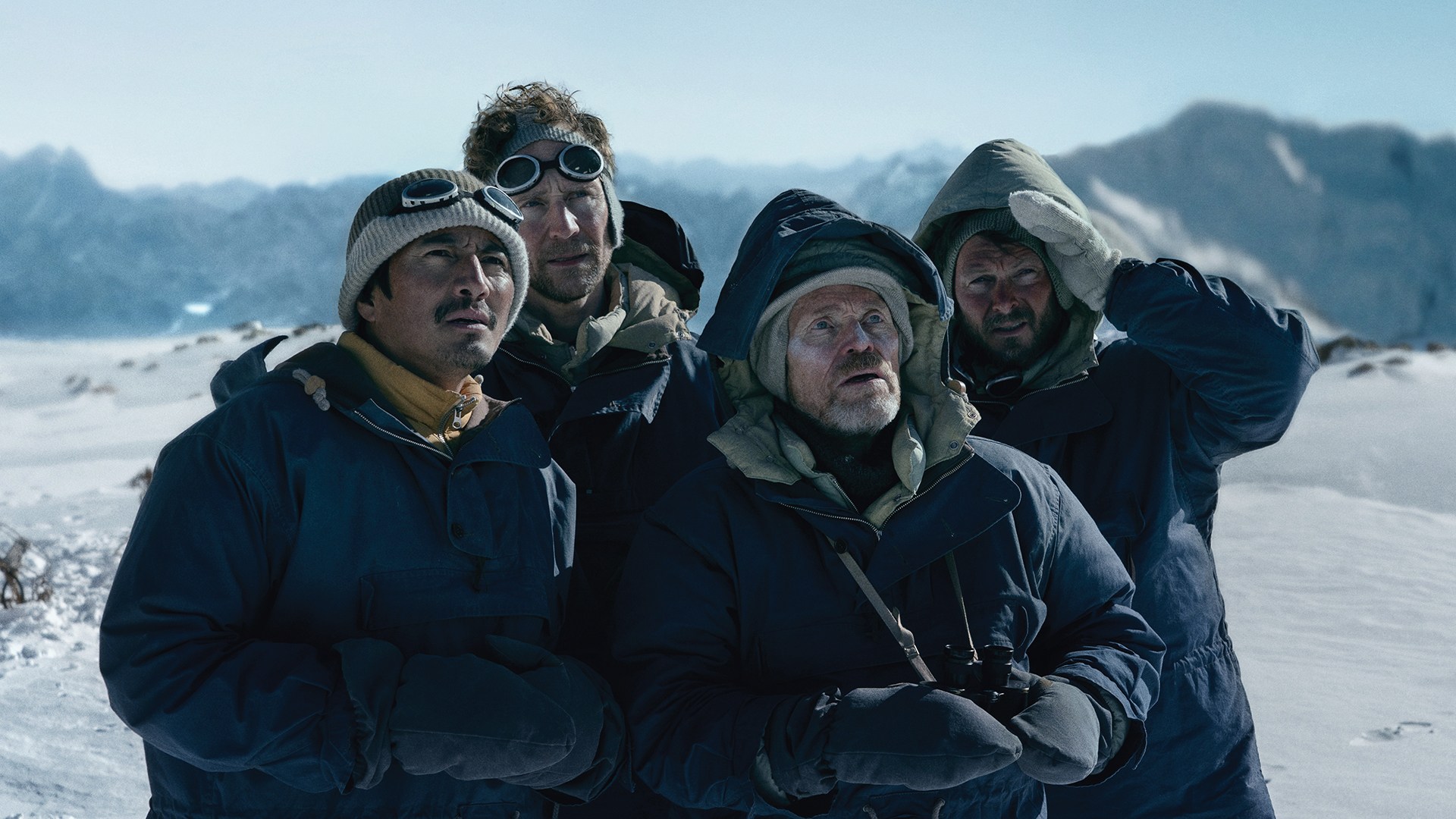
The story works on multiple levels. As a quest, it is compelling. The mission faces extremes of weather and altitude sickness. Incredible drone footage captures just how alone the Everest adventurers were. But it is as a way to explore ideas around human interaction with the natural world that it really soars.
They began filming in Nepal, which Dafoe feels was vital to connect with the spirituality that threads through the film.
“I mean, I’m there already,” grins Dafoe.
Keep reading the journalism that powers our mission
Register free to continue and learn more about the stories, campaigns and the support we provide, helping people facing poverty across the UK.
“But even in Kathmandu, where they live figuratively if not literally in the shadow of the Himalayas, it colours so much of their lives. They live by this nature that’s so elemental, so magnificent, and can be so cruel. So that shapes them.
“It’s also a mix of cultures. There are places where Hinduism and Buddhism sit right next to each other, and there’s even some crossovers. It’s not a rich country – I mean, it’s rich in many things but it’s not wealthy – so the people are always dealing with a level of economic struggle.
“And all that puts you in a place that is a world away from our experience as Western people making movies. So it’s a good slap in the face. It wakes you up. Then you get on board with them because they’re going to show you the way because it’s their land, it’s their place, it’s their culture.”
Read more:
The connection to the natural world is real for Dafoe, who has described himself as a gentleman farmer, and is a keen keeper of alpacas on his farm outside Rome.
“It’s what drives me in a lot of things,” says Dafoe. “Nature is the way to enter into what’s important. It puts you in touch with the rhythm of the rise and fall of things and what’s really important. There’s a mysterious order to it all. I keep on going back to all the functions in your body – think of all the wonderful things that we have nothing to do with – what’s that about?
“Expand that into a bigger world, and it’s a place of wonder and a place of beauty and a place that can really lift you up and encourage you not to be a jerk. So that’s where you go to get inspired. Because it tells you what’s really going on, away from all the noise we create to make our way through the world.”
By foregrounding the story of the Himalayan climber who persuaded the expedition’s leadership – and in particular Colonel John Hunt (Dafoe) – that he should be a fully fledged member of the climbing team – director Jennifer Peedom’s debut narrative feature serves as a corrective to the way the Everest mission has been talked about in the past.
And Tenzing also offers a timely look at colonialism, asking how and why we want to stick a flag on things. There are similarities to the space race as competing nations each try to boldly go where no one has gone before by becoming the first to lead a successful mission up Everest.
For Dafoe’s character, putting a British flag on this Nepalese mountain was paramount. “It’s about Tenzing’s tenacity and his relationship, spiritually, to the mountain and how that trumps – trump is a corrupt word now, but, you know – it trumps any of the ambitions of the crown or these individuals,” says Dafoe.
“I was thinking about a colonial past and a post-World War II world – I wasn’t born yet in 1953, so I can only rely on research. But so many things have changed since then. I’m not a historian or a sociologist, but the big thing is that people have ceded power to the businessmen.
“Capitalism has won in many circles. There are power grabs everywhere. So that’s what’s going on – and now, with new technologies, people are easier to control.
“It’s a pretty scary mix. But I don’t want to get too crazy about that. I’m here to talk about the film.”
And when it comes to the film, shooting up a mountain in New Zealand presented serious challenges. But they served to reinforce actor Dafoe’s philosophy of filmmaking.
“Films are collaborative anyway. You kind of make a family,” says Dafoe.
“And that doesn’t happen in too many work environments, sadly. But this one was so challenging, and you find your limitations in extreme circumstances.
“It is cold. It is dangerous. It is hard work. It is uncertain. So people need to take care of each other. There’s this whole idea of working for a common goal, particularly in this movie, because while we’re not literally
summiting Everest, we are summiting a very big mountain in New Zealand. So there’s a direction and a goal that everyone’s working together on. It was a very sweet experience.”
All these years into his career, what is it that Willem Dafoe looks for in a role these days? Transformation. Inspiration. The shock of the new.
And, with two more new films imminent – Late Fame, with Greta Lee, is “an interesting movie about identity and how, when people flatter you or put you on a pedestal, there’s a tendency to become the person they want you to be if you’re susceptible to that need for validation.”
And in gothic folk horror Werwulf with Aaron Taylor-Johnson and Lily-Rose Depp “a 13th-century story by Robert Eggers, which changed me as well” – he’s still finding plenty of it. “Seeing what’s out there, melting into what is, and trying to have an experience – that’s my basic feeling. I want to have an experience that transforms or changes me,” says Dafoe.
“As you work on a film, as you try to entertain a way of thinking that’s not necessarily your own, you learn something. And that opens you up.
“If it’s sincere, if you’re really giving yourself to have that world work on you, then people can come with you. Because it’s not for you, it’s for everybody.
“You’re one of the community that’s been sent out to do this task for advancing an understanding.”
Tenzing is in select cinemas, and on Apple TV from 16 October
Do you have a story to tell or opinions to share about this? Get in touch and tell us more.
Change a vendor’s life.
Buy from your local Big Issue vendor every week – and always take the magazine. It’s how vendors earn with dignity and move forward.
You can also support online:
Subscribe to the magazine or support our work with a monthly gift. Your support helps vendors earn, learn and thrive while strengthening our frontline services.
Thank you for standing with Big Issue vendors.