Advertising helps fund Big Issue’s mission to end poverty
Housing

Thousands of LGBTQ+ young people are homeless this Christmas. You may not see them on the streets

There are an estimated 31,000 LGBTQ+ young people experiencing homelessness in the UK today, yet many do not fit the stereotypical image of what homelessness looks like, writes akt's Adam Pemberton Wickham

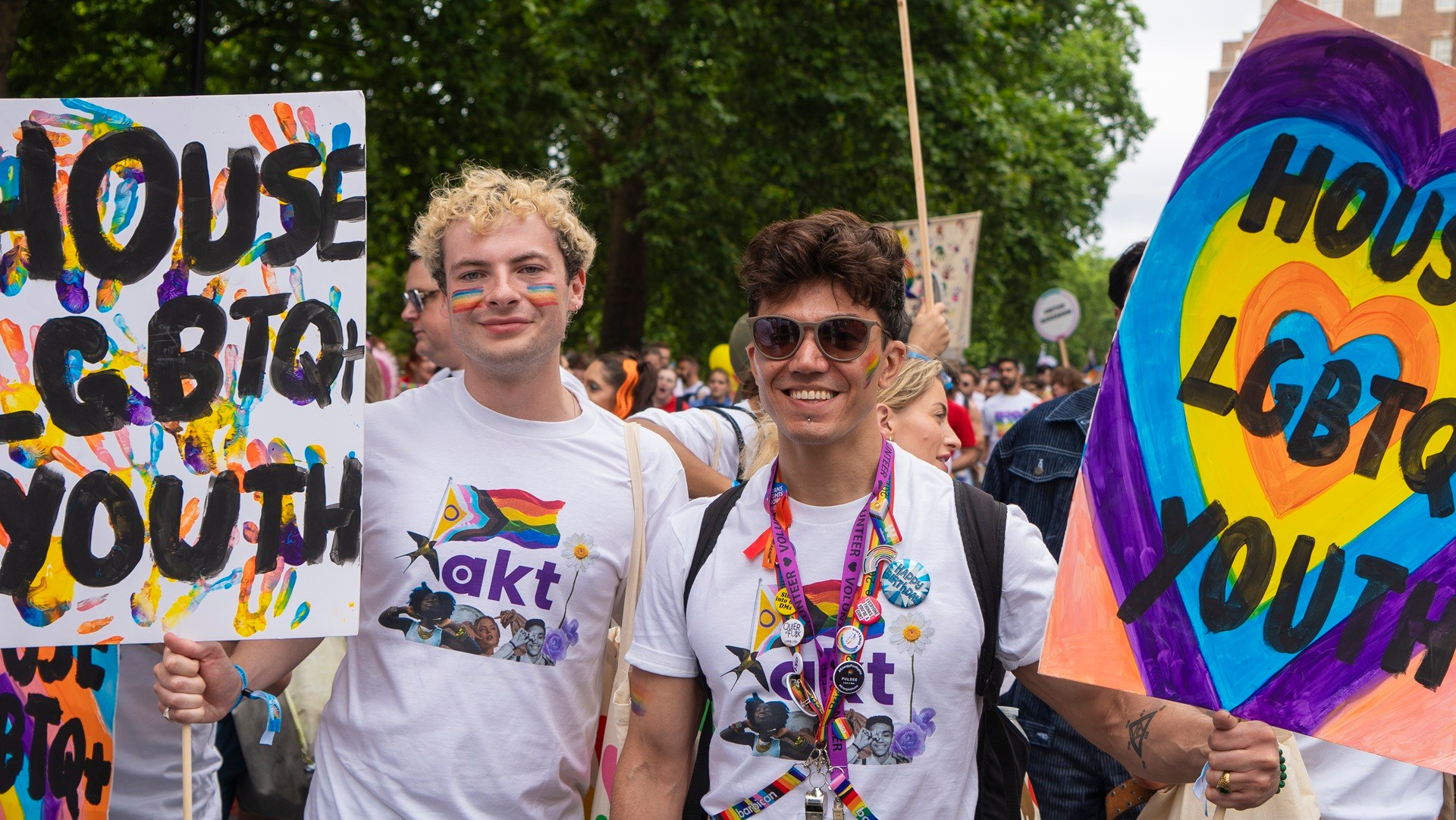
Two young men at aqn akt event with signs reading House LGBTQ Youth

Of the young people who came to akt for help last year, 19% were sofa surfing and 9% were sleeping rough, while almost a third were still living with their families. Image: akt

As Christmas approaches, spare bedrooms across the country will be reclaimed ready for the arrival of returning loved ones. University students will be packing their bags and heading home for the holidays, with friends who ordinarily see each other every day disappearing for a fortnight or so. For most of us, these are fairly unremarkable features of December, but for some LGBTQ+ young people experiencing homelessness, this can mean losing a safe place to sleep.

There are an estimated 31,000 LGBTQ+ young people experiencing homelessness in the UK today, yet many do not fit the stereotypical image of what homelessness looks like. LGBTQ+ people are also twice as likely to experience ‘hidden homelessness’ as their non-LGBTQ+ peers, and this can take many forms. Some young people move between friends’ sofas or rely on temporary accommodation, while others remain in households that are unsafe because they have nowhere else to go. There are also university students who have nowhere safe to go when their halls of residence close for the holidays.

As CEO of akt, a UK charity supporting LGBTQ+ young people facing homelessness, I’ve come to see LGBTQ+ youth homelessness as a hidden crisis within a wider housing emergency. Part of the challenge we face is helping people to understand just how difficult life can be for these young people, even if they’ve never spent a night on the streets.

Of the young people who came to us for help last year, 19% were sofa surfing and 9% were sleeping rough, while almost a third were still living with their families. Family or parental issues were a reason for 32% of referrals, with abuse or violence featuring in 12%. It’s also worth remembering that many of these young people are at an age where they would ordinarily still be quite reliant on their parents, both financially and emotionally.

For some, ‘coming out’ can mean losing the financial and practical support that was enabling them to go to university or pursue a particular career. They might suddenly find themselves unable to see younger siblings or grandparents with whom they’ve always had a good relationship. Even for those who are fortunate enough to have friends who can put them up for a while, there’s often an underlying anxiety about how long they can reasonably expect to stay before they become a burden.

Read more:
Advertising helps fund Big Issue’s mission to end poverty

These are difficult circumstances to navigate at any time of year, but Christmas can be particularly hard. Friends who have been a great source of emotional and practical support might be spending the holidays with their own families, and there are fewer opportunities to seek help as many of the places and services young people ordinarily access close for the festive period. There can also be an enormous sense of loneliness at a time when so much of what’s going on around you is about family.

I was really encouraged by the government’s announcement earlier this year of its ambition to end rough sleeping this Christmas, particularly its recognition of some of the challenges facing LGBTQ+ people. I hope we can build on this momentum and use it as an opportunity to develop a better understanding of the different ways in which young people experience homelessness.

We saw a 22% increase in the number of individual young people referred to akt last year, and I would love for us to be able to reach more of these young people before they find themselves in a housing crisis. There’s a great deal we can achieve by working more closely with local authorities and other housing providers, helping them to understand why a young person might be reluctant to return to their family home or why certain types of accommodation might not be appropriate for them.

Keep reading the journalism that powers our mission

Register free to continue and learn more about the stories, campaigns and the support we provide, helping people facing poverty across the UK.

One of the things I enjoy most about my job is hearing from young people who have previously experienced homelessness and are now getting on with their lives. When you’ve spent months or sometimes years worrying about where you’re going to sleep, being able to make relatively ordinary decisions about your future can be quite a big thing. For some young people, it might be going back to college or university after having to abandon their studies, or finally feeling settled enough to apply for a job they’ve always wanted to do.

We often underestimate how much of a young person’s development can be disrupted by homelessness. Your late teens and early twenties should be a time when you’re discovering more about yourself and developing relationships with other people, but for LGBTQ+ young people who have experienced rejection from their families, there can also be a great deal of work involved in learning to trust people again and feeling comfortable enough to form those relationships.

There are many of us in the LGBTQ+ community who have been fortunate enough to find people over the course of our lives who have given us that sense of family and belonging. I’d love for more young LGBTQ+ people to have the opportunity to build those relationships for themselves, without feeling that their acceptance by others is something upon which their housing or personal safety depends.

Adam Pemberton Wickham is CEO of akt, a charity supporting LGBTQ+ young people aged 16-25 who are experiencing homelessness or living in unsafe or hostile environments. The charity has recently launched its ‘We Are Family’ campaign to help more LGBTQ+ young people find a safe place to call home. Find out more at www.akt.org.uk or follow @aktcharity on Instagram.


Do you have a story to tell or opinions to share about this? Get in touch and tell us more. 

Change a vendor’s life.

Buy from your local Big Issue vendor every week – and always take the magazine. It’s how vendors earn with dignity and move forward.

You can also support online:
Subscribe to the magazine or support our work with a monthly gift. Your support helps vendors earn, learn and thrive while strengthening our frontline services.

Thank you for standing with Big Issue vendors.

Advertising helps fund Big Issue’s mission to end poverty

There’s more than one way to make a difference

Big Issue vendors need you more than ever this Christmas.

Recommended for you

View all
A record number of children are homeless in England ahead of Christmas: 'It's deeply troubling'
A young girl sits on a bed, holding a large Mickey Mouse plush toy. She has curly hair tied in a bun and wears a colourful pyjama set. The room features soft bedding and a grey curtain, creating a cosy atmosphere. A small figure is perched on Mickey's head.
Housing

A record number of children are homeless in England ahead of Christmas: 'It's deeply troubling'

How can Andy Burnham ensure LGBTQ+ people are included in the race to end rough sleeping?
Denholm Spurr
Homelessness

How can Andy Burnham ensure LGBTQ+ people are included in the race to end rough sleeping?

Homeless children struggle in school. We must put housing policy at the heart of education
A child writing on paper
Nick Harrison

Homeless children struggle in school. We must put housing policy at the heart of education

Why are homeless families living in former office blocks? 'No one would wish it on their enemies'
Tamara Townsend and her children lived in a converted office block for several years
Temporary accomodation

Why are homeless families living in former office blocks? 'No one would wish it on their enemies'