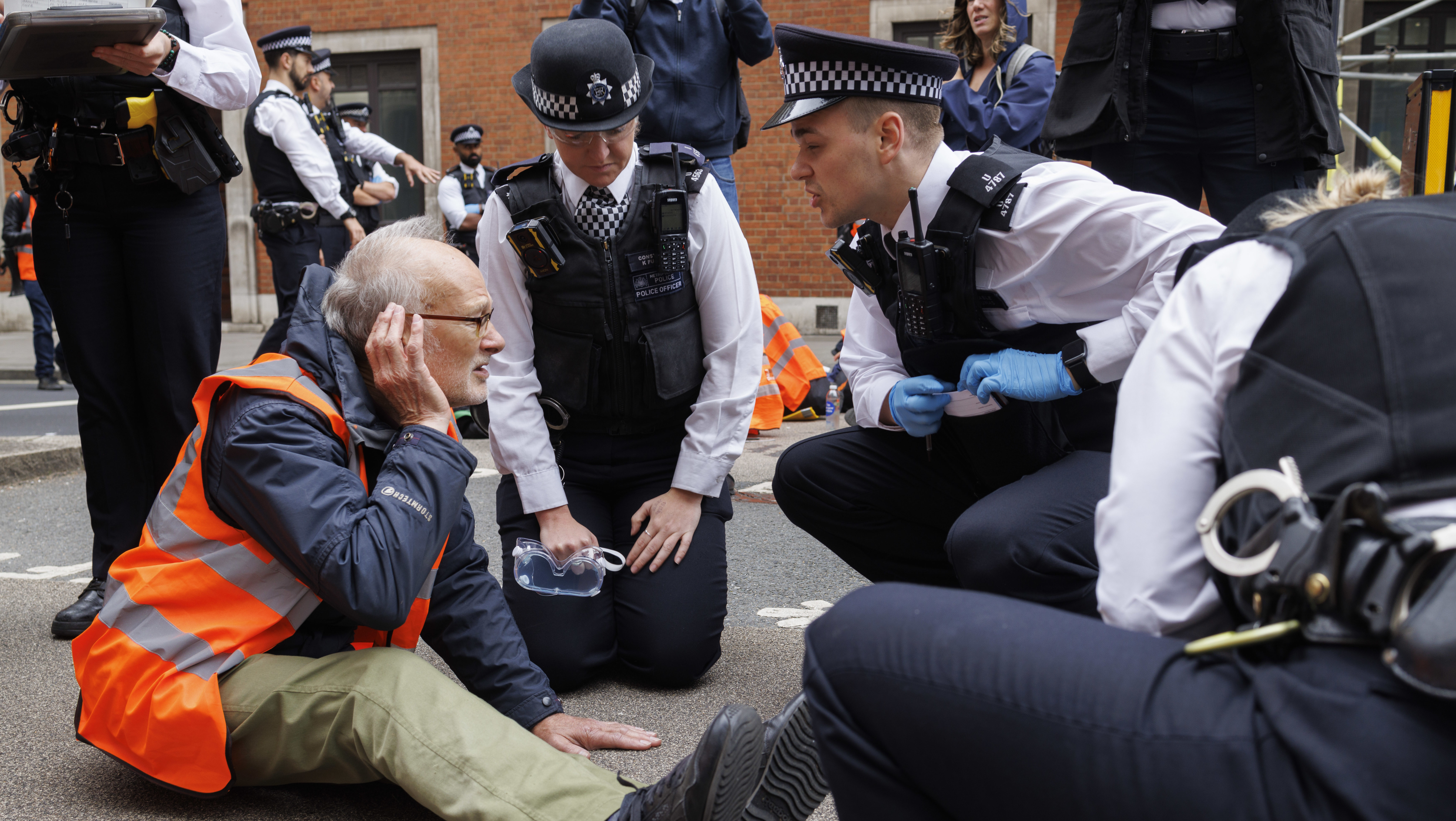
Police and a Just Stop Oil activist in London, October 2022. Image: Extinction Rebellion
Share
A new anti-protest law making its way through parliament could criminalise somebody for tying their dog up outside a cafe – if that dog starts barking loudly – peers have been warned.
Designed to crack down on protest groups such as Just Stop Oil and Extinction Rebellion, the government’s Public Order Bill could mean people face arrest for walking down the street arm-in-arm and bumping into someone, and locking up a bicycle where it might impede more than one person walking down the street.
In a briefing sent to members of the House of Lords ahead of the bill’s second reading, cross-party law reform organisation Justice warned that the new offence of “locking on” created by the bill, as well as a proposed beefing-up of stop and search powers, risk creating situations where ordinary people face police action.
Proposed expansions to police powers could see people stopped and searched for items such as belts or sellotape, while public acts of worship, pride marches and pickets could also be classified as protests under the new act.
Tyrone Steele, Criminal Lawyer at Justice, told The Big Issue: “The bill would have a chilling effect on vital freedoms of thought, expression, and assembly, beyond direct supporters of particular protests. Protest Banning Orders could be applied to people with the most tangential connection to a protest, from shopkeepers who sell protesters glue, soup, or cake, to those who post encouraging messages on social media.
“In practice, this could mean severe restrictions on individuals’ liberty, including GPS ankle tagging, prohibitions on internet usage, and even, if breached, incarceration.”
Advertising helps fund Big Issue’s mission to end poverty
The House of Lords debated the Public Order Bill on Tuesday, after MPs in the House of Commons voted it through last month, with peers also warning that tourists and shoppers could be caught up in the restrictions.
Devised by former home secretary Priti Patel, the bill has been enthusiastically taken up by Suella Braverman. In her first tenure as home secretary, Braverman described the bill’s detractors as “tofu-eating wokerati”.
Continue reading for free
Registration is free and takes less than 30 seconds.
Our supporters make Big Issue’s work possible. Join us to see the impact we’re having together and discover more ways to help people facing poverty access income, opportunity and support.
Noting that police already had powers to arrest protesters blocking roads and defacing works of art, Labour peer Vernon Coaker said: “The Government’s Bill will potentially inadvertently criminalise many from a huge law-abiding majority.”
He added: “This would allow the police to stop and search not only completely peaceful protesters but also anyone in the vicinity of a protest, including unknowing passers-by.
“If Parliament Square were so designated, anyone—people going to work, shoppers, school students, parliamentary staff or tourists—could be stopped without reason. Is that where we want to go? Unacceptable.”
Advertising helps fund Big Issue’s mission to end poverty
Lib Dem peer Brian Paddick, a former deputy assistant commissioner of the Metropolitan police, said the law is “a culture wars bill that further erodes people’s right to assembly, free speech and peaceful protest.”
Highlighting how ministers showed concern about free speech in universities while restricting the right to protest, Labour peer Shami Chakrabarti said: “The Home Secretary pleads redemption for herself but incarceration for those who plead for the planet, against poverty, and even for free speech itself.
“Hypocrisy is not mere tactical error. When it invades our statutes, it threatens the legitimacy layer: that which protects law-based order in which civilised society endures.”
Responding, Conservative peer Andrew Sharpe, a parliamentary under secretary of state for the Home Office, said: “Protesters can continue to have their voices heard but…they will not be allowed to wreak havoc on the lives of others while doing so.”
Sharpe added that new stop and search powers were necessary to deal with the “fast-paced context” of protests and “would be targeted only at preventing the guerrilla tactics employed by some”.
Advertising helps fund Big Issue’s mission to end poverty
Read more of The Big Issue’s coverage of the Public Order Bill: