Advertising helps fund Big Issue’s mission to end poverty
News

Asylum seekers with an uncertain future are spending Christmas in detention

Locked up away from their families, the Home Office's policy of detaining immigrants with no time limit is leading to tragic consequences. This is how asylum seekers in detention centres will be spending Christmas

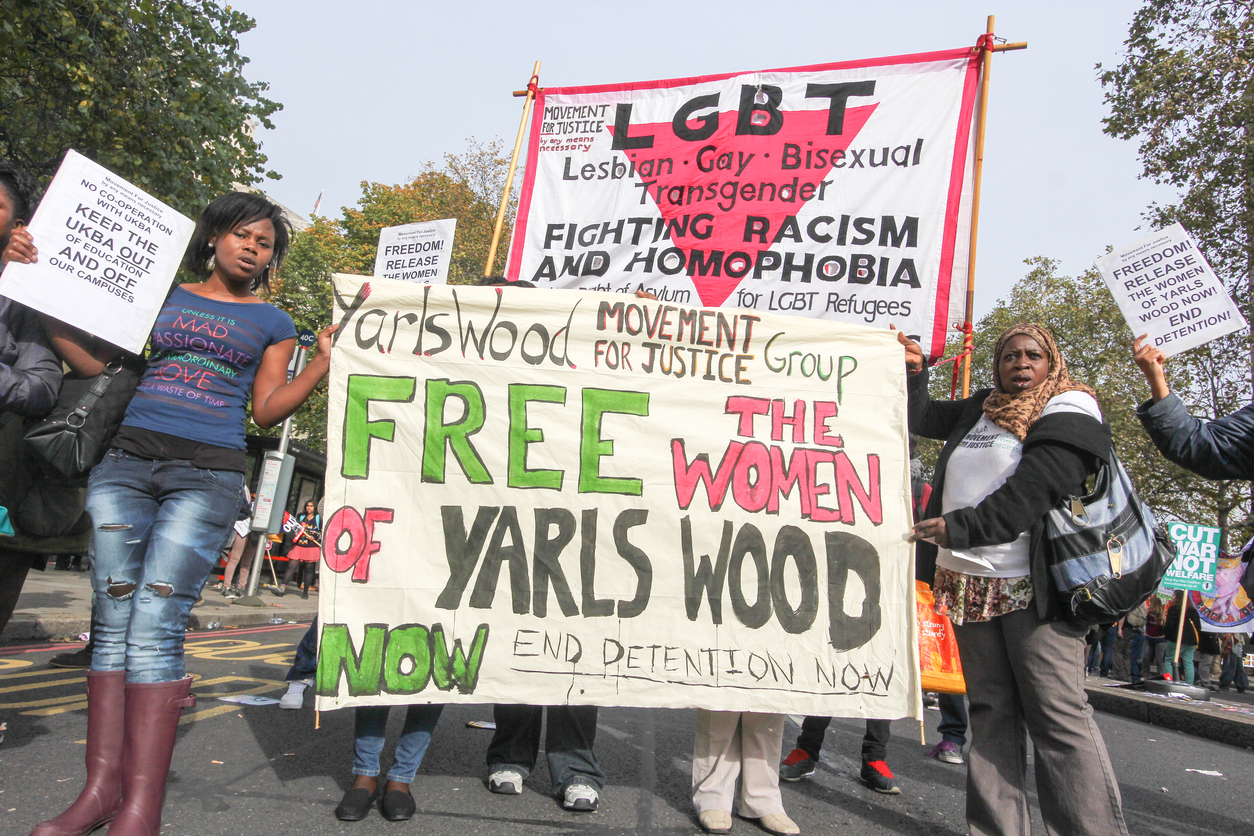
London, England - October 20, 2012: Protesters march against David Cameron's Coalition Government spending cuts that are taking place in the UK public sector. In the image, two women of African descent hold up a banner referring to the women of Yarl's Wood Removal Centre - a removal immigration centre for women

Over 2000 asylum seekers will be unable to celebrate the holiday period with loved ones as they wait for their future to be decided by the Home Office.

Immigration detention is the practice of holding people who are subject to immigration control in custody whilst detainees wait for a decision to be made on their asylum application. With 26,541 individuals entering detention centres in the year that ended in March, the UK has one of the largest immigration detention systems in Europe. Yet, unlike any other country in Europe, the UK’s immigration system has no time limit for detention.

Courts have ruled that detaining asylum seekers can only be lawful when there is a realistic prospect of removal within a reasonable period. A sample of 188 detainees in August last year shows this condition is not being met, with the median stay being four months; the longest nearly three years. These delays can become especially harmful considering that 56 per cent of the sample were officially classified as “adults at risk”.

Tragic consequences

Failure to implement the ‘adults at risk’ protection was highlighted by a custody watchdog report which found that the uncertainty over the length of detention was a contributing factor to the suicide of one 28-year-old man. Findings like these demonstrate that systematic disregard leads to tragic consequences.

Abusive treatment towards asylum seekers is also commonplace

Despite half of detainees never having committed a crime, bleak corridors, tasteless food and claustrophobic cells make detention centres seem like prisons. Cells contain two bunks and are furnished with barely concealed toilets and uncomfortable plastic chairs. The food is repetitive and sub-standard, with chicken, rice and chips being the same option every day.

Abusive treatment towards asylum seekers is also commonplace. BBC Panorama showed shocking footage from Brook House immigration removal centre in September 2017. Undercover recordings showed one officer appearing to throttle one man and threatening to put him to sleep. One detainee in The Verne detention centre describes the sickening nature in which officers reacted to the suicide of one asylum seeker: “When the guy died, an officer came in laughing, and joking as if nothing happened. They just think a joke happened. They were laughing loud.”


Advertising helps fund Big Issue’s mission to end poverty

Integrating with communities after release is made even harder by the Home Office which has delayed the provision of asylum accommodations, claiming that emergency housing is “not dissimilar” to detention. For ease, immigrants are left in detention centres for months on end, despite being granted bail. Additionally, keeping migrants in detention for a prolonged period is financially counter-productive with the Home Office paying out £21m in compensation for unlawful detention in the last five years.

Hostile environment

Among many of its consequences, May’s “hostile environment” policy has seen the government repealing a law in January that had previously enabled homeless detainees to apply for accommodation whilst in detention. The abolition of this legislation has meant around 2000 detainees who previously applied for this support each year are no longer able to, leaving many ex-detainees on the streets after being unable to secure accommodation in advance.

Home Secretary Sajid Javid recently announced that the Home Office would allow vulnerable women claiming asylum to be managed in the community rather than detention. This is yet to be put into practice.

The UK government desperately needs to reform its hostile environment with an asylum process that facilitates support and understanding. Compassion is at the heart of Christmas spirit. Let’s make it the heart of our immigration system too.

Maddie Grounds is the political correspondent at the Immigration Advice Service

Image: iStock/David Callan

Advertising helps fund Big Issue’s mission to end poverty

Do you know how Big Issue 'really' works?

Watch this simple explanation.

Recommended for you

View all
What are Andy Burnham's cost of living plans and what will they mean for you?
Andy Burnham as he arrived at 10 Downing Street.
Cost of living

What are Andy Burnham's cost of living plans and what will they mean for you?

How one woman's arrest helped to scrap the Vagrancy Act and decriminalise rough sleeping
Campaigner Kerri Douglas
homelessness

How one woman's arrest helped to scrap the Vagrancy Act and decriminalise rough sleeping

Andy Burnham must tackle poverty as prime minister. Here's Big Issue's blueprint for him to follow
Andy Burnham
Politics

Andy Burnham must tackle poverty as prime minister. Here's Big Issue's blueprint for him to follow

New prime minister Andy Burnham starts with vow to end rough sleeping. Here's how he aims to do it
New prime minister Andy Burnham outside 10 Downing Street
Housing

New prime minister Andy Burnham starts with vow to end rough sleeping. Here's how he aims to do it