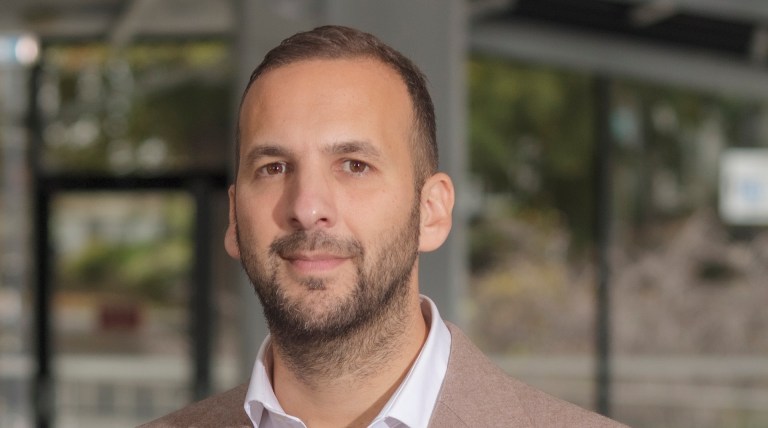
Supported by Big Issue Invest, the Independence Initiative helps homeless and vulnerable people in Liverpool. Its clients are increasingly reporting “exploitative filming”, explains Connell.
“These people have got families. These people are human beings. They’re at the lowest ebb,” she adds. “Somebody may not have contacted that individual for 10 years, and then they crop up on TikTok or YouTube.”
Non-consensual filming has exploded since the advent of smartphones and the prevalence of social media.
Keep reading the journalism that powers our mission
Register free to continue and learn more about the stories, campaigns and the support we provide, helping people facing poverty across the UK.
But the trend has gained momentum over the past 12 months, as camera-enabled ‘smart glasses’ with built-in cameras grow in popularity.
Meta, by far the biggest market player, sold over seven million pairs of these AI-powered devices last year.
There have been several instances of Big Issue vendors being filmed using Meta Glasses without their consent – often sharing information about their lives and backgrounds without knowing it would end up online.
Advertising helps fund Big Issue’s mission to end poverty
Several vendors have even been subjected to horrible – often racist – abuse; incidents which have been filmed using wearable technology and posted on X as right-wing ragebait.
“Many of our vendors are vulnerable individuals with little ability to challenge or remove this content once it’s spread,” says Paul Cheal, CEO of Big Issue Group. “This can leave them feeling exposed and humiliated, or even pose a real threat to their safety at work.”
Read more:
Bring back compassion
It’s not just our vendors. In early September, Blackpool Council issued an official plea to bring back “compassion” to the town’s public spaces after “self-appointed auditors” started visiting public places to “film local people without their knowledge or consent… and post that footage online to get views and make money”.
“We should not lose sight of the fact that behind every video is a real person,” a council spokesperson said.
In Newcastle, nearly 6,000 people have signed a petition urging local authorities to ban exploitative “content creators” from the city centre.
Advertising helps fund Big Issue’s mission to end poverty
“No one should be filmed while in distress, intoxicated, sleeping rough, or experiencing a mental health crisis,” the open letter urges. “These individuals deserve safeguarding, privacy, and dignity. Not public humiliation for entertainment.”
The petition singles out Michael Ballymore and fellow creator Tin Tin. Ballymore filmed the woman on the park bench, one among a litany of videos featuring homeless or vulnerable people.
In some clips, he’s mocking: a recent post accuses a begging man of “telling porkie pies” about being homeless. In others, he appears sympathetic: a video of a part-barefoot man in the throes of what appears to be a psychotic episode is captioned “real life withdrawal from heron” [sic], followed by a crying emoji.
In a joint Facebook post responding to the petition, the two creators denied “targeting vulnerable people for entertainment”.
“Me and Tin Tin both highlight the problems on our streets,” Ballymore wrote.
“We aren’t doing it for clout or views – we genuinely care. We’ve both been in dark places ourselves and know how quickly life can go wrong.”
Advertising helps fund Big Issue’s mission to end poverty
But the people in the videos often don’t consent to taking part – or even know that they’re being filmed. And once the videos are online, it’s very hard to get them taken down, explains Subhajit Basu, a professor at the University of Leeds School of Law.
“We’ve built a system of privacy rights that is vindicated principally by claimants who can afford solicitors, and then we’re surprised when it fails to protect somebody sleeping in a shop doorway,” he told Big Issue.
There is no general offence in England and Wales of filming a person in a public place, covertly or otherwise. Instead, there is a patchwork of specific offences for specific circumstances.
Voyeurism, for example, is illegal under the Sexual Offences Act 2003, and stalking is illegal under the Protection from Harassment Act 1997.
Those offences won’t cover most of the current spate of social media videos. Harassment and stalking laws could apply where someone repeatedly targets the same person, but generally require multiple instances, says Basu.
Such posts might breach privacy or data protection law, he adds– but taking legal action is difficult.
Advertising helps fund Big Issue’s mission to end poverty
When people film strangers
Article 8 of the European Convention on Human Rights protects your right to a private life, family life, home, and correspondence. We also have General Data Protection Regulation (GDPR).
If someone is identifiable in a video, the footage may constitute their personal data, meaning recording and using it can amount to “processing” under data protection law.
While purely personal or household activity is exempt from UK GDPR, Basu said that exemption becomes much harder to rely on when people film strangers with a view to putting the footage online, particularly if they’re monetising it.
On paper, all this amounts to “quite a lot” of legal recourse under rules around data protection and misuse of private information, Basu says. But in practice, it’s “not much”.
“Bringing any of [these complaints] requires a stable address, identity documents, a bank account, an email address, and the sustained capacity to conduct proceedings over many months – every one of which is a thing that people sleeping rough characteristically do not have,” he told us.
“It requires knowing the video exists in the first place, which many subjects never do.”
Advertising helps fund Big Issue’s mission to end poverty
Homeless people themselves feel acutely powerless, Connell adds.
“One of our people said, you know, ‘I can’t afford my mobile phone to stream music. I know music’s more protected than me’,” she says.
“It was very profound. Because they haven’t got access to streaming platforms or through smartphones, but… pictures or videos of them can go viral and there’s not much they can do.”
A cat-and-mouse game
Smart glasses have an LED indicator light that signals when the device is recording.
In August, Meta introduced a software update that can detect whether the indicator light has been covered or destroyed. The company then disabled the cameras for thousands of users who had tampered with it.
These safeguards aren’t foolproof, concedes Alex Himel, Meta’s vice president of wearables.
Advertising helps fund Big Issue’s mission to end poverty
“It’s been a little bit of a cat-and-mouse game,” he told Semafor, an American news website.
“I don’t think we’ll ever be done… There’s always new ways to get around the safeguards that are
in place.”
Even if the safeguards were perfect, an LED light won’t always alert someone to the fact that they’re being filmed – and particularly if they’re a vulnerable person, they might not realise. In any case, knowledge doesn’t automatically mean consent.
“People will say: ‘you’re in a public space, I can film you’,” says Connell. “I don’t like that. Just as somebody who goes into the city centre for weekends, I’m constantly dodging YouTubers now, when I just want to go to the shop. And I’m somebody with social capital, and who can leave.”
“Somebody who’s homeless has got no shelter from that.”
Cheal is calling on tech companies to engage with the homelessness sector.
Advertising helps fund Big Issue’s mission to end poverty
“We’ve shared guidance on how our vendors can spot when they’re being filmed, and how to respond if they feel like they’re being targeted,” he says.
“We would also welcome a dialogue with social media companies to discuss just how damaging this type of content can be, and ways in which it can be effectively and swiftly removed from platforms.”
Stronger regulatory safeguards are also needed on the manufacturing end, insists Basu.
“Let’s be clear that regulating through design is not some exotic proposal – it’s how we deal with seatbelts, with child-resistant packaging, with a hundred other things,” he says.
It can be done. The Norwegian government has commissioned a panel of experts to draft regulations on smart glasses and other devices that are equipped with cameras, microphones and AI.
But in the UK, we’re lagging behind. While Prime Minister Andy Burnham has slammed secret filming as “completely disrespectful”, he described any legal change as “premature”.
Advertising helps fund Big Issue’s mission to end poverty
Basu is urging the Labour government to at least give the information commissioner a statutory code of practice on wearable and body-worn cameras.
“The existing surveillance guidance was built for fixed CCTV operated by organisations with premises and signage,’ he says.
“It doesn’t speak clearly to a mobile camera worn by a private individual who is simultaneously a commercial content producer. That’s a category the guidance simply didn’t anticipate.”
No private place to go
It’s not just homeless people who are impacted: Women’s rights and privacy advocates have also expressed deep concerns about the technology’s invasive potential. But questions of privacy are particularly pertinent for homeless people, for whom there often is no private place.
“We tend to reason as though people who live in public have thereby given up their claim to privacy,” Basu says.
“I think the opposite is closer to the truth, and the inversion is quite important. If you have a home, you have a door. The most difficult things in your life – illness, grief, breakdown, intoxication, simply being asleep – happen where nobody can see them.
Advertising helps fund Big Issue’s mission to end poverty
“If you’re sleeping rough, you have nowhere to put any of that. Every part of your life that other people conduct in private, you are obliged to conduct in the street.
“So to say that the involuntary publicness of destitution amounts to a waiver of privacy is to make the loss of a private life the price of having lost a home. That can’t be right.”
A Meta spokesperson pointed to recent LED safeguards – and insisted that such content would be removed from its platforms, saying: “Harassing content doesn’t belong on our platforms. We’re cracking down by removing it, taking action on the accounts behind it, and continuing to refine and evolve our enforcement efforts to stay ahead of anyone who violates our policies.”
Nevertheless, many videos of homeless people are online, and many are viral. On a human level, it’s devastating for people, Connell says – and can set them back in their recovery if they’re suffering from substance misuse issues.
“It’s somebody’s son, daughter, husband, wife,” she tells Big Issue. “They need to understand that that’s there forever, and the impact of it on people. I haven’t got words to describe it.”
“No matter how clean you get in the future, what if your child stumbles across that ? You may get to a point where you’ve been through rehab, and you’re in accommodation, and you’re moving forward with your choices. But it’s there. And it can never go.
Advertising helps fund Big Issue’s mission to end poverty
“It’s a stain that can never be washed out.”
Do you have a story to tell or opinions to share about this? Get in touch and tell us more.
Change a vendor’s life.
Buy from your local Big Issue vendor every week – and always take the magazine. It’s how vendors earn with dignity and move forward.
You can also support online:
Subscribe to the magazine or support our work with a monthly gift. Your support helps vendors earn, learn and thrive while strengthening our frontline services.
Thank you for standing with Big Issue vendors.
Advertising helps fund Big Issue’s mission to end poverty