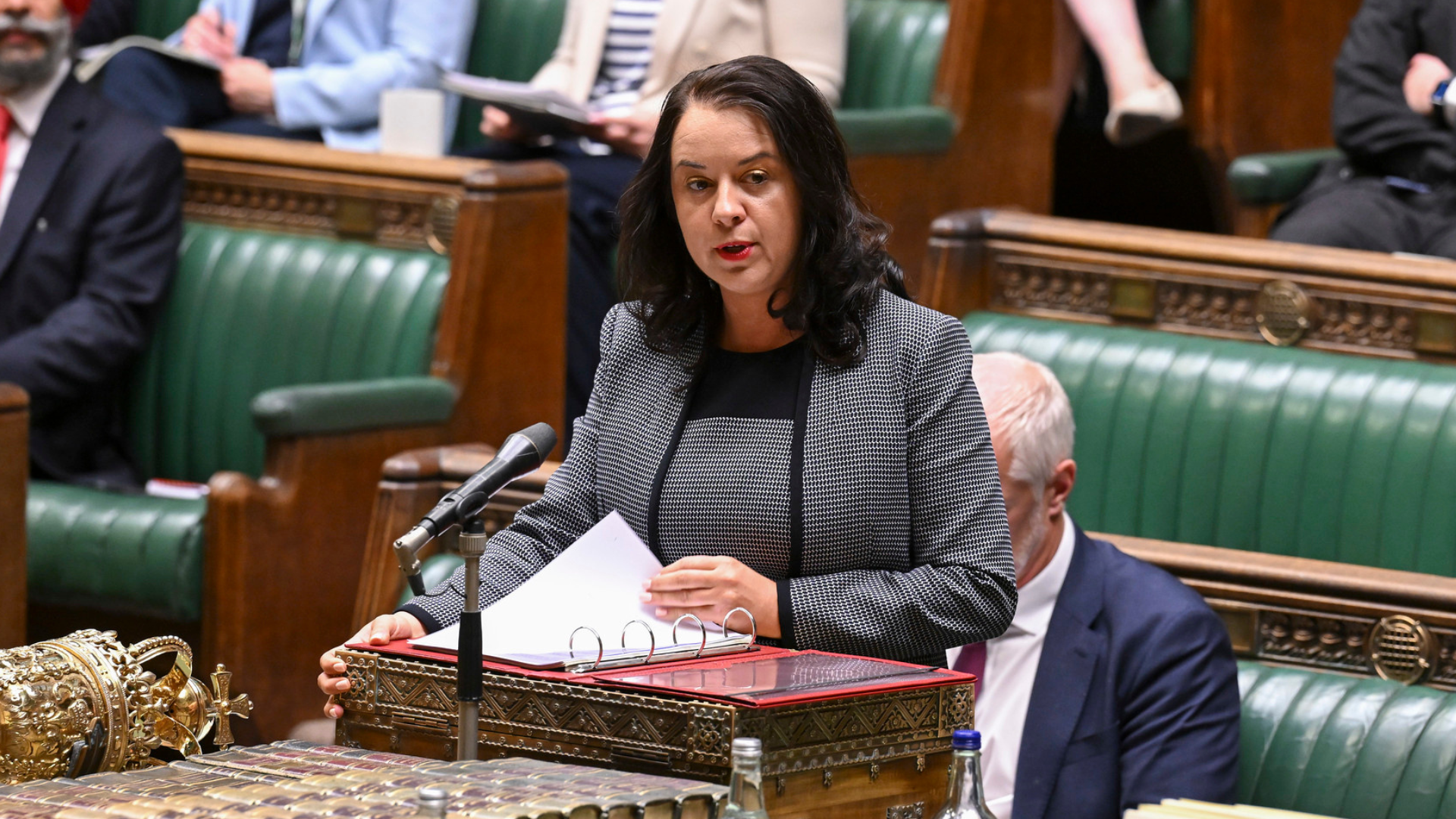
Peacock argued that the wider £500 million strategy – including new youth spaces, trusted adults and early support – would reach those young people. But the measures announced today (10 December) do not affect the UC rates that many charities say are pushing vulnerable young people into hardship.
Why legal targets exist for apprenticeships, but not for child poverty
Peacock was also pressed on the government’s decision to set legally binding targets for apprenticeship participation, while resisting similar commitments on child poverty.
She defended the government’s approach, describing the recent end to the two-child benefit cap as a “significant” move that could lift thousands of children out of poverty in her own constituency of Barnsley South alone. “This is a Labour government focused on lifting children out of poverty,” she said.
Her response underscored a tension already raised by youth organisations: a 10-year youth strategy built partly around tackling poverty and isolation contrasts with the absence of long-term, enforceable poverty reduction targets. Peacock emphasised that both the youth strategy and the child poverty strategy are “cross-government” and that ministers are working to deliver “tangible difference”.
But the question of why child poverty does not merit the same statutory targets as apprenticeships remains unanswered, and charities say the proof will come only in measurable outcomes.
The Big Issue’s own Poverty Zero campaign has repeatedly warned that the lack of legally binding child poverty targets risks undermining wider anti-poverty efforts.
Advertising helps fund Big Issue’s mission to end poverty
Last week’s child poverty strategy did not include legally binding poverty targets, a gap that Big Issue founder Lord John Bird described as “deeply concerning” and a “missed opportunity.”
Through our Poverty Zero campaign, more than 50 charities, MPs and public figures have called on the government to adopt measurable and statutory goals. The Institute for Fiscal Studies has also warned that without binding targets, delivery is vulnerable to political drift and economic uncertainty.
Cuts to the universal credit health element for young disabled people
The strategy outlines ambitions to expand youth opportunities, rebuild trusted adult relationships, and strengthen resilience. At the same time, reforms to universal credit mean some young disabled people will lose access to the UC health element – something disability and youth organisations warn will disproportionately harm those most in need of support.
Peacock did not address that contradiction directly. She said the government “appreciates the difficult circumstances we inherited” and stressed that ministers want young people to receive mental health and employment support. She presented the youth strategy as a way of “tying these things together”, working with the Department for Work and Pensions (DWP) on the youth guarantee and early support pathways.
But her response did not explain how reducing financial support for some disabled young people aligns with the government’s ambition to widen access to opportunity. For many in the sector, this unresolved tension remains one of the most significant obstacles to the plan’s success.
Keeping young people at the centre for the next 10 years
Ministers were keen to stress that more than 14,000 young people helped shape the strategy, the largest youth consultation the government has ever undertaken. But how will young people remain part of the process beyond launch day?
Advertising helps fund Big Issue’s mission to end poverty
Peacock insisted the strategy builds in accountability “throughout”, including annual events and a formal 2027 review. “This is the start of the conversation, not the end,” she added.
Zafeera Karim went further. A medical student at the University of Sheffield and a member of the UK Youth Parliament, the 19-year-old was appointed as one of the government’s youth collaborators on the strategy in 2024. She has spent the past year in meetings with ministers, including the prime minister, shaping the document released today.
“It’s a historic moment,” she grinned. “This has never happened before. It’s the first time young people have sat in rooms where we’ve been made to feel like equals in decision making.”
She recalled the experience of seeing her own feedback, and that of her peers, go directly into the strategy text. “We’ve been in countless youth spaces, and this was the first time we could actually see our feedback being ingrained into a national document that will shape the discourse for the next ten years.”
Why safe spaces matter
Karim grew up in Gloucester and says the decline in youth provision is visible everywhere.
“There’s such a lack of spaces available for young people. Or there might be spaces, but they’re not connected, and young people have no way of knowing about them,” she said. The investment in Young Futures Hubs (50 planned by 2029) is, she believes, “going to make a massive difference”.
Advertising helps fund Big Issue’s mission to end poverty
Karim, confident and articulate, recognises the risk that people like her are not the only voices that need to be heard.
“We tried our best to hear from everyone,” she reaffirmed. “14,000 young people took part. We heard from people who are not in education, from refugees, from disabled young people.” She believes the range of voices included in the consultation gives the strategy a chance to reach those it has historically missed.
A youth-led accountability system
Karim wants young people to remain the ones holding ministers to account.
“There are accountability mechanisms that involve young people directly,” she explained. One proposal is for the UK Youth Parliament to form a body that tracks progress and challenges the government over the next decade. “Because the strategy was co-produced, the accountability should be too.”
After a year of meetings, consultations and negotiations, Karim says her overriding feeling is optimism.
“You can say that I feel more hopeful than I’ve ever felt about the future of young people in this country,” she said sincerely. “And I genuinely feel that way.”
Advertising helps fund Big Issue’s mission to end poverty
Do you have a story to tell or opinions to share about this? Get in touch and tell us more.
Change a vendor’s life this Christmas.
Buy from your local Big Issue vendor every week – or support online with a vendor support kit or a subscription – and help people work their way out of poverty with dignity.