It's 15 years since Amy Winehouse died. Here's how her legacy is helping women overcome addiction
As the world remembers Amy Winehouse 15 years on from her death, residents at Amy's Place have praised the housing project set up in her memory as it turns 10, saying the celebrated singer would be 'proud' of her legacy
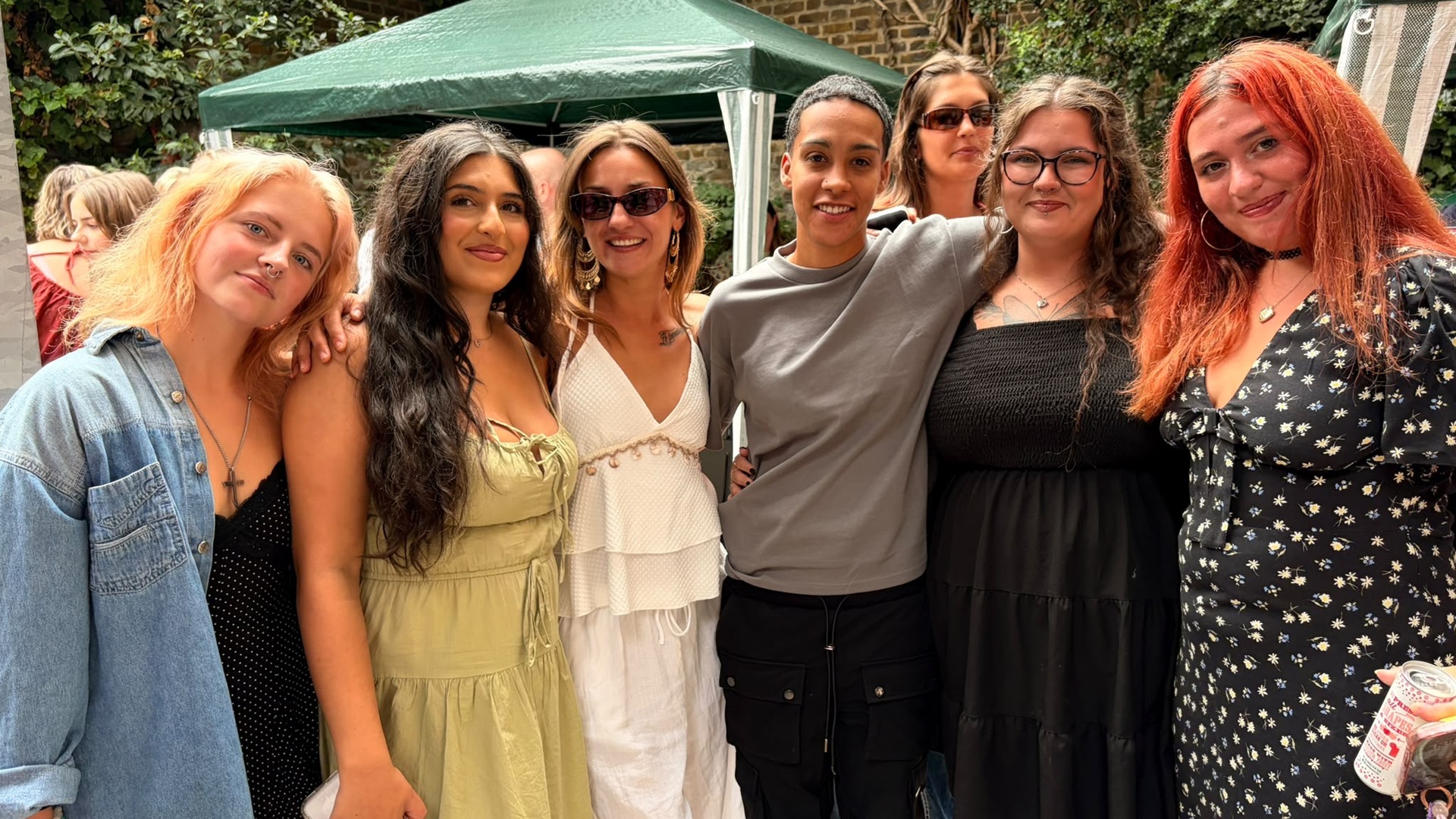
Current and former residents of Amy's Place. Image: Amy's Place/Amy Winehouse Foundation
Share
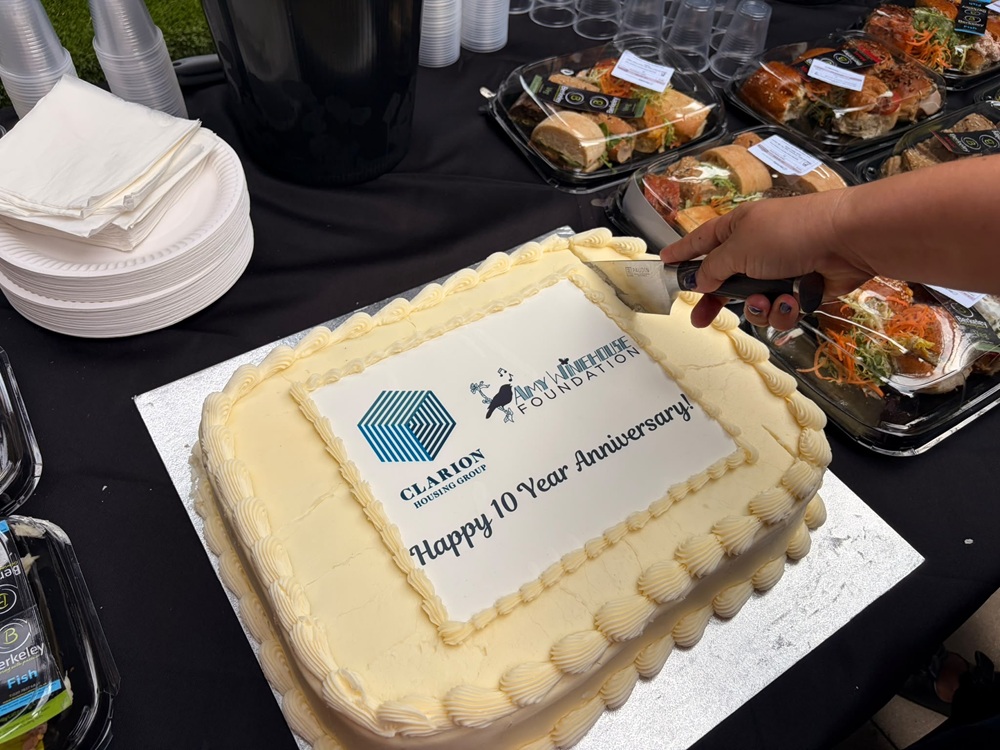
In the garden of an unassuming house in east London, a group of young women cut into a huge cake and watch their friend sing a soulful rendition of Amy Winehouse classic Valerie in the sunshine.
The young women have all been supported by Amy’s Place, a housing project for young women aged 18 to 30 overcoming drug and alcohol addiction, set up by Winehouse’s family with Clarion Housing Group in her honour.
“It’s given me hope that I never had before,” says Ciara, a 27-year-old resident of Amy’s Place, explaining that the recovery house has been a “safe haven” after being turned away from addiction services “so many times”.
“I grew up in a council estate,” she says. “My mum had an addiction, and I struggled. I tried to go for help before my addiction really took place. I was going to the council for help, just wanting a safe space for myself. I had a lot of trauma in my area, and there was no way out. I just indulged further into drugs to numb and suppress all my feelings and trauma that I had gone through throughout my life.”
Ciara says that there wasn’t much help available to her after being turned away from her local council at aged 17 carrying “bin bags full of my clothes”.
“I had evidence of issues that the council was aware of, and the most they gave me was a room in a shared house full of men,” she says. “I was only 23 at the time and I wasn’t comfortable being [there] because I was upstairs with all of them. I had found out that the landlord let people in my room and it just wasn’t a safe environment.”
Advertising helps fund Big Issue’s mission to end poverty
Advertising helps fund Big Issue’s mission to end poverty
Thursday (23 July) marks 15 years since Amy Winehouse’s death at the age of 27. Despite the tragedy of her passing, her family and the staff of Amy’s Place are determined that her legacy lives on through the transformative work the centre does for its residents, celebrating 10 years since its first resident walked through its doors.
With around 90 women supported in the decade it’s been open, it is the UK’s only housing project set up specifically to help young women recover from drug and alcohol addiction. In most cases, 16 women at a time stay at Amy’s Place, living in their own flat or sharing with another resident, which they decorate and make their own.
“Finding out about this place, that it was for young girls in recovery, somewhere to become independent, grow, it was like one in a million,” Ciara says. “I’ve been turned away so many times from certain services. To finally have somewhere, it was like, in God’s time, it came. It’s hope that I can live a life now, and that I am looking forward for a future. A few years ago, I was using [substances] to die. I didn’t want to be here. So, it’s changed my life.”
Keep reading the journalism that powers our mission
Register free to continue and learn more about the stories, campaigns and the support we provide, helping people facing poverty across the UK.
Rachel Finlinson, recovery project manager at Amy’s Place, is herself in recovery from addiction, and says one of the defining values of the project is that, unlike some other services, it does not turn away those who have relapsed.
“I’m in recovery, it happens, and there is absolutely no value to anyone to throw someone out onto the streets of London,” Finlinson says. “If someone slips up, then if they’re honest with us and they’re willing to work with us, we will bend over backwards to make it work, because all we’re doing is adding to the homelessness problem, adding to the social justice problem, adding to the NHS if we just chuck someone out on the street.”
Advertising helps fund Big Issue’s mission to end poverty
Finlinson explains that as well as the work Amy’s Place does in supporting its residents, staff also want to break down the stigma and stereotypes facing people going through addiction, explaining that she often faces ignorant comments surrounding her own recovery.
“I will still now get people saying to me, ‘you don’t look like [an addict]’, or ‘you don’t talk like one’. There isn’t a specific profile, and a lot of what we try to do here is to smash that stigma,” she says.
She adds that part of breaking the stigma surrounding addiction is considering it as a mental health condition and ensuring that adequate funding is put into addiction services.
“I had to be taken away from where I was and put into rehab,” she says, explaining that without the intervention, “I would not be here, and I did nearly die. The only thing that saved me [was rehab], and that funding is now gone. How do people think this is going to just suddenly, miraculously fix itself? It’s not going to fix itself, and they really need to listen, they need to talk to people like our residents.”
She explains that for every pound spent on Amy’s Place, it saves around £3 for the wider economy when considering criminal justice, national health and other expenses, so “to give that support is actually in the long run saving money”.
Finlinson explains that the most important aspect of Amy’s Place is the women it helps, and that over the average two years each woman spends in the housing project, “you watch them develop into the young woman that they were always meant to be”.
Advertising helps fund Big Issue’s mission to end poverty
“There’s the presence [of Amy Winehouse] here, and there’s almost a pride in being here because it’s in her name,” she says. “It’s funded because of something so tragic, but out of it has come something so amazing, and so I think there’s almost a pride in feeling that ‘yeah, we can do this’. For her.”
A ‘safe haven’ for young women
Staff members at Amy’s Place particularly note the centre’s impact on young women, stating that many who face addiction have gone through deep trauma, and may be more reluctant to go into rehab.
“Some young women who were going to be leaving [rehab] felt completely and utterly hopeless,” Finlinson says. “They’d done brilliantly in rehab but were going to go back to their same dealers, in some cases, the same pimps, same environment, and it’s really difficult. There are more services geared towards men and, because of the nature of trauma, it’s really important to have a safe space for young women.
“If women have children, they’re too frightened to seek help because they’re worried the children are going to get taken away from them. For our residents over the years, from the past experiences they’ve had, the trauma they’ve had, to put them into a mixed environment isn’t the right thing.”
Beyond a safe space for the women at Amy’s Place, it also provides a community that prevents the isolation that can make relapse more likely.
“We’re all really close,” says Ciara. “There’s not cliques; people are naturally going to be closer to others, but everyone’s more than welcome to join in if we’re chilling out in the evenings.
Advertising helps fund Big Issue’s mission to end poverty
“We all come from different backgrounds. We’re all so different. We might have different interests or hobbies and a different story, but we all generally just gel and get on,” she says. “Sometimes it’s hard to want to stay off the drugs and hard to stay off the alcohol. Sometimes when that isolation’s there, and you’ve got the girls around you, that is the extra push. I’ve had a tough time recently, but the dynamic here at the moment is the thing that’s kind of pulled me through, the girls here.”
Another current resident of Amy’s Place, 21-year-old Stella, said the centre offered a “safe place and a real community that I hadn’t had before” where before she had felt “very isolated and very lonely”.
Amy’s Place’s 10-year anniversary comes in the same year that Amy Winehouse’s classic album Back to Black turns 20. Image: Amy’s Place/Amy Winehouse Foundation
Stella explained that while she is “so grateful” for Amy’s Place, spots are limited, and more must be done to fund addiction services around the UK.
“There is not enough funding for the amount of clients that are there,” Stella says. “You have people who are sleeping on the streets, who have been in addiction for so long, who do not have the funding to be sent to treatment, or have to wait two years [for a space]. By those two years, you’re dead. This isn’t a show, this is serious, and people’s lives are so at risk here. The council really has to step it up with the funding to drug and alcohol services.”
Jane Winehouse, Amy’s step-mum and co-founder of the Amy Winehouse Foundation (AWF), adds how important services for women are, explaining that her work at AWF has highlighted that there is “sadly huge need” for addiction services, citing ketamine use becoming a growing issue among young people.
“There can always be more education, more funding, more support, more training, more, more,” she says. “It’s always a struggle to recruit and to train and to have the consistent funding. It’s a difficult landscape, there are so many demands.”
Advertising helps fund Big Issue’s mission to end poverty
Melissa Rice came to Amy’s Place in January 2018 and spent two years at the centre, creating the podcast Hooked with friend and fellow resident Jade Wye discussing the highs and lows of addiction and recovery.
Describing Amy’s Place as a “shining example of best practice”, she explains that addiction “robs you of creativity and of knowing who you are”, and that Amy’s Place allowed her to rediscover herself and make friends for life.
“It just felt like Amy wasn’t too far away,” Melissa says, praising the centre’s art and music therapy and its support for her setting up her podcast. “We [herself and Jade] went on to do the podcast with the BBC. We recorded the demo on like my cracked iPhone in the living room of Amy’s Place, London sirens in the background, and we genuinely thought nothing of it.”
Without Amy’s Place, Melissa says her life “would look very different”.
“To be honest, I think if I would have went back to Liverpool, I’m quite certain I would have relapsed because too much had happened, and I hadn’t had enough time to process and heal,” she says. “Living in London, I then met my partner, and now I’m pregnant with my second child, all of that is because of Amy’s place.”
She adds: “In the last 15 years, in the austerity years, addiction services were completely hollowed out. For me to get that bursary felt like a lottery win, it genuinely felt like I won the lottery because it was a real battle.”
Advertising helps fund Big Issue’s mission to end poverty
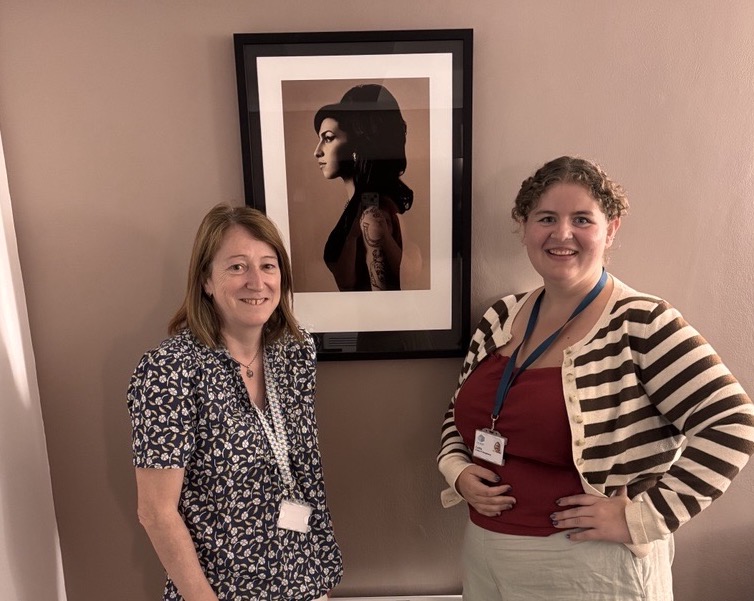
Rachel Finlinson, recovery project manager and Caitlin Palmer-O’Shaughnessy, recovery support worker at Amy’s Place. Image: Amy’s Place/Amy Winehouse Foundation)
She adds that so many of the women she has met at Amy’s Place have gone on to “thrive” and come out as “the best version of themselves” thanks to the support of Amy’s family and the staff.
“When I think about Amy [Winehouse]. It’s not just Amy. It’s her entire family,” says Melissa. “What that family has done with that unimaginable loss and that tragedy. To lose their daughter in such a horrific way, and then have the world passing comment, then to go on to educate people in schools, to fund programmes in Saint Lucia, in children’s hospices for music therapy, to pay for young women to go to rehab, that legacy.
“For every addict there’s at least five people who are affected, that ripples out, but when you’re in recovery, that also ripples out. It’s not just the young people who are sent to rehab or have lived in [Amy’s Place]. All of their family members, all the people in that network around that person, also benefited from it.
“It’s incredible, what [Amy’s family] do and continue to do. Whilst we all wish that Amy was still here – it was a tragedy, a real tragedy – I’m eternally grateful to Amy’s family because I wouldn’t have my son now, I wouldn’t be here today. That legacy is incredible, and the family and what they do day-in-day-out to help all those desperate families is really special.”
Speaking of Amy’s legacy, Ciara mentions that the singer was 27 when she died, the same age that she is now.
“When I was younger, that seemed so much older than what it really is,” she says. “Here, we’re all connected to her. We’re all so similar, and she’s very relatable. Our journey is her journey. We can understand what she has gone through, and I think she would be super proud of what her family have done, and from all the support of her fans and everyone.”
Advertising helps fund Big Issue’s mission to end poverty
Ciara explains that Amy’s death was “tragic”, but her legacy and her family’s work has had “such an impact on our lives”.
“Her and her journey, her music, who she was as a person, her love of children… it’s a massive legacy. I think she would be very proud,” she says.
Learn more about the Amy Winehouse Foundation and donate here.