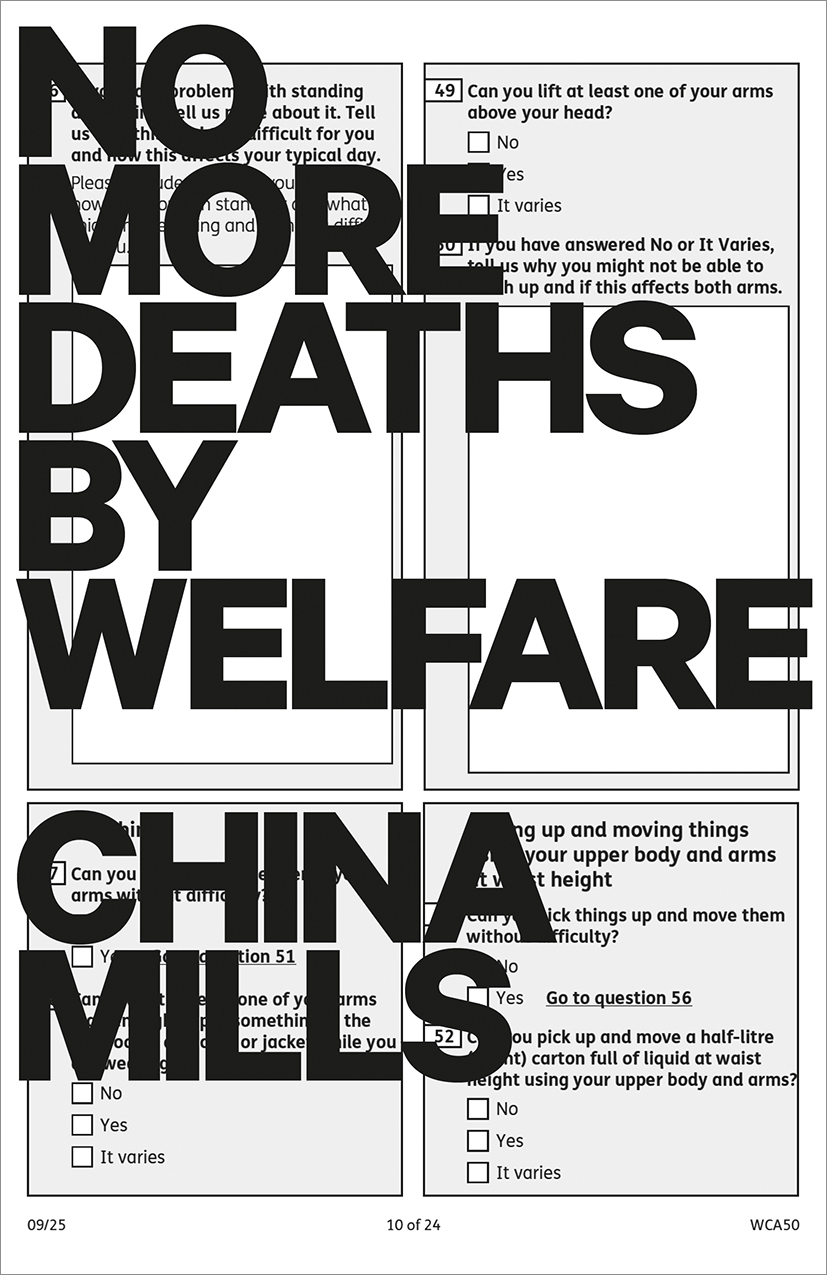
'There have been too many deaths at the hands of the welfare system. It's time to end the violence'
China Mills has spent years researching deaths at the hands of the welfare system. She is now publishing her findings in a book: No More Deaths By Welfare
by: China Mills
19 Oct 2026
'DWP Deaths Make Me Sick' shroud created by artist Vince Laws. Image: Vince Laws
Share
What do you think of when you think of the welfare system? Something benevolent that needs protection; something broken in need of reform; or something violent right to its core? Years of anti-austerity activism and more than a decade researching welfare reform related deaths has taught me a lot.
In one of many chats with Tumu Johnson, co-director of the feminist disabled women’s collective, Sisters of Frida, she explained to me how the welfare state is designed to wear people down. It does this through care schedules that dictate what time you can go to the toilet and go to bed, through appointments at the Jobcentre with no leniency, and through grinding bureaucracy that forces people to prove time and again that they’re disabled and deserving.
Rick Burgess, co-founder of Manchester Disabled People Against Cuts, says: “For disabled people to relax in this country, we would need to see the end of the Department for Work and Pensions (DWP). For the victims and survivors to feel justice, the ideal would be that the DWP is abolished.”
That disabled people need to see the end of a government department in order to relax speaks volumes to the fear, surveillance, policing and bureaucratic terror that go under the name of ‘welfare’, and the energy it takes to navigate and resist. This is a system that has been designed to make you so on edge that to relax becomes revolutionary.
According to Tumu, this wearing people down is a form of “violence that is by design and deadly”. That means that the institutions we are told are benevolent and good, also surveil, regulate, criminalise, abandon and kill us. Naming this ‘welfare state violence’ invites us to recognise how violence is a feature of the welfare state, not a ‘mistake’, not a flaw, not something we fix with a few tweaks. The deadliness of its design weighs heavy. It could make us feel like there’s nothing we can do.
Advertising helps fund Big Issue’s mission to end poverty
Advertising helps fund Big Issue’s mission to end poverty
But if it has been designed that way, then we could design it differently, together, in ways that honour interdependency, dignity and safety. So, how do we do that?
One place to start is the ways we talk to ourselves and each other about welfare. We’ve been told so many times on loop that some people are a burden and are undeserving of supposedly scarce public resources that these ideas live deep inside us, wired into our nervous systems, ingrained in our muscle memory, a habit like brushing our teeth.
There’s no point in getting rid of the DWP if it still lives in our heads, and if we continue to police ourselves and each other around eligibility, spy on our neighbours, report people through a benefits hotline, shame each other, call some people undeserving and feel undeserving ourselves. We can refuse the trap to fight each other for scraps and refuse to talk about our loved ones who have died while suffering at the hands of the welfare system as ‘perfect victims’ – to say they were ‘deserving’ as if others are not.
Keep reading the journalism that powers our mission
Register free to continue and learn more about the stories, campaigns and the support we provide, helping people facing poverty across the UK.
Who would we need to be to be able to build welfare systems that affirm our lives and that don’t come from a place of scarcity and punishment – built on abundance, trust and dignity? We need deep embodied collective change, so we can refuse shame and give it back to who it belongs; refuse the devaluation of anyone’s lives, refuse to equate worth with work. And not only to refuse but to dream, relax, get creative and build. We need repair in order to reimagine.
And what can we imagine? Welfare that isn’t built on extraction and exclusion; welfare that isn’t justified at the expense of someone else, somewhere else, however different, however far away. This means delinking welfare from the nation state that borders and weaponises it. It means recognising that it’s never only about welfare, because welfare is an important part of a broader global struggle, in which we all have stakes. We can practice welfare as the radical redistribution of wealth. This involves rethinking what work could be outside of capitalism, and exploring, as many disabled people currently are, what universal basic income and living wages mean for disabled people.
We could demand divestment of funds from the DWP and their investment into community-led work that meets people’s needs rather than shaming and punishing them, and builds power. If we defund the DWP, then we can channel those funds into community wealth stewardship, learning from lineages of black- and women-of-colour- led mutual savings societies and solidarity economies.
Don’t let anyone dismiss this as idealism. People are doing this right now. The brilliant Northern Police Monitoring Project mobilises around funding communities, not policing – grounding our imaginations in concrete ideas for how we could differently spend tax money currently funnelled to the police. Healing Justice Ldn is part of communities led by global majority people collectively stewarding wealth, redistributing resources and reclaiming land as community owned (such as Baobab Foundation, Project Tallawah and the Good Ancestor Movement). Civic Square is demonstrating this at neighbourhood scale in Birmingham by buying a building and co-building a neighbour public square as a way to democratise access to public space; organising street-based demonstrations, such as a neighbourhood trade school and retrofit house.
Land, financial speculation, extreme wealth – these are things we rarely hear spoken of in welfare or health policies. Yet think about how they shape our lives, how they distribute our life chances, how things could be different. Imagine welfare rooted in access to land, wealth and resources stewarded by community, cooperative housing, strong local food systems enabling food sovereignty. This is welfare too. Welfare justice is land justice, economic justice, racial justice, migrant justice, climate justice, disability justice, and on and on. If our economic systems affirmed life, rather than producing premature death, what might welfare be like? Resisting capitalist productivity, refusing to equate our worth with paid work, changing the way we talk to, and police, ourselves and each other, healing from shame – this is the work we need to do, together.