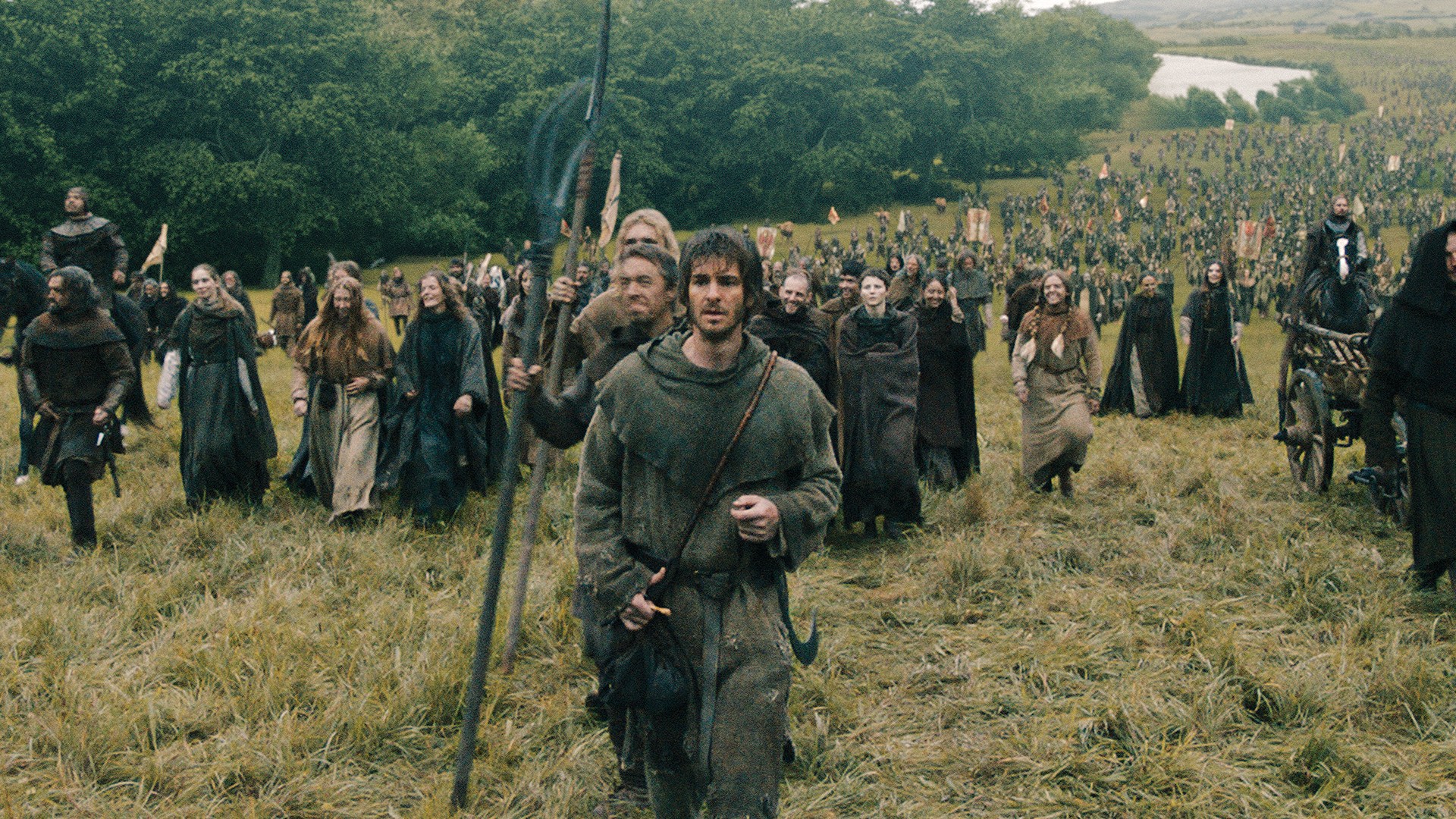
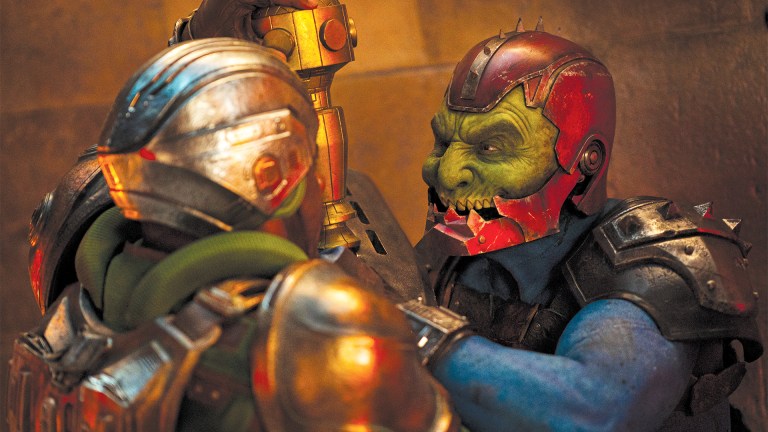
Andrew Garfield’s Ploughman leads the way in The Uprising. Image: Focus Features
Share
The new film by Paul Greengrass takes us inside the Peasants’ Revolt of 1381. This was 10 days that changed the world – the biggest rebellion by a large and struggling underclass against the super-rich landowner class in British history.
Spoiler alert: the rebellion was eventually crushed. And The Uprising shows just how the rag-tag rabble of farmworkers and disenfranchised villagers and townsfolk was double-crossed by boy king Richard II as he headed into his tyrant era.
But even if Wat Tyler, John Ball and the Ploughman – the fictional everyman farmworker, played by Andrew Garfield, invented by Greengrass to represent the workers in the peasants’ revolt – were vanquished, their efforts were not in vain.
These 10 days sowed the seeds for the labour movement, higher wages and stronger workers’ rights and freedoms, as well as the ongoing (though threatened) practice of democratic protest against the powerful. “When I started writing The Uprising, it was very eerie how contemporary it felt,” says Greengrass. “A world sharply divided between oligarchs hoarding their power and wealth and an enraged population out there. Like any period movie, you’re really talking about today.”
So it is that lines like, “All will be well when the poison of wealth is removed” reverberate loudly from the cinema speakers, coming so soon after Elon Musk briefly attained trillionaire status.
Treasurer Robert Hales is one of King Richard’s coterie of older advisers who are desperate to maintain the status quo, played with unholy relish by Rev star Tom Hollander. When Hales concludes, “If we tax the merchants, they will expect a seat at the table… So we have no choice! We must tax the common man”, it sits somewhere between current debates around wealthy political donors influencing policy and arguments that taxing the super-rich cannot be done in case they leave the country.
Advertising helps fund Big Issue’s mission to end poverty
Advertising helps fund Big Issue’s mission to end poverty
“Exactly, exactly, exactly!” shouts Greengrass. “Come on, any fool can see that a world so sharply divided by these plutocratic oligarchs – we don’t have to name them – where that kind of wealth and privilege exists while the people are being asked to pay more and more for less and less is not a world that’s going to be stable.
“It’s going to be unstable. It’s going to be angry. And it’s getting worse.”
Read more:
Keep reading the journalism that powers our mission
Register free to continue and learn more about the stories, campaigns and the support we provide, helping people facing poverty across the UK.
The Uprising was a lockdown project for writer-director Greengrass. He first came to prominence making World In Action documentaries for ITV, graduated to hard-hitting true-life film with The Murder of Stephen Lawrence, Bloody Sunday and Bafta-winner Omagh, before entering full-scale action movie beast mode with the opening trio in the Bourne film franchise. The new film, all filth and fury, combines huge action sequences with social comment.
“In the aftermath of Brexit, I started to think about doing a story about an English rebellion,” he says. “And I always came back to the peasants’ revolt.
“Most historians would agree that it was the largest rebellion in medieval Europe. It was a huge event that erupted suddenly, but the demands of these people were highly specific, to do with economic and political rights. It wasn’t just an enraged mob storming the city and trashing the place. And, from that moment on, the oligarchal class could never again take the people for granted – they always had to be aware of the power of what they would term ‘the mob’.”
Advertising helps fund Big Issue’s mission to end poverty
The peasants’ revolt briefly threatened to recreate this country as a more equitable place to live. It also pushed the mythic character Robin Hood into the wider public consciousness. The publicity surrounding the new film has largely focused around the messy and muddled way it was revealed that the film also serves as a Robin Hood origin story. If this was intended to help the US box office numbers, it palpably failed. However, it adds an intriguing element to the powerful story. “You know, it’s a movie. It’s not a documentary and it’s not a history lesson – I’m sure medieval historians will have lots of critiques. But I tried to follow the thrust of the events,” says Greengrass.
“There just didn’t seem to be any point to doing a film about a rebellion where the end was ‘and then everybody died and the bad guys won’.
“And that got me thinking about the ledger for 1381. And one of the things that happened in the aftermath of the peasants’ revolt is a great flowering of outlaw balladry. There were various outlaws, but the most famous and popular was Robin Hood.
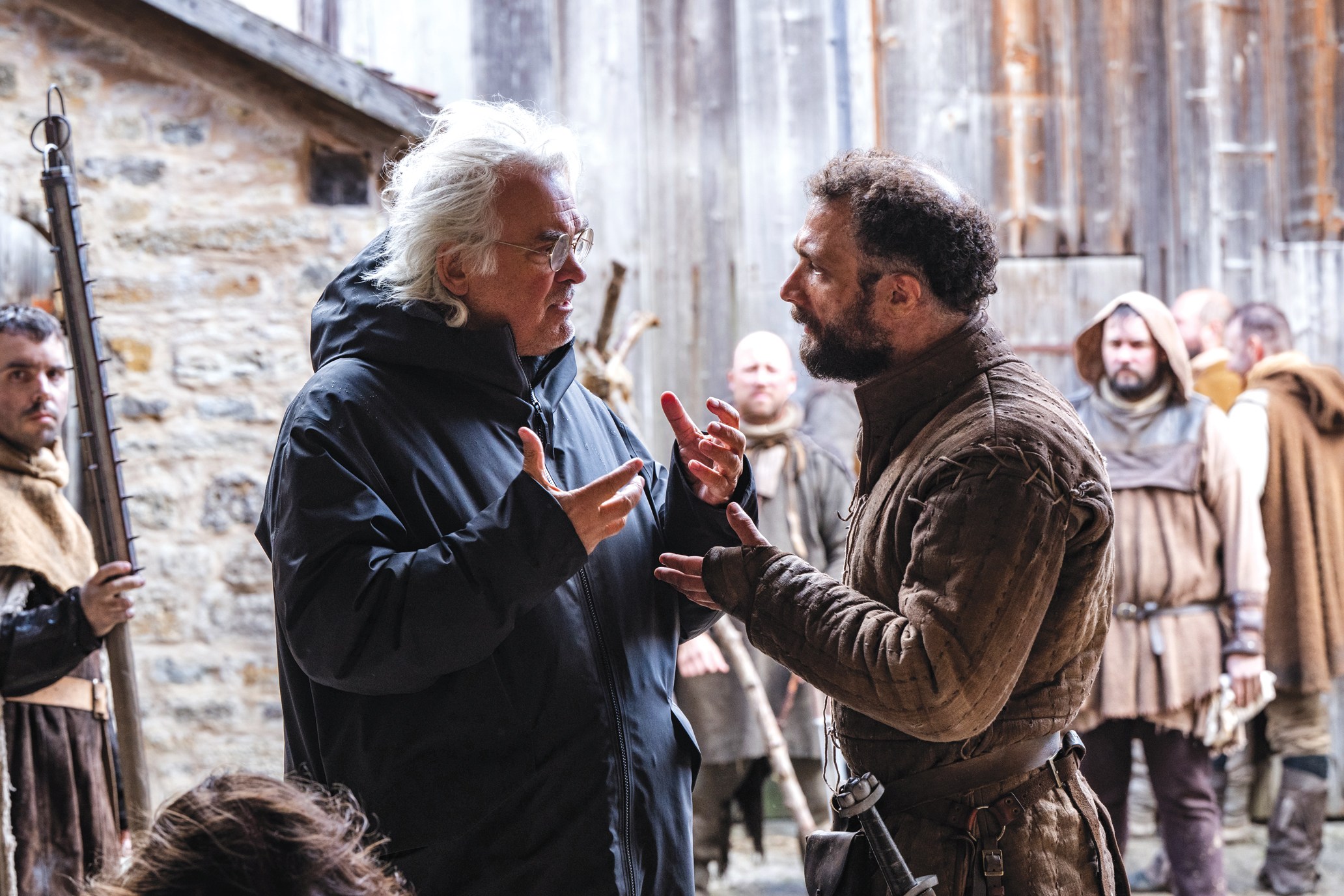
Director Paul Greengrass with Cosmo Jarvis (Wat Tyler) during the making of The Uprising. Image: Betina La Plante / Focus Features
Greengrass has done his research. He knows Robin Hood was first referred to in the poem Piers Plowman by William Langland, which predated the peasants’ revolt. And he also knows that even before that was published, Robin Hood was a popular figure in oral folklore. But he is unrepentant. Because, he argues, it not only makes for a better film, but is true to the spirit of the times.
“Ordinary folk told stories of outlaws in taverns and village squares because they were a way of keeping the dream alive,” he says. “You could tell stories about people who dared to take on the rich and powerful or steal from the rich to give to the poor, which is a later invention of the Robin Hood story. But you can see where the root is. The original roots of outlawdom were stories people told when they had just lost, to keep the dream of the peasants’ revolt alive.
“I also wanted to put my finger on something I think is going on today. Politicians like to talk about the generational settlement. It’s a real issue, the sense that young people have of being disenfranchised and locked out of a system rigged against them.
Advertising helps fund Big Issue’s mission to end poverty
“So in the film, if you want to think of a rock and roll song from my era, it’s Won’t Get Fooled Again [by The Who]. He starts out as a modest, moderate ploughman. He doesn’t want to destroy the country, he just wants a fairer world. And they were tricked. But my farmer won’t get fooled again. That’s the ultimate moment of his radicalisation.
“So, at the end of the film, there’s a sense of, ‘fuck you lot. You’ll never sleep easy with us locked out’. And I think that’s very true to how people feel today.”