Join The Ride Out Recession Alliance
The Ride Out Recession Alliance (RORA) will develop and implement practical steps and solutions to prevent families losing their homes, and help people remain in employment.
Learn MoreBut today if anyone was curious about why leaves are green they would simply search for the answer online. Facts are easy to obtain but knowing what they mean is more elusive than ever. Perhaps this is why facts can be taken and twisted to serve multiple purposes. Cox and Forshaw wrote Universal with this in mind. Instead of the reader being spoonfed information without understanding where it comes from, the authors provide a step-by-step guide about how we could work out for ourselves the circumference of the Earth or how far away Neptune is, using a telescope and some calculus.
They point out that this process is essentially the same as ones that allow scientists to ask questions about what happened at the Big Bang, and even before that (just because there was no observable space before the Big Bang does not mean that there wasn’t something there). Another mind-melting part of the book talks about how although our universe will keep expanding and expanding forever, it is likely only one of an infinite number of universes being created by other Big Bangs going on all the time.
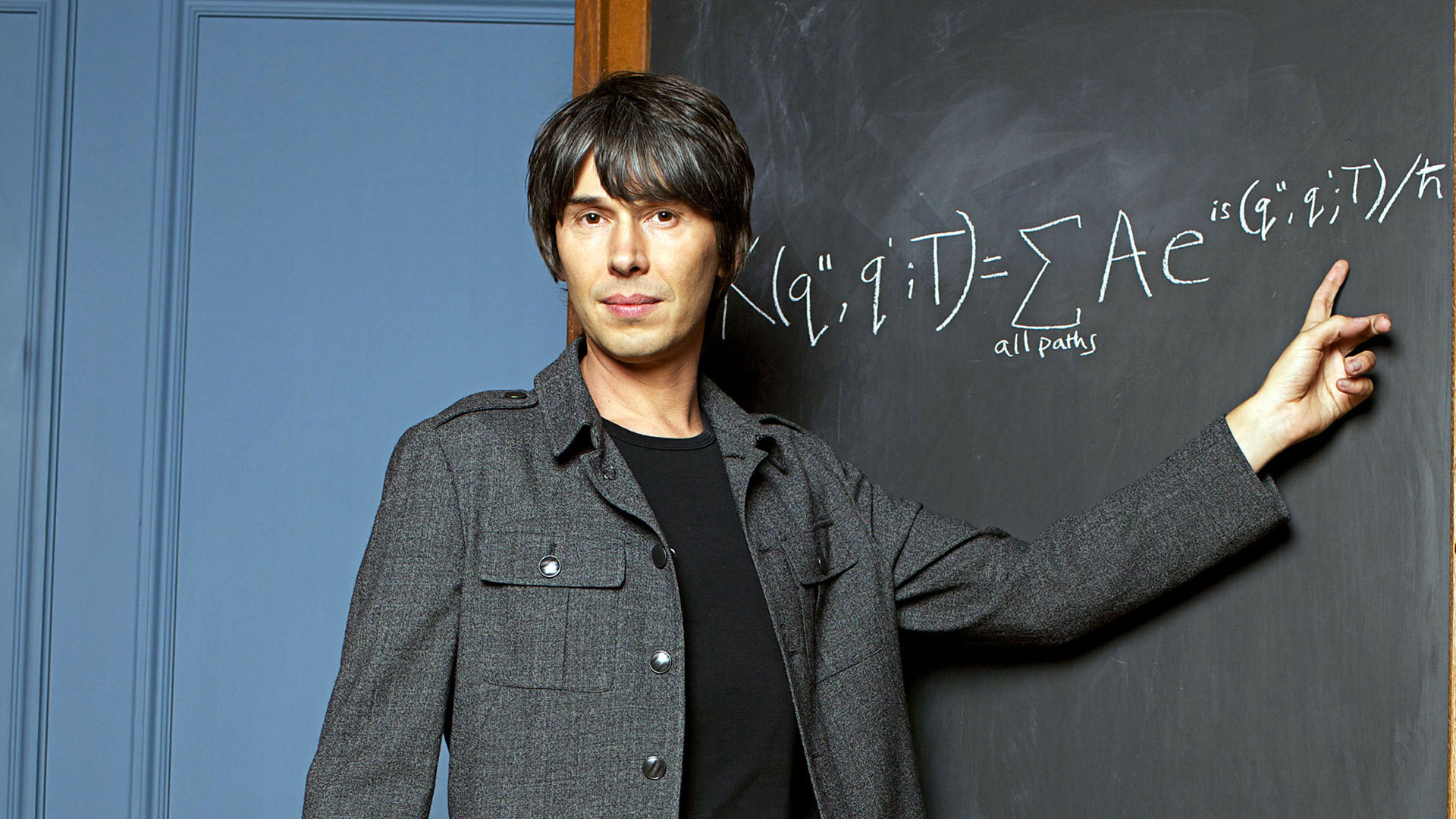
It is a lot to take in, and Cox (pictured above with astronaut Buzz Aldrin) wonders if we are losing the ability to process complex ideas. “If Donald Trump is president by the time you read this, what you see there is a retreat from reasoned analysis,” he says. “We have a civilisation like we do because we have – or we had – sufficient numbers of people who understand what evidence is, what data is and that changing your mind in the face of new evidence is a good thing.
Keep reading the journalism that powers our mission
Register free to continue and learn more about the stories, campaigns and the support we provide, helping people facing poverty across the UK.
“Certainty is not something to be valued – it is the road back to the caves. We may have taken this for granted over the last several decades, and one of the reasons you’re seeing the rise of certainty, perfectly illustrated by Donald Trump, is that people are not really being taught how to think. We did consider calling the book ‘How to Think’ at one point.”
“Brian did,” Forshaw interrupts.
You’ve got to be taught how to think and be taught what it means to take a position based on data and change it
“Well, I did,” Cox says. “You’ve got to be taught how to think and be taught what it means to take a position based on data and change it. You’ve seen in Britain over the last few years a rise of people who are absolutely certain, who want to be seen to be right all the time, and I think that’s a big problem.”
Advertising helps fund Big Issue’s mission to end poverty
The book frequently talks about the delight in being shown to be wrong about something. When was the last time Cox was happily mistaken?
“There are some mistakes in most of our books,” he says, explaining a mistake he may have made relating to quantum mechanical systems, but I’m not sure many people would have corrected him on the details. “The point about being wrong is that it’s not negative,” he says. “Every time you’re wrong, you learn, in some senses, as much as when you’re right.”
Which brings us back to Cox’s latest theory – posited before Trump’s victory, which immediately makes his warning more prescient – the state of education is in crisis. It is not just the education system in the UK he is concerned about but across the entire western world. “People have the power, that’s the way that democracy works,” he says, “but if you get sufficient numbers who have been short-changed by our system – it’s not their fault usually – then go down the line a few decades what you end up with is a pop-ulation that might end up voting for Donald Trump.
“Assuming we’ve survived [Trump], it will come,” he continues. “One of these countries will end up like Germany in the 1930s if we don’t start treating education as something that’s absolutely vital. It’s as important to our security and the stability of our society as building aircraft carriers or investing in missile defence – all these things that we accept as national security issues that we have to spend money on. It’s a line of thought I’m beginning to develop. I’d at least like to have a debate about that.”
This is the first time he has shared this view in front of Forshaw, and Cox is keen to hear his thoughts. Forshaw ponders the point and says: “It’s not that schools have suddenly gone into decline – universities are as brilliant as they’ve always been, students are as clever as always – it’s that popular culture has sidelined, and does not seem to value, the intellectual side of decision-making any more.”
It’s become more complicated to be a citizen. There is more information, more opinions
Cox agrees. “It’s become more complicated to be a citizen. There is more information, more opinions. You have to judge whether it’s trustworthy or not. That’s a skill you didn’t need a few decades ago but you need it now. Maybe the education system is not keeping up with the increasing complexity of living in a democratic society and it needs very quickly to solve that problem. The polar-isation of opinion is a reflection of a lack of thought. We need to equip our citizens to better their own life chances but also to actually keep our society stable.”
Advertising helps fund Big Issue’s mission to end poverty
It might even be worth asking an expert what they think the solution is… “I think it’s very simple. It’s about class sizes, the professional standing of teachers,” says Cox. But then again, nobody, not even Professor Brian Cox, could have predicted Trump would be the next pres-ident of the United States. What do experts know anyway?
Universal: A Guide to the Cosmos by Brian Cox and Jeff Forshaw (Allen Lane, £25). For Brian Cox Live dates: apolloschildren.com