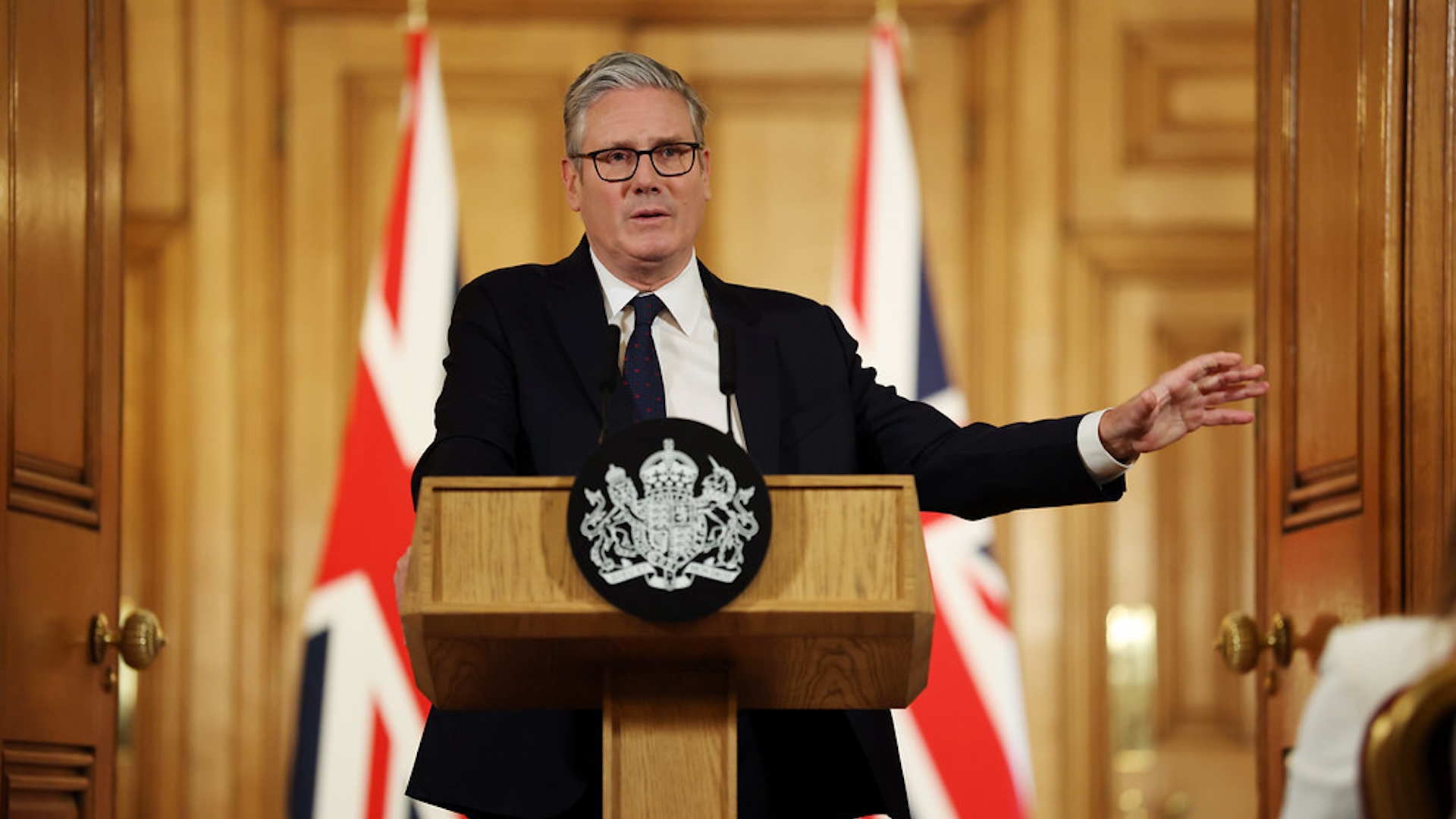
It was just weeks ago that Big Issue was invited into Downing Street for an exclusive interview with the prime minister. It was soon after the local elections and Starmer was facing a rising number of calls for his resignation.
“I think there’s always the challenge of getting the good news out there,” Starmer said.
So, how will Keir Starmer be remembered in the history books? What is his legacy on the biggest issues facing Britain today? We delved into it.
Keep reading the journalism that powers our mission
Register free to continue and learn more about the stories, campaigns and the support we provide, helping people facing poverty across the UK.
What is Keir Starmer’s legacy on poverty?
Starmer promised the Big Issue back in his election campaign that he would be “as bold as Atlee” – the post-war PM famous for setting up the NHS – in tackling poverty in Britain. But has he managed it?
Some of the Labour government’s policies on tackling poverty have been steeped in controversy. One of his early moves was to slash the winter fuel payment for pensioners, a move which saw significant outcry among the public and his own MPs.
More than 2.5 million pensioners lost their winter fuel payment. And, according to the government’s own analysis, 50,000 pensioners were plunged into poverty in the winter of 2024-2025 and 100,000 extra pensioners ended up in A&E.
Ministers were forced to U-turn on it the following year, and the majority of pensioners got their winter fuel payment.
Then there came the threat of disability benefit cuts. Starmer’s Labour wanted to slash personal independence payment (PIP), with hundreds of thousands of vulnerable people expected to lose at least some of their benefits and risk being pushed into poverty.
But Labour MPs fought hard against it and Starmer was forced to U-turn again. Any changes are now put on pause until a review of the PIP assessment process has concluded, led by disability minister Stephen Timms.
However, there were still some cuts made to the health element of universal credit for new claimants, which are still expected to push tens of thousands into poverty.
But there have been positive changes too. Labour’s child poverty strategy was a historic move, with changes that charities and campaigners had been fighting for for years. This included the end to the two-child limit on benefits, which has seen hundreds of thousands of children lifted out of poverty, almost overnight.
There were other hugely significant changes too, like the expansion of free school meals to all children in households on universal credit. Yet perhaps, as Starmer says, the challenge has been getting that good news out there, and it is often overwhelmed by the rigmarole of politics.
And the reality is that people have spent years suffering after austerity saw public services cut and the cost of living crisis drove more people into poverty. People needed to feel the radical changes in their own lives. Instead, prices are still rising – and more so now due to global conflict in the Middle East – and millions of households are being squeezed when they have nothing left to sacrifice.
What is Keir Starmer’s legacy on housing?
One of Starmer’s most notable policy changes is the Renters’ Rights Act. It has allowed monumental changes to come into force – changes that Big Issue and other organisations have spent years campaigning to make happen.
It has seen an end to no-fault evictions and bidding wars; fixed-term contracts swapped for rolling contracts; tenants being allowed to keep their pets; and rents only being increased once a year.
In our interview, Starmer said that the Renters’ Rights Act is exactly the kind of change he had hoped to be able to introduce as prime minister.
He said: “We came into power to change lives for the better. And with this act, we’ve been able to do it. And look, you’ve been campaigning on it. Big Issue has been campaigning on it. None of this is without a fight. It’s a fight with lots of people saying that won’t work, saying this’ll cause the following problems. And you have to push through that. And so I’m really pleased that we’ve done it.”
But there are still extremely high levels of homelessness, and the Labour government has faced criticism about its lack of action in addressing the affordability of housing, both for renters and buyers.
Labour has a target of 1.5 million new homes built over the course of this parliament, a level of construction not seen in the UK since the late 1960s, but experts at Full Fact argue that the government needs to pick up the pace to achieve this.
Government estimates suggest that, between 9 July 2024 and 15 March 2026, there was a net addition of 342,100 homes – less than a quarter of the target.
What is Starmer’s legacy on employment?
Starmer inherited a problem: youth unemployment is at a record high. The most recent figures show that more than a million young people are not in employment, education or training (NEET). And that will have dire consequences for their lives as well as the British economy.
This cannot be blamed entirely on Starmer. Alan Milburn recently published the first part of his government-commissioned review into youth unemployment and said “the institutions we built to support young people into adulthood are no longer fit for that purpose” and that “the country has known this for some time”. In other words, it’s a systemic issue.
Rising ill health, a hands-off benefits system, a weak labour market, a changing digital world and limited vocational education are all identified in the report as key drivers of youth unemployment.
The Labour government has talked about tackling the numbers of NEET young people since coming into power, and it was a key reason given for its plans to slash disability benefits – to push people into work. Campaigners agreed that this was not the answer.
But Starmer’s government has made positive changes too. Ministers claim to have already brought forward “the biggest youth employment reforms in a generation to create 500,000 opportunities for young people”, including a youth jobs grant for businesses starting next month, more apprenticeships, and subsidised employment for young people.
The Get Britain Working white paper, published in November 2024, outlined significant plans, including replacing the network of Jobcentres with a new National Careers Service and providing support to people facing long-term sickness and mental health conditions to help them get into work.
It will take time for the changes to be implemented, with a phased approach to rolling out the careers service between now and 2029.
What has Keir Starmer done about education?
In February this year, Starmer and education secretary Bridget Phillipson launched a long-awaited overhaul of the SEND system in England, backed by a £4bn investment to redirect funding to improve inclusion in mainstream schools, early years support and create a new tiered system of Individual Support Plans.
Reform was overdue. The debate was fierce.
The hope is that a transition to a needs-based system will benefit families without the funds, time or resources to fight, often for many years, for an education, health and care plan (EHCP) and thereby reduce class-based disadvantage.
Much of the policy’s success rests on local authorities having the funds and well-trained staff to implement it. But one key player did back the policy – with Andy Burnham expressing his support and suggesting Manchester as an early adopter to build confidence in the changes.
The upcoming social media ban for under-16s is set to be one of Starmer’s major legacies. He was quick to proclaim this as a policy that would echo down through future generations.
“We’re going further than any country in the world by banning social media for under-16s and putting wider protections in place to give kids their childhood back,” he proclaimed.
“This is a line in the sand. Tech giants had their chance and failed, but we’re stepping in to protect children, back parents and set a new normal for future generations.”
Whether the policy will work, however, is a question for the future. Personalised algorithms for teenagers will remain in place, there is little compunction for tech companies to actually make their products safe. A big policy change was called for, and Starmer will say he delivered. But the jury’s still out on whether he has delivered the right policy.
Elsewhere in education, there has been very little support for the struggling university sector, VAT on independent school fees to fund new state school teachers, the establishment of Skills England, the introductions of V-Levels from 2027, and an attempt to join up post-18 education system with a boost for ‘gold-standard apprenticeships’.
However, changes to education policy take time – Starmer will be long gone before the results are in.
What is Keir Starmer’s legacy on the arts and culture?
Starmer’s impact on the arts is much like elsewhere. The mood music definitely changed. The vibes were positive. There were a lot of warm words and a recognition of the strategic importance of the creative industries.
But the action and money was often slow to follow in a sector crying out for quick change.
So whilst the ten-year industrial strategy included the creative industries as one of eight priority sectors, there was frustration over cuts in funding for the DCMS in the first Labour budget since 2009.
Since then, there has been better news. The National Youth Strategy has been well-received and is backed by £500million of funding.
And Starmer as PM was a consistent advocate of arts education, which filtered through into policy. In September, the new National Centre for Music and Arts Education will open, with the ambition to revitalise arts in schools.
“My life was changed by the opportunity to study music,” Starmer told PMQs in March. “The Conservatives cut those opportunities – that particularly excluded poorer children – and now they call creative arts courses a ‘dead end’. I totally disagree – they are the lifeblood of the creative industries that showcase Britain around the world.”
What is Keir Starmer’s legacy on immigration?
By the numbers alone, Starmer’s immigration policy seems to have been successful, but Reform UK’s rise has undermined its political impact.
A key political battleground against Nigel Farage’s Reform UK, net migration fell dramatically, from its peak at 944,000 in 2023 to 171,000 in 2025 – one of the lowest figures since Brexit and the largest decline in years.
Starmer also introduced some of the toughest legal migration rules seen under a Labour government, extending settlement from five to 10 years, introducing tougher English language requirements, more restrictions on family migration, and greater emphasis on economic contribution.
However, Reform UK has continued to rise, now holding 24 outright majorities in 24 councils across Great Britain. Think tanks have shown that many people in the UK believe net migration is rising in Britain, despite the dramatic drop in figures.
Starmer’s success in reducing immigration is therefore undermined by his inability to convey it. Critics say he reinforced Reform’s basic premise that immigration is a major national problem, pushing voters to the party that talks about it most aggressively.
Despite any success, Starmer will be remembered for governing during a period when anti-immigration policy grew in importance, and for failing to diminish its sway.
What is Starmer’s legacy on the environment?
Starmer’s environmental legacy is defined by continuity on net zero targets and the largest investment in clean energy in British history, but he will ultimately be remembered for a cautious and economically focused approach that has slowed the pace of transition and avoided ambitious or costly green policies. This has alienated younger voters who view the environment as a priority.
Since taking office, Starmer has kept the UK committed to net zero by 2035 and maintained the country’s main climate laws. His government made a strong start on clean energy in the first year of office and kept its promise to stop giving out new licences for oil and gas drilling at sea, as well as continuing the expansion of renewables. Offshore wind capacity now accounts for 15-20% of UK electricity generation.
Starmer committed to an 81% cut in emissions by 2035 and promised to remove all fossil fuels from the UK’s electricity supply by 2030. However, he faced backlash when reports emerged that he was prepared to miss this goal if it compromised keeping energy bills down.
This is the central theme of Starmer’s green legacy: softening policies that could increase household costs or place pressure on industry, and avoiding faster and more disruptive decarbonisation measures.
Do you have a story to tell or opinions to share about this? Get in touch and tell us more.
Change a vendor’s life.
Buy from your local Big Issue vendor every week – and always take the magazine. It’s how vendors earn with dignity and move forward.
You can also support online:
Subscribe to the magazine or support our work with a monthly gift. Your support helps vendors earn, learn and thrive while strengthening our frontline services.
Thank you for standing with Big Issue vendors.