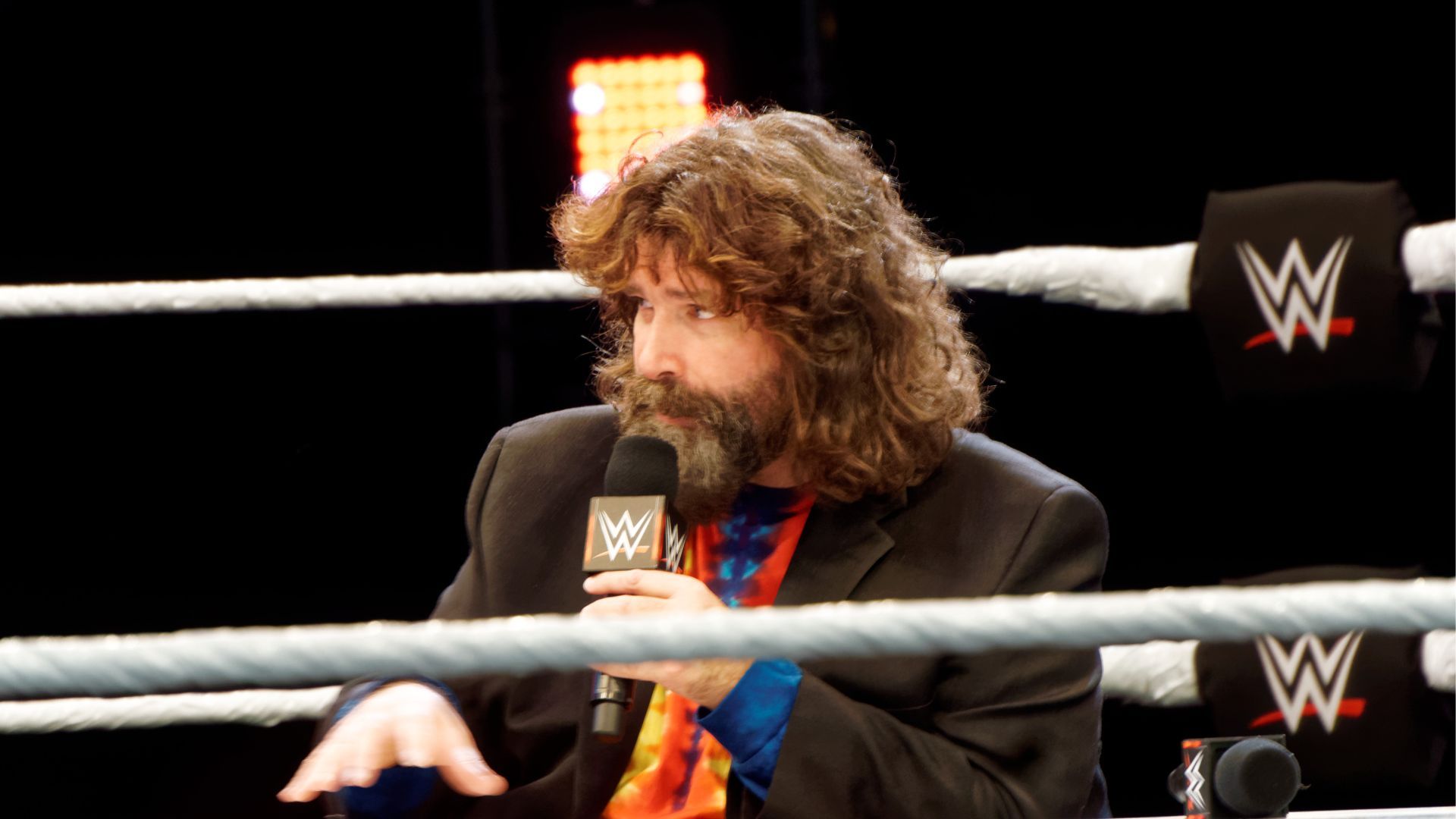
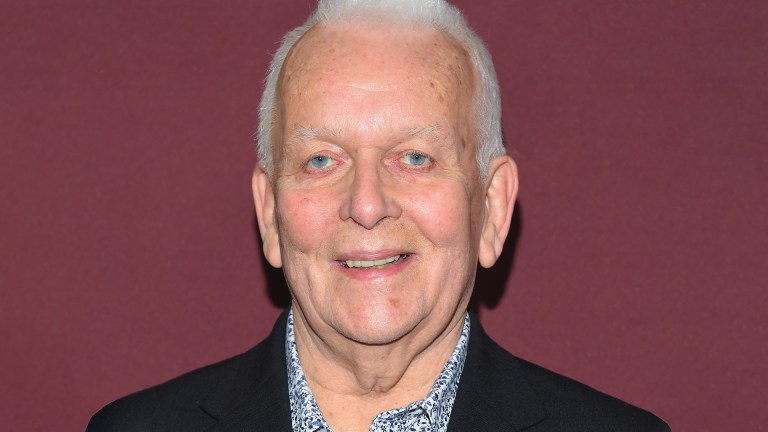
Mick Foley. Credit: Miguel Discart from Bruxelles, Belgique, CC BY-SA 2.0 , via Wikimedia Commons
Share
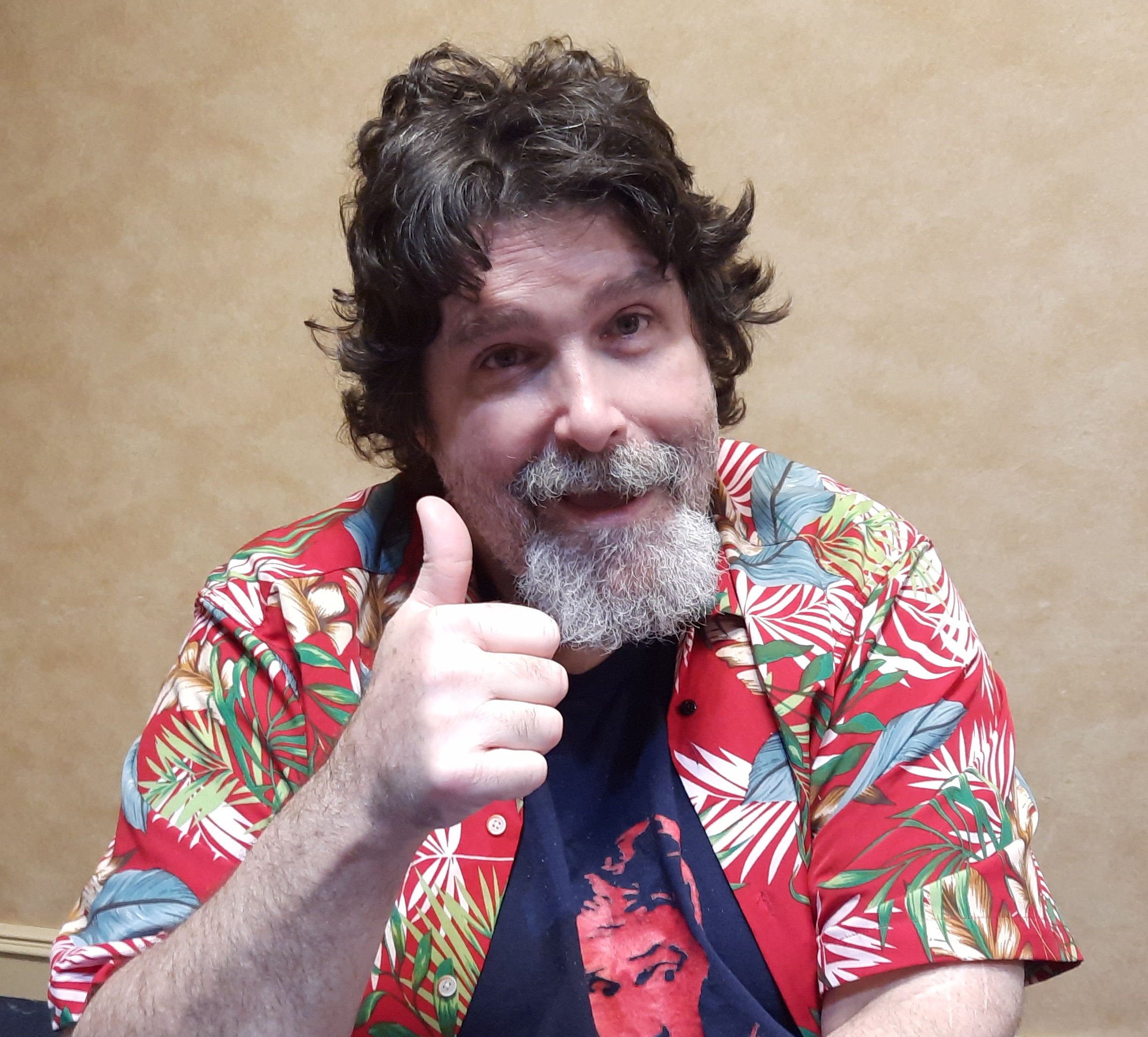
Mick Foley goes by many names. To some, he’s Cactus Jack. To others, Mankind or Dude Love. Over the years, he’s been called the Hardcore Legend, the King of the Deathmatch and Mrs Foley’s Baby Boy. And, every Christmas, he becomes Santa Claus. Born in Bloomington, Indiana, in 1965, Foley is a bona fide professional wrestling legend.
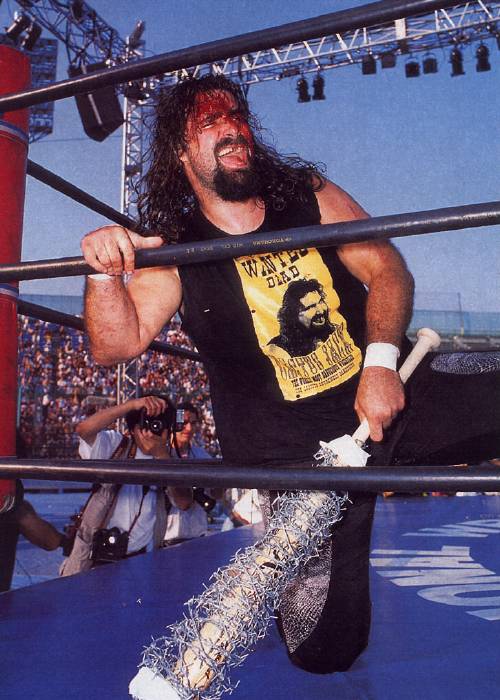
He wrestled his first match in 1985, beginning a career that would take him around the world several times over and eventually make him a three-time WWF – now WWE – world champion. His wrestling personas became synonymous with leopard-print boots, barbed wire and an almost unimaginable tolerance for pain. But perhaps no image defines Foley more than the sight of The Undertaker throwing him from the top of a 20-foot steel cage during their infamous Hell in a Cell match in 1998 – one of the most shocking and iconic moments in wrestling history. Today, Foley appears as an on-screen personality for All Elite Wrestling (AEW).
But there has always been more to Mick Foley than wrestling. He’s a bestselling author, stand-up comedian and speaker, a longtime charity campaigner and a man with such a devotion to Christmas that he has spent years portraying Santa Claus for children, families and charitable causes. His latest project is The Mick and Kenny Show, which he co-hosts with 17-year-old disabled wrestling superfan Kenny Jordan.
Speaking to Big Issue for his Letter to My Younger Self, Mick Foley looks back on the moments that mattered more than championships, the regrets that have stayed with him, learning when to say sorry – and when to tell people you love them.
At 16 years old, I was both popular and strange. And I was a wrestling superfan. At that point, I think I already wanted to be a professional wrestler, but I thought that if I couldn’t be a wrestler, I wanted to be part of the wrestling business in some way. I’m jumping from 16 to 23 here, but by 23 I was doing pretty well in wrestling. I was in World Class Championship Wrestling and, by some standards, I was an international superstar. But I was only making $75 a night.
I had my first date at 17 and I had an amazing time. I may possibly have fallen in love in one day – at the very least, been thoroughly infatuated. I had the presence of mind to take my first date to First Blood with Sylvester Stallone. Not exactly a romcom, right? The next day, a couple of my friends asked her how it went. She said: “I really like him, but I hear he’s weird.” A couple of days later, I got a call. She asked me if I was sitting down, and she gently broke my heart. Since then, I’ve come to realise that all of the things that made me seem strange in high school made me successful in wrestling.
Advertising helps fund Big Issue’s mission to end poverty
Advertising helps fund Big Issue’s mission to end poverty
I tell people to embrace the things that make them different. I think I even said to Darby Allin [AEW wrestler and former world champion], “Win one for the weird ones.” Darby’s become incredibly successful partially because he’s insane, right? The things that he does defy belief and logic. But also because he was a strange kid, and he’s a unique adult. So I would tell my younger self to embrace those things that made me different.
I would also tell my younger self there is no law against telling a young lady that you’re interested in that you’re interested in them, instead of waiting for some type of defining classic moment to unfold, like From Here to Eternity, where you’re rolling around in the surf. That doesn’t need to happen. You could put it out there. You could actually talk to a woman. For someone who was supposed to be fearless in the ring – I wasn’t fearless, I was scared all the time – I displayed courage, action in the face of fear, in my wrestling career. But not on the social level.
What moment in my career would make my younger self the proudest? That’s a good question. I’m trying to go deeper than Hell in a Cell because, literally and figuratively, I got back up when I was down. I quote Sylvester Stallone in Rocky Balboa quite a bit when people are down: “Life’s not about how hard you can hit. Life’s about how hard you can get hit and keep getting up and moving forward. That’s how it is done.” I think that’s really profound. On that night, I did get up and I did move forward. I didn’t win. It was a devastating defeat. But I made my name losing in spectacular fashion.
Keep reading the journalism that powers our mission
Register free to continue and learn more about the stories, campaigns and the support we provide, helping people facing poverty across the UK.
But I’d like to go deeper than that. Glenn Ruth, who wrestled as Headbanger Thrasher, tells a story about the time we went to Fayetteville, Arkansas. There were only 26 people in the crowd and I went 48 minutes with the Colorado Kid, doing all the classic Cactus bumps. Glenn was in his first year in the business. Afterwards, he asked me, “Why did you do that?” And I said, “Every one of those 26 people deserves the best match I can give them.” The moral of the story is: don’t ever let the size of a crowd dictate to you the importance of a match. And, by extension, don’t let the size of an event of any kind dictate to you its importance.
We all have WrestleMania moments in life, and you get to choose what they are. I remember when CM Punk was really down because he wasn’t in the main event at WrestleMania. He thought he deserved it, but he *was* wrestling The Undertaker! I was like, “Phil [CM Punk’s real name], it doesn’t matter who they advertise as the main event. Edge and I were not the main event at WrestleMania 22, and we felt like we had the match of the night. I don’t care if they give us the main-event bill. If you go out there and steal the show at WrestleMania, that’s your WrestleMania moment.” Don’t let anyone else define to you what being a success is. You get to define that for yourself. In so many cases, some of the most rewarding jobs are not rewarding financially. If my younger self asked me, “What’s the secret to success?” I’d say: you just try to make the world a little better place than you found it. I really believe in that.
Cactus Jack, one of Mick Foley’s three alter egos. Credit: wikimedia commons, public domain
I’m a moment guy, not a match guy. When I was doing my podcast with Conrad Thompson, he would always say what the Wrestling Observer gave a match. I guess Dave [Meltzer, veteran wrestling journalist and Wrestling Observer editor] gave the match I had with The Rock when I won the WWE title two-and-a-half stars. And I said, “I’m sorry, but I’m not going to let a star rating define that moment for me.” It was one of the great moments in wrestling history. You can have a paint-by-numbers great match, with enough athleticism and a good opponent, any day of the week. You cannot create a moment like that. That’s really time in a bottle there.
Advertising helps fund Big Issue’s mission to end poverty
The big thing I would say to my younger self is: there’s a difference between not being mean and doing the right thing. There were times when I stood by and watched as other people were treated poorly. Even though I didn’t treat them poorly myself, my note in my letter to my younger self would be: stand up for people who were not able to stand up for themselves.
There was a young lady I met in seventh grade who was picked on terribly because of a rumour that I’m 98% sure wasn’t true. It would be a stretch to say she was a friend, because I never took the time to know her. But even if the rumour was true, there was nothing wrong with what it purported she had done. I stood by and watched as people treated her terribly.
Years later, I saw that woman in a grocery store – I’m talking about 25 years later, probably. She told me one of her children was a wrestling fan. I said, “Could you give me your address? I’ll send her a couple of photos.” The real reason I asked for her address was that I wanted to write her a letter. I wrote the letter and expressed how sorry I was that I had not done more to make her life a little better. We developed a really nice friendship and we’re friends to this day. But that’s one of the things I would say to my younger self: be willing to stand up for people who can’t stand up for themselves.
I really believe in the power of forgiveness. The only reason I had anything against Marc Mero [fellow wrestler and former colleague] was that he signed a guaranteed contract with WWF a week after I signed for nothing more than an opportunity. “We don’t give guarantees in WWF, we give opportunities.” And I resented him for that.
Marc had been a good friend of mine at WCW and has gone on to do amazing things post-wrestling. He’s one of the best school speakers, talking to kids about really important things. I once asked him how he could keep tapping into that emotional reservoir, pouring his heart out and still recovering in time to do it again the next day. He’s got almost like a superpower for compartmentalising.
But when I ran into him, I said, “Marc, I was really tough on you for no reason, other than you signed a contract. I’d really like you to forgive me for that.” And he said, “Ah, Cactus. You didn’t even need to say that. But yes, you are.” It was like a weight was lifted off my shoulders.
Advertising helps fund Big Issue’s mission to end poverty
Even now, just a couple of days ago, I was thinking about something I wrote in Have a Nice Day [Mick’s bestselling 1999 memoir]. I was talking about wrestling in gym class and how one of the tougher kids in school came up to me before we wrestled and said, “Please don’t pin me.”
In the book, I referred to him as a high-school bully. But he wasn’t a bully. He was a tough kid. I never saw him bully anybody. And for some reason, we included his real name. I’d never written a memoir before. I didn’t know the rules of the game, that unless somebody is a public figure, if you’re saying something negative you give them a pseudonym. And that passed through the editing process.
Just a few days ago, I was thinking, “Man, I’d like to apologise to him for that.” Because that had to hurt. People are going to say, “Oh, you’re the bully that Mick Foley mentioned in his book.” You can see the theme in my letter to my younger self: not to be hurtful. The golden rule: treat people the way you want to be treated.
I can’t imagine my younger self not loving The Mick and Kenny Show. We didn’t have access to wrestling interviews at that time. Nothing existed outside what you saw on television. Even the Pro Wrestling Illustrated interviews were fabricated, so everything was kind of fictional in nature. The characters didn’t really let you in and let you know what made them tick. Kenny’s 17 years old. When I first met him, he was literally in a baby stroller. He can’t stand or walk, and he’s not very tall – we’re talking maybe three feet. But brother, does he light up that screen.
He interviewed me at a convention in South Carolina about seven months ago. It was only a three-minute interview, but I found myself watching it over and over because it made me feel good. I’d be sitting in an airport and say to somebody, “Hey, can I make your day a little brighter?” And I’d show them the interview and you could see their heart warming. His enthusiasm is contagious. I have no problem being the second most interesting and charismatic person of the two of us. He’s like a little wrestling encyclopaedia, and he’s going to bring out the real wrestling fan in every person he interviews.
If I could relive one day from my life exactly as it happened, it would be the night I lost something special in college. I was one week away from being 20, and it was a really beautiful moment.
Advertising helps fund Big Issue’s mission to end poverty
But also when my son was visited by the real Santa Claus. And when I say real, he legally changed his name. That’s dedication. It’s in my documentary I Am Santa Claus. It was my first year portraying that iconic figure, and I created a little diversion downstairs. I was jingling bells and laughing when my son Mickey came down with my daughter Noelle. I thought it would take Mickey about two minutes to realise that it was his father, at which point the real Santa was going to enter the home and be upstairs. Instead, he recognised me before he was even down the stairs.
“Oh, it’s Dad! It’s Dad!”
I said, “Oh no, little fella.”
“Dad, it’s you! It’s you!”
Eventually I said, “I know, buddy. I just don’t know when Santa’s going to be here.”
And he said, “No, he’ll be here. He comes here every year. He comes at like 2.30 in the morning.”
Advertising helps fund Big Issue’s mission to end poverty
All of a sudden, we heard our dog Randall barking, which meant that he’d heard or seen something. The look on my son’s face – it was just that magic of Christmas. He ran up the stairs and there, putting presents under the tree, was the real deal. Right? The real deal. Mickey thought he was whispering, but he was actually shouting to his brother Hughie, who was fast asleep: “Hughie! Wake up! Wake up! Santa’s here! Santa’s here!” Santa turned around and we had the best interaction. I remember thinking, this is one of the greatest moments of my life. I think that’s a lot of the reason why I take so much pride in trying to create similar moments for other families, and try to do the very best portrayal that I can.
I’m a big believer in the handwritten letter. I write probably 40 letters a year as Santa. And I don’t know if you know that my handwriting is my superpower. It’s not a superpower – I worked on it. I worked on it and worked on it, with the goal of making my writing look like Santa’s. And it does. It’s really cool. When I sit down and spend a couple of hours handwriting letters, that’s the way I show people I care. It’s kind of a lost art, but I think it’s always appreciated. There are families who’ve kept letter after letter, year after year. Renee Paquette [the wrestling broadcaster] said, “We have a box. We have all the letters Mick has written.” Becky Lynch is the same way with her daughter. Trish Stratus has six or seven of them.
You need to tell the people you love that you love them before it’s too late. I hearken back to that special moment I had in my college life that I wouldn’t mind reliving again. She was real big on that. I hadn’t told my mom and dad I loved them in many years at that point, and she said, “You need to tell them you love them.” I think that’s important. Neither of my parents are here, but they knew they were loved. I made it really clear. We said those things frequently.
But if I was to have one more conversation with someone who’s no longer in my life, I’d say Terry Funk [wrestling legend, Mick’s mentor and one of his former tag-team partners]. I did have a chance to write him a letter before he passed, telling him how much I appreciated everything he had done for me. By the time Terry left us, his memory was not good, and I hope that I made it clear how much he had meant to my life. I wish I’d made it clearer to Terry. I wish I’d been more accessible when he went into assisted living. It was difficult. He was a phone-call guy, and it’s difficult to talk to people whose cognitive skills are declining. I did go out to see him. Every time I was within like 300 miles of Amarillo, I would make it a point to go see him. But I think I could have been a better friend. I wish I’d been a better friend.
Mick Foley is currently touring his one-man show and will appear at AEW All In at Wembley Stadium, London, on 30 August. The Mick and Kenny Show is available to watch on YouTube. Visit realmickfoley.com for more information.